Carp are remarkably hardy fish, which can create the impression that they are comfortable spending a long time out of the water.
They are not.
A carp does not necessarily die within seconds of being lifted onto an unhooking mat, and under favorable conditions it may remain alive considerably longer than the few moments normally required to unhook, weigh and photograph it. But survival time and safe handling time are two completely different things.
Once a carp is removed from the water, normal gas exchange through the gills becomes severely impaired. Stress from the fight is already present, and prolonged air exposure adds another problem at exactly the point when the fish should be recovering.
For catch-and-release fishing, the useful question is therefore not how long a carp can stay alive out of water.
It is how little time you can reasonably keep it there.
How Long Can Carp Survive Out of Water?
There is no universal answer such as five minutes, ten minutes or half an hour.
How long an individual carp remains alive depends on its condition, how hard it fought, temperature, humidity, injuries, the surface it is lying on and numerous other factors.
That makes any exact survival time misleading.
A carp that is still moving strongly after several minutes has not proved that several minutes of air exposure was harmless. The fish can remain alive while undergoing substantial physiological stress.
This distinction matters because many online answers confuse “not dead yet” with “safe to keep out of water.”
For an angler intending to release the fish, survival should never be treated like a countdown timer.
The aim is simply to minimize unnecessary air exposure.
What Happens to a Carp When It Is Out of Water?
Fish gills are designed to function while supported by water.
Once a carp is in air, the delicate structures responsible for gas exchange cannot work normally. Oxygen availability in the blood begins to fall while carbon dioxide and metabolic products accumulate.
Carp are more tolerant of difficult oxygen conditions than many freshwater fish, but that tolerance does not make air exposure harmless.
A classic study specifically examining common carp exposed to air found changes including reduced blood oxygen and increased carbon dioxide, alongside changes in blood acid-base balance. In other words, the carp remained alive, but its internal physiology was already being disrupted.
What Determines How Long Carp Can Stay Out of Water?
The same carp could cope very differently with air exposure on two different days.
| Factor | Lower-Risk Situation | Higher-Risk Situation |
|---|---|---|
| Fight before landing | Fish landed efficiently | Long, exhausting fight |
| Temperature | Cool, moderate conditions | Hot weather and warm water |
| Sun exposure | Shade | Direct strong sunlight |
| Surface | Wet padded mat or cradle | Dry ground, gravel or concrete |
| Fish condition | Strong, healthy fish | Injured or exhausted fish |
| Handling | Wet hands, body supported | Dry hands, squeezing or poor support |
| Time in air | Brief and organized | Repeated or prolonged handling |
| Photography | Camera ready beforehand | Fish waiting while equipment is found |
The important factor is that these stresses can combine.
A carp that has already spent a long time fighting in warm water has less reason to be kept on the bank while an angler searches for scales, rearranges a camera or decides which photograph looks best.
Preparation is one of the easiest ways to reduce that risk.
Does Water Temperature Matter?
Yes.
Fish metabolism and oxygen demand generally increase as water gets warmer, and catch-and-release stress can become more important under hot conditions.
Research across recreationally caught fish has repeatedly shown that temperature and air exposure can interact, with long air exposure becoming more damaging at higher temperatures.
That does not give carp anglers a temperature at which a particular number of minutes suddenly becomes safe or unsafe.
It simply means extra care is sensible during hot weather.
If a carp has fought hard in warm water, spending additional time in the air for repeated photographs is particularly difficult to justify.
Can Common Carp and Mirror Carp Survive Different Lengths of Time?
There is no useful reason to give them different air-exposure limits.
Common carp and mirror carp are both forms of Cyprinus carpio. The obvious difference is primarily their scale pattern, not a fundamentally different respiratory system.
You may encounter claims that mirror carp can survive for one amount of time while fully scaled common carp can survive for another.
There is no practical basis for treating them that way on the bank.
Both should be handled using the same principle:
keep the fish wet, properly supported and out of the water for as little time as possible.
How Long Should You Keep a Carp Out of Water?
Shorter is better.
General catch-and-release guidance from NOAA advises keeping air exposure to a minimum and describes less than 60 seconds as ideal when a fish must be removed from the water. UK animal-care guidance goes further by saying fish should not be handled in air where avoidable and that unavoidable exposure should be kept to an absolute minimum.
That 60-second figure should not be interpreted as a guarantee that every carp is perfectly safe for 59 seconds.
It is much better used as a reminder of how quickly routine handling should happen.
If everything is prepared before the fish leaves the landing net, unhooking and a photograph do not need to become a long process.
How to Handle a Carp Safely on the Bank
Prepare everything first.
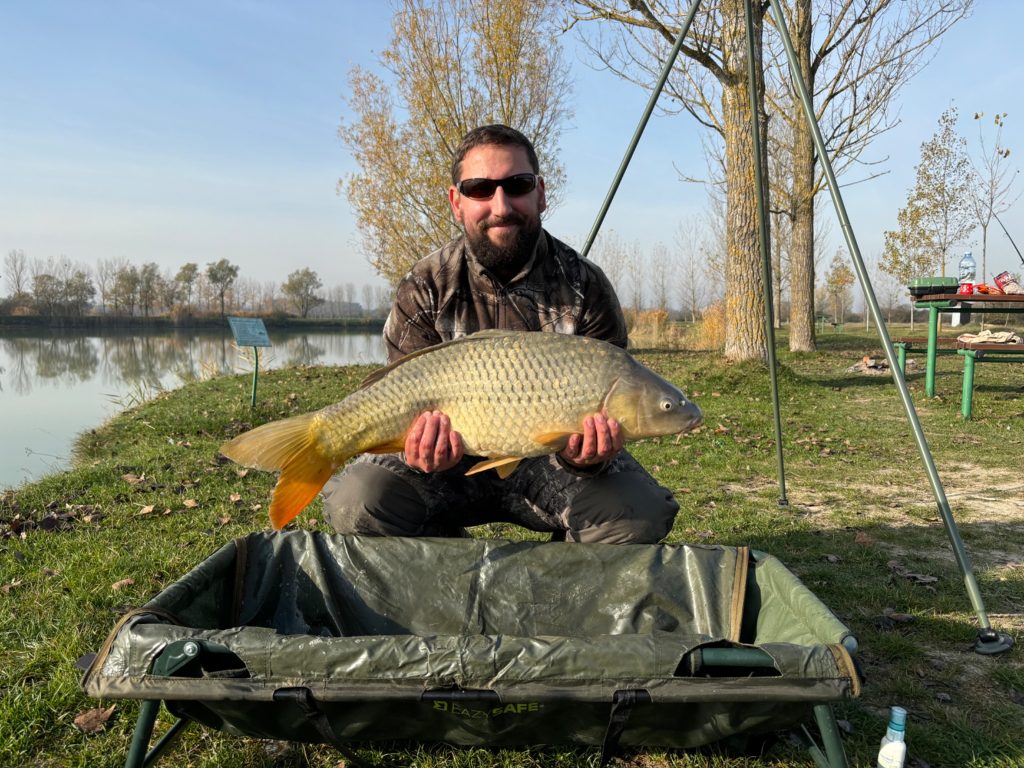
The unhooking mat or cradle should already be wet and positioned close to the water. Forceps or other hook-removal tools should be within reach. If you intend to weigh the fish, prepare the wet weigh sling beforehand.
If you want a photograph, set up the camera before lifting the carp.
Then:
- Wet your hands before touching the fish.
- Keep the carp low over the mat whenever it is being moved or photographed.
- Support the fish underneath rather than lifting it by the mouth, gill area or tail alone.
- Do not cover or insert fingers into the gills.
- Avoid squeezing the body.
- Complete unhooking, weighing and photography efficiently.
- If something delays the process, return the carp to the water rather than making it wait on the mat.
Freshwater angling guidance also recommends soft knotless nets, wet hands and wet unhooking mats or cradles for larger fish such as carp.
Land the Carp Efficiently Before Handling It
Fish care starts before the carp reaches the mat.
Dragging out a fight unnecessarily exhausts the fish before air exposure even begins.
That does not mean hauling every carp in as aggressively as possible. It means using tackle appropriate for the water and applying sensible pressure rather than deliberately extending the fight.
Our guide to what lb line for carp fishing explains why line strength should be chosen around weed, snags, abrasion and the water being fished rather than simply the carp’s weight.
That becomes especially important around heavy cover, where tackle that is too light can turn a manageable fight into a prolonged battle.
Prepare Before Night Carp Fishing
Good preparation becomes even more important after dark.
You do not want to land a carp and then discover that the unhooking mat is still folded away, the headlamp is inside the bivvy and the camera tripod has not been set up.
Our night carp fishing guide already covers organizing the swim before darkness so that the net, mat, tools and lighting are ready before a run occurs.
That same preparation directly reduces the amount of time a carp needs to remain out of the water.
What If the Carp Has Already Been Out of Water Too Long?
Return it to the water as soon as possible.
Do not throw the fish back or expect it to swim away immediately.
Support the carp upright in the water and give it time to regain balance and strength. In flowing water, position it so clean water can naturally pass across the gills.
In still water, simply support the fish gently until it begins holding itself normally and actively tries to swim away.
A carp that has fought hard may need some time.
Do not release it merely because the photograph is finished.
Can You Keep Pouring Water Over a Carp Instead?
Keeping the fish wet is helpful, but it is not a substitute for returning it to the lake.
Pouring water over the body helps prevent the skin and protective mucus layer from drying, and keeping the mat wet reduces abrasion.
It does not restore normal gill respiration in the same way as putting the fish back into water.
A wet carp is still a carp exposed to air.
Use water to protect the fish during necessary handling—not as a reason to prolong that handling.
Common Carp-Handling Mistakes
Treating survival time as a target: The fact that a carp might remain alive for a long period does not justify keeping it out that long.
Preparing equipment after the fish is landed: Cameras, scales, forceps and slings should already be ready.
Using a dry mat: Wet the mat or cradle before placing the carp onto it.
Taking repeated photographs: Have the camera settings and position sorted first.
Holding a carp too high: Kneel and keep the fish close to the mat in case it kicks.
Ignoring the fight that came before: A heavily exhausted carp deserves particularly fast handling and adequate recovery.
Assuming hardiness means immunity: Carp tolerate difficult conditions well, but they still experience physiological stress during air exposure.
Frequently Asked Questions
Can carp breathe air?
Carp are not true air-breathing fish. They are highly tolerant of low-oxygen conditions, and research has investigated whether their swim bladder may contribute during air exposure, but normal respiration still depends on functioning gills in water. Air exposure causes measurable changes in blood oxygen, carbon dioxide and acid-base balance.
How long can a common carp survive out of water?
There is no dependable universal time. Conditions and individual fish vary considerably. A common carp may remain alive longer than the short period normally required for handling, but that should not be interpreted as a safe amount of time to keep it on the bank.
How long can a mirror carp survive out of water?
Mirror carp should be treated exactly like other common carp. There is no useful separate safe-air-exposure limit for mirror carp.
Can a carp survive ten minutes out of water?
It may be physically possible for a carp to remain alive after ten minutes under some conditions, but that does not make ten minutes an acceptable catch-and-release handling target. Physiological stress occurs during air exposure, so deliberately testing how long the fish can tolerate it is unnecessary.
Should you photograph every carp you catch?
There is nothing wrong with taking a quick photograph when the fish is in good condition and everything is ready. If the carp is badly hooked, exhausted or struggling, releasing it promptly is more important than getting the photograph. NOAA similarly recommends having the camera ready before lifting a fish that will be released.
Final Takeaway
A carp’s hardiness makes the question “how long can carp survive out of water?” sound as though it should have a simple answer.
It does not.
Carp can remain alive through conditions that are already causing physiological stress, so the maximum possible survival time has little value to an angler practising catch and release.
Prepare the wet mat, tools, scales and camera first. Land the fish efficiently. Handle it with wet hands, support it properly and keep it low.
Then get it back into the water.
The safest amount of unnecessary air exposure is none at all.