Do fish hooks dissolve when they are left inside a fish? Not exactly. Fish hooks are made to survive water, abrasion and the pressure of fighting fish, so the idea that a hook simply “dissolves” can be misleading.
Some fish also get rid of retained hooks before the metal has completely corroded. Others can carry a hook for much longer.
That distinction matters if you have just released a fish with a hook too deep to remove. Leaving the hook does not mean it will magically disappear overnight, but forcibly extracting a deeply embedded hook can sometimes cause more damage than cutting the line and allowing the fish to deal with it naturally.
Do Fish Hooks Dissolve?
Technically, corrode is the better word.
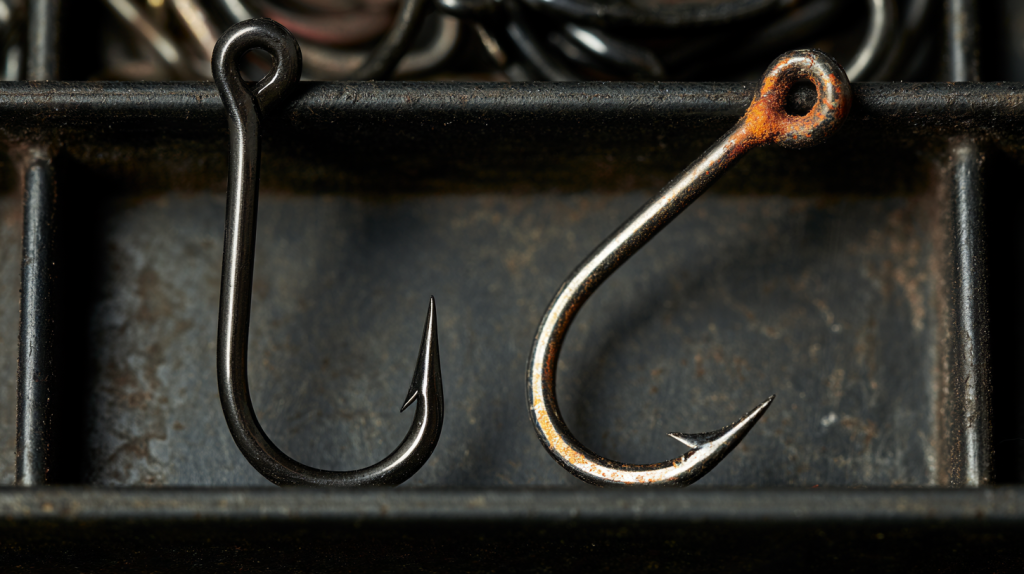
When anglers say a fishing hook will “dissolve,” they are usually describing the gradual destruction of the metal through oxidation and corrosion. Rust develops, the metal loses material, the wire becomes thinner and weaker, and eventually part of the hook may break.
The entire hook does not have to vanish for a fish to lose it.
A hook can work loose from tissue. It can break at a weakened section. A swallowed hook may change position or eventually be expelled through the digestive system. A hook lodged in the mouth can also be shed as the wound changes and heals.
That is why asking, “How long until the hook completely dissolves?” does not quite describe what happens in many real fish.
The more useful question is:
How long does the hook remain attached to the fish?
Those are not necessarily the same thing.
A partially corroded hook may fall out long before every piece of metal has disappeared.
How Long Does It Take a Fish Hook to Rust Away?
There is no trustworthy universal number for how quickly fish hooks dissolve or corrode. The answer depends heavily on the hook and its environment.
You may see claims that a hook takes a few days, two weeks, several months or even years to disappear. All of those could potentially describe different hooks under different conditions.
Several factors change the rate substantially.
| Factor | Effect on the hook |
|---|---|
| Carbon steel vs stainless steel | Non-stainless carbon steel normally corrodes much more readily |
| Saltwater vs freshwater | Saltwater generally accelerates corrosion |
| Thin vs heavy wire | A thin hook has less metal to lose before it weakens |
| Protective coating | Plating, lacquer and other finishes can delay corrosion |
| Hook location | A hook exposed to surrounding water may behave differently from one embedded in tissue |
| Existing damage | Scratches and damaged coating can expose the underlying metal |
| Water chemistry and temperature | Environmental conditions can alter corrosion rate |
This makes exact predictions difficult.
A lightweight, non-stainless hook with damaged coating in saltwater is a completely different corrosion problem from a thick stainless hook embedded in a freshwater fish.
Even two apparently identical hooks may not disappear at exactly the same rate because their location within the fish can differ.
What Studies Have Actually Found
Research on retained hooks shows just how variable the process can be.
A field study of wild white-spotted charr that were deeply hooked and released after the line was cut found that retained hooks began showing corrosion over time. The researchers estimated an average of about 22 days before a remaining hook began to corrode, while the estimated average time to hook evacuation was approximately 53 days.
Those numbers should not be treated as a countdown for every fish. They describe one species, one hook type and one set of environmental conditions.
Another study comparing hook materials in three Australian fish species found substantial differences between carbon-steel and stainless-steel hooks. Carbon-steel hooks oxidized more readily, while the stainless-steel hooks remained largely resistant to corrosion during the study period.
Why Hook Material Matters So Much
The material may be the single biggest reason one angler sees a hook rust rapidly while another finds an old hook that looks surprisingly intact.
Non-Stainless Carbon-Steel Hooks
Carbon-steel hooks can corrode relatively readily once their protective finish is damaged or once they remain exposed long enough.
That does not necessarily mean they are poor hooks.
Manufacturers normally protect them with coatings because anglers obviously do not want a hook rusting in the tackle box after one wet session. The problem is that the same corrosion resistance that helps us store tackle also affects what happens if the hook remains inside a fish.
Thinner wire also requires less corrosion before its strength is compromised.
Stainless-Steel Hooks
Stainless steel is designed specifically to resist corrosion.
That makes it useful in demanding environments, particularly saltwater, but it also means that a stainless hook left in a fish can potentially remain intact much longer.
For catch-and-release fishing where retained hooks are a realistic possibility, this distinction matters.
Coated and Plated Hooks
A carbon-steel hook is not necessarily bare metal.
Nickel plating, lacquer and other finishes can delay contact between the steel underneath and the surrounding environment.
Those finishes also affect the hook’s appearance underwater, which raises a separate question: does fishing hook color matter to the fish?
Eventually a coating can be scratched or damaged, particularly around the point and bend, but until that happens it may slow corrosion.
That is another reason you cannot identify an exact corrosion time simply from the hook’s size.
What Happens to a Hook Left Inside a Fish?
A retained hook does not have only one possible outcome.
The Hook Can Corrode and Break
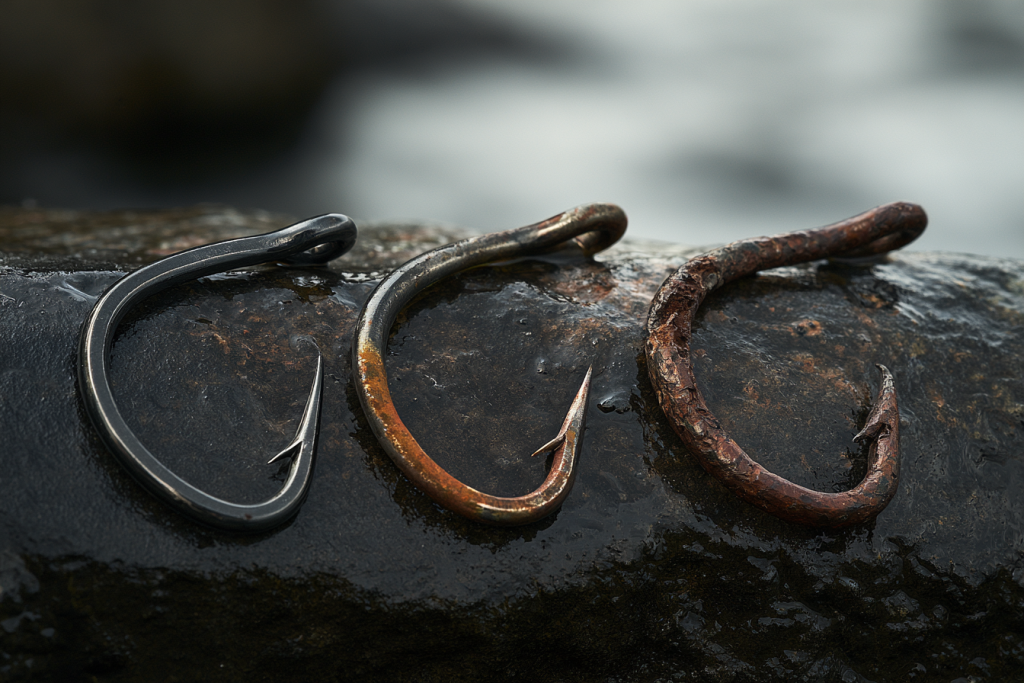
This is the outcome anglers usually mean when they say a hook “rusts out.”
Corrosion removes metal and weakens the wire. Eventually the hook may break at the bend, point, eye or another weakened area.
Once part of the hook fails, the remaining section may become easier for the fish to shed.
The Fish Can Expel the Hook
This can happen surprisingly quickly in some cases.
Studies involving deeply hooked fish have documented hooks being expelled even before corrosion could have destroyed the entire hook.
For example, research on deeply hooked bluegill found that many fish in the line-cut treatment expelled retained hooks within the ten-day observation period.
So when an angler later catches a fish without the hook, it does not necessarily mean the metal completely dissolved.
The fish may simply have gotten rid of it.
The Hook Can Remain Embedded
Some hooks stay put.
The hook may become surrounded by tissue or remain in a location where movement is limited. Resistant materials such as stainless steel can make long-term retention more likely because very little metal is being lost to corrosion.
A fish being able to survive with a hook does not mean leaving hooks in fish is harmless.
Location is enormously important.
A hook passing through tissue without damaging major structures is very different from one that has punctured an organ, damaged the gills or caused severe bleeding.
Should You Remove a Swallowed Hook or Cut the Line?
Remove a hook when it is easily accessible and can be removed quickly without causing additional damage.
A normal hook in the lip or jaw is usually straightforward.
The decision becomes different when a hook has been swallowed deeply.
Pulling aggressively on a hook embedded in the throat, esophagus or digestive tract can tear tissue and damage organs as the hook is forced back through the fish.
In those situations, leaving the hook can be the less damaging option.
Current NOAA Fisheries catch-and-release guidance recommends cutting the line as close to a swallowed hook as possible when the hook cannot be easily removed. NOAA also recommends non-stainless steel hooks because they can corrode and fall out over time.
A practical approach is:
- Keep the fish in the water whenever possible.
- Determine whether the hook is genuinely accessible.
- Remove an easy hook quickly with appropriate pliers or a dehooking tool.
- Do not spend several minutes performing improvised surgery on a deeply hooked fish.
- If safe removal is not realistic, cut the line close to the hook.
- Return the fish promptly.
The objective is not simply to get your hook back.
It is to minimize the overall injury to the fish.
Does Saltwater Dissolve Fishing Hooks Faster Than Freshwater?
Generally, yes — saltwater is much more aggressive toward ordinary steel.
Salt water conducts electricity well and chloride ions are particularly effective at promoting corrosion. Anyone who has left wet terminal tackle in a saltwater tackle box has seen the result.
That does not mean every carbon-steel hook in the sea will disappear rapidly.
A thick wire hook with a durable coating can still persist.
Likewise, a stainless-steel hook may resist corrosion extremely well even though it is surrounded by saltwater.
Freshwater hooks can rust too, particularly when left continuously wet, but corrosion is normally less aggressive than in marine conditions.
Water chemistry also varies enormously between lakes and rivers.
For that reason, statements such as “a hook dissolves in saltwater in exactly three weeks” should be treated with skepticism.
The type of hook matters at least as much as the fact that the water is salty.
Do Fish Stomach Acids Dissolve Hooks?
A fish’s digestive environment can contribute to corrosion, but it is another mistake to imagine a swallowed hook being rapidly digested like food.
The fish is not chemically “eating” the hook.
Metal corrosion still takes time, and protective coatings or corrosion-resistant alloys can slow the process considerably.
More importantly, research on retained hooks shows that many fish deal with them through movement, corrosion and eventual ejection, rather than simply reducing the entire hook to nothing inside the stomach.
That explains why a fish can lose a hook much sooner than would be required for every gram of metal to completely disappear.
Do Hooks Really Rust Out of Fish?
Yes, some absolutely do.
But “rust out” should not be interpreted as a guarantee.
A non-stainless hook may:
- begin corroding,
- become weakened,
- break,
- work loose,
- or eventually be expelled.
A corrosion-resistant hook may remain much longer.
There is also no guarantee that the fish will survive long enough for any of those processes to happen. The original hooking injury still matters.
A badly damaged gill or perforated vital organ cannot be fixed simply by choosing a hook that eventually rusts.
That is why avoiding deep hooking in the first place remains more important than relying on corrosion afterward.
Can You Still Fish With a Rusty Hook?
A small amount of cosmetic surface rust does not automatically mean a hook will snap the moment a fish bites.
But I would not deliberately keep fishing with a hook once corrosion begins affecting the parts that actually matter.
Inspect:
- the point,
- the barb,
- the bend,
- the eye,
- and any visible pits in the wire.
Rust around the hook point can reduce sharpness. Corrosion around the eye can damage the line or weaken the hook where it is tied. Deep pitting anywhere around the bend creates a possible failure point under load.
Hooks are inexpensive compared with losing a good fish because a weakened hook opened or broke.
If your hook looks questionable, replace it.
Sharpness matters as well. A rusty or damaged point can contribute to poor penetration, so if fish are showing interest but you repeatedly fail to connect, work through the checks in our guide to fish biting but not getting hooked.
This is also where the rust visible on an old hook in your tackle box and the corrosion of a hook retained by a fish become related: both are the same basic deterioration of metal, but the environment and consequences are very different.
Common Myths About Fishing Hooks Dissolving
“Every Hook Dissolves in a Few Days”
No.
Some retained hooks are expelled quickly, but that is not the same as the hook completely corroding.
Others can remain for weeks, months or longer.
“Stainless Steel Will Eventually Rust Out Anyway”
Given enough time and the right conditions, even corrosion-resistant materials can deteriorate.
That does not make stainless steel comparable to ordinary carbon steel.
For practical catch-and-release purposes, stainless hooks can remain intact substantially longer.
“A Fish That Swallows a Hook Will Definitely Die”
Also false.
Deep hooking is a serious injury and can kill fish, particularly when vital organs or gills are damaged. But studies have repeatedly documented fish surviving retained hooks and, in many cases, eventually expelling them.
“You Should Always Get the Hook Out”
Not if removing it requires substantial additional trauma.
An easily accessible hook should generally be removed.
A deeply embedded hook is a different problem.
Sometimes the best release involves accepting the loss of the hook.
Frequently Asked Questions
How long does a fishing hook take to dissolve inside a fish?
There is no fixed period. Research has documented corrosion beginning within weeks in some situations, while other hooks — particularly stainless-steel or heavily protected hooks — can persist much longer. Fish may also expel a hook before it has fully corroded.
Will a fishing hook dissolve in a fish’s mouth?
A non-stainless hook can corrode while retained in a fish’s mouth, but it may also work loose and fall out before completely rusting away. Stainless and strongly corrosion-resistant hooks may persist considerably longer.
How long does it take a fishing hook to dissolve in saltwater?
There is no reliable universal number. Saltwater generally accelerates corrosion of ordinary steel, but wire thickness, material and protective coating can dramatically change the result.
Can a fish survive after swallowing a hook?
Yes. Many fish survive retained hooks, particularly when the hook has not caused catastrophic internal damage. Studies have also shown fish subsequently expelling swallowed hooks. Survival depends strongly on hook location, bleeding, species and how the fish is handled.
Do hooks really rust out?
Non-stainless steel hooks can rust and weaken until they break or are shed. The phrase “rust out” is therefore reasonable, but it does not mean every hook completely disappears or that it happens within a predictable number of days.
Should you remove a deeply swallowed hook?
If the hook cannot be removed easily without causing substantial additional injury, cutting the line close to the hook is often preferable to pulling or digging it out. An easily accessible mouth hook is a different situation and can normally be removed quickly.
Should I throw away rusty fishing hooks?
Replace hooks showing meaningful corrosion, pitting, damage around the eye or loss of point sharpness. Minor superficial discoloration may not have destroyed the hook’s strength, but there is little benefit in gambling on questionable terminal tackle.
Final Takeaway
Fish hooks can eventually disappear from a fish, but “dissolve” is an oversimplification.
Ordinary non-stainless hooks corrode. As the metal deteriorates, the hook may weaken, break or be expelled. A fish may also shed a hook before corrosion has progressed very far.
Stainless steel, heavy wire and protective coatings can dramatically extend how long a hook remains intact, which is why no responsible answer can promise that a retained hook will disappear in a certain number of days.
For anglers, the most important lesson is not to rely on rust as a rescue plan.
Prevent deep hooking when possible, remove accessible hooks quickly, and avoid causing additional injury in an attempt to retrieve a deeply swallowed hook. When safe removal is not realistic, cutting the line close to the hook may give the fish a better chance than forcing the hook out.