Understanding the braid to mono equivalent can save you from buying the wrong fishing line, overfilling a reel, or misunderstanding the strength of your setup.
The problem is that braided and monofilament lines are not directly interchangeable by pound test. A 30 lb braid can be about as thin as a much lighter monofilament, even though its rated breaking strength is considerably higher.
That difference matters when filling a reel, choosing a mainline, or working out how much line your spool can hold.
Fortunately, converting between braid and mono is straightforward once you understand what the numbers actually represent.
What Does Braid to Mono Equivalent Actually Mean?
When manufacturers describe a braided line as equivalent to a particular monofilament, they are usually comparing thickness.
For example, a braided line rated at 30 lb might occupy approximately the same amount of spool space as an 8 lb monofilament.
That does not mean the two lines have equal breaking strength.
The braided line is still rated at 30 lb, while the monofilament is rated at 8 lb.
The equivalence is about diameter.
This distinction is important because fishing reels are frequently labeled with line capacities expressed using monofilament pound-test ratings.
A reel might display:
- 8 lb / 200 yd
- 10 lb / 170 yd
- 12 lb / 140 yd
Those figures describe how much line the manufacturer expects the spool to accommodate using particular monofilament sizes.
They are not universal limits on the breaking strength of the line that can be installed.
A thinner braided line may allow a substantially higher rated strength without requiring a proportionally larger spool.
However, the exact amount of line that fits still depends on its diameter, construction, and how tightly it is wound.
Braid to Mono Equivalent Chart
The following braid to mono equivalent chart uses the published PowerPro Spectra braided-line diameter equivalences.
It provides a useful starting point when comparing common fishing line strengths.
| Braided Line Strength | Approximate Mono Equivalent |
|---|---|
| 4 lb braid | Less than 1 lb mono |
| 8 lb braid | 1 lb mono |
| 10 lb braid | 2 lb mono |
| 15 lb braid | 4 lb mono |
| 20 lb braid | 6 lb mono |
| 30 lb braid | 8 lb mono |
| 40 lb braid | 10 lb mono |
| 50 lb braid | 12 lb mono |
| 65 lb braid | 16 lb mono |
| 80 lb braid | 18 lb mono |
| 100 lb braid | 20 lb mono |
| 150 lb braid | 30 lb mono |
For a practical example of how line diameter and breaking strength affect lure fishing, check out our guide on what pound test for walleye jigging, including recommended braid strengths and fluorocarbon leaders.
These are manufacturer-published diameter equivalences for one braid product family, not a universal conversion standard.
A different brand of braid may publish a different equivalent for exactly the same pound-test rating.
How to Read the Chart
Suppose your reel is labeled as holding 150 yards of 10 lb monofilament.
The chart indicates that 40 lb PowerPro braid has approximately the same diameter as the reference 10 lb mono used in that conversion.
In principle, a similar amount of that braided line could fit on the spool.
However, this is a capacity comparison, not a recommendation to automatically replace 10 lb monofilament with 40 lb braid.
Your rod, reel, drag, target species, and fishing conditions still determine the appropriate line strength.
The table should answer a specific question:
How thick is this braided line compared with monofilament?
It should not decide how strong your fishing line needs to be.
Why Is Braided Line Thinner Than Monofilament?
The difference comes primarily from the materials and construction used to manufacture the lines.
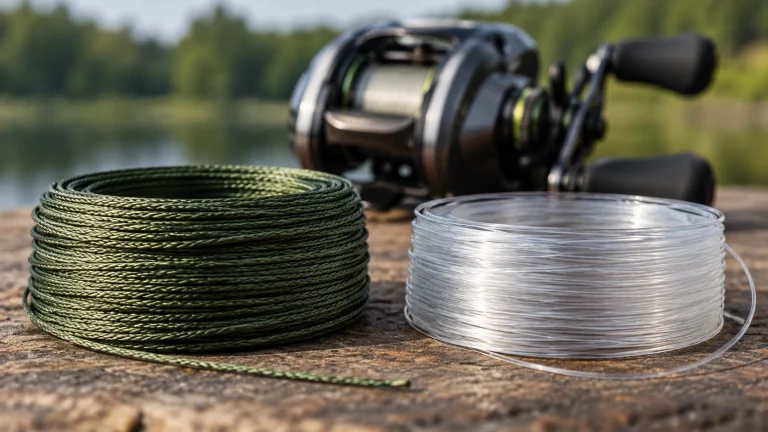
Monofilament is typically made from a single continuous strand of nylon or another polymer.
Braided fishing line is made from multiple high-strength synthetic fibers woven together.
Modern polyethylene-based braided lines can provide considerably greater tensile strength than conventional nylon monofilament at a comparable diameter.
This allows manufacturers to produce strong lines without requiring the same thickness as monofilament.
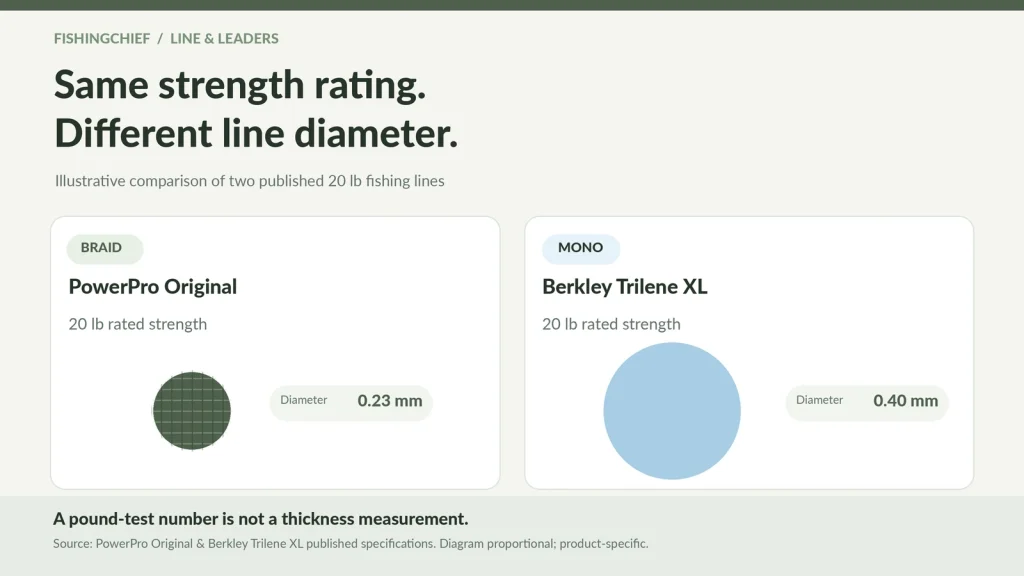
Consider two specific products:
- PowerPro Original 20 lb braid has a published diameter of approximately 0.23 mm.
- Berkley Trilene XL 20 lb monofilament has a published diameter of approximately 0.40 mm.
Both lines carry a 20 lb rating, but one is substantially thinner than the other.
This does not automatically make braid better.
Monofilament provides stretch, different handling characteristics, and often greater tolerance for sudden loading.
Braid provides a higher strength-to-diameter ratio, low stretch, and direct transmission of movement through the line.
The correct choice depends on how the line will be used.
Why Line Diameter Matters in Practice
Diameter influences several important aspects of fishing.
Spool capacity: Thinner line generally allows more length to fit on a reel.
Water resistance: A thinner line presents less surface area to moving water, which can help maintain control in current.
Casting: Diameter affects resistance as line leaves the reel and moves through the guides, although line stiffness, coating, wind, and reel design also influence casting.
Lure presentation: Line thickness and drag can change how a lure moves, particularly when fishing lightweight presentations or working in current.
Abrasion resistance: Diameter alone does not determine durability. The material, coating, surface contacted, and severity of abrasion all matter.
Understanding these differences is often more useful than trying to find a single conversion number.
How to Convert Braid to Mono for Your Reel
The most reliable conversion method is to compare the actual published line diameters.
A basic process requires only the specifications of your reel and the line you intend to use.
Step 1: Check Your Reel’s Capacity Rating
Look for the capacity information printed on the spool or listed in the reel’s specifications.
You might find something like:
0.30 mm / 150 m
This means the manufacturer rates the spool for approximately 150 meters of line with a diameter of 0.30 mm.
Some reels instead list capacities by monofilament pound test.
When possible, find the diameter specifications behind those pound-test values.
Step 2: Find the Diameter of Your Braided Line
Check the product packaging or manufacturer’s technical specifications.
Do not assume that all 20 lb braids have the same diameter.
One product might be relatively thin, while another uses a thicker construction or different coating.
Even products from the same manufacturer can differ significantly.
Step 3: Compare the Two Diameters
If the diameter of your braid is similar to the diameter used for the reel’s published capacity, the expected amount of line should also be broadly similar.
If your braid is substantially thinner, the reel may hold considerably more.
A rough mathematical estimate for equal spool volume is:
Estimated capacity = Original capacity × (Original diameter ÷ New diameter)²
For example, suppose a reel is rated for 150 meters of 0.30 mm line.
You want to install braid with a published diameter of 0.23 mm.
Using the formula:
150 × (0.30 ÷ 0.23)² ≈ 255 meters
That suggests a theoretical capacity of approximately 255 meters.
This is only a mathematical estimate, not a guaranteed real-world capacity.
Braided line is not always perfectly round, and its packing behavior, coating, winding tension, and actual dimensions can affect how much fits.
Use the result as a planning reference rather than a precise measurement.
Step 4: Account for Backing and Spool Fill
If the conversion suggests that your reel will hold considerably more braid than you need, backing can reduce the amount of expensive mainline required.
Monofilament backing is a common choice.
It takes up space beneath the braid and can help prevent the mainline from slipping around a smooth spool arbor.
Some reels are designed specifically to grip braid without backing.
Check the reel manufacturer’s instructions before deciding which approach to use.
Underfilling a spool can reduce casting performance, while excessive filling can encourage loops and tangles.
Follow the reel’s recommended fill level.
For larger carp reels, the relationship between reel design and line capacity is also discussed in the 6000 vs 8000 reel comparison.
Does Equivalent Diameter Mean Equivalent Strength?
No.
This is the most important limitation of any braid-to-mono conversion chart.
A braided line rated at 30 lb does not suddenly become an 8 lb line because its diameter resembles 8 lb monofilament.
It retains its manufacturer-rated breaking strength.
Similarly, 8 lb monofilament does not become stronger simply because it occupies the same amount of space on the reel.
Line strength and diameter describe different properties.
Two lines may share a diameter but have very different breaking strengths.
Alternatively, two lines may share a pound-test rating while having substantially different diameters.
Why This Matters for Your Rod and Drag
Installing much stronger braid does not automatically make the entire setup capable of handling greater loads.
Your rod, drag system, knots, leader, hooks, and other components still have limits.
Because braid stretches very little, it transmits sudden loads more directly.
Aggressive hooksets, abrupt changes in fish direction, and snagged tackle can place considerable pressure on the equipment.
A heavier braid can also exceed what is sensible for a lightweight rod or lure presentation, even if its diameter fits the reel perfectly.
Choose the required breaking strength first, then use diameter to make sure the line suits your spool and fishing technique.
Choosing Between Braid and Mono for Different Fishing Situations
Diameter is an important consideration, but it should not be the only one.
Spinning and Lure Fishing
Thinner braid is commonly useful when casting relatively light lures or trying to maintain contact with them at distance.
Its low stretch can help transmit subtle changes in lure movement.
However, a thin line is not automatically the best choice around abrasive rocks or heavy cover.
The leader, drag setting, and surrounding structure still matter.
Fishing in Current
Thinner line can reduce the amount of water pushing against the line.
This can be useful when trying to maintain bottom contact while jigging or controlling a presentation in flowing water.
A relatively thick mainline may create more drag, causing the line to bow downstream.
Nevertheless, current strength, depth, casting angle, and lure or sinker weight also influence the result.
Carp Fishing
For general carp fishing, monofilament remains a practical mainline option because of its handling characteristics and stretch.
Braid may be appropriate for specialized applications, but its low stretch and behavior under tension require consideration.
Some fisheries also restrict braided mainlines, so venue rules matter.
If you are selecting a carp setup, start by determining what lb line is appropriate for carp fishing rather than replacing monofilament based only on diameter equivalence.
Fishing Around Snags
Heavy braid provides considerable tensile strength at a relatively small diameter.
That can be useful when trying to control fish close to vegetation or structure.
However, braided line can be vulnerable to abrasion against sharp surfaces.
A thinner line may also cut into tightly wound layers on some baitcasting reels under heavy pressure.
Sometimes a thicker monofilament or an appropriately selected leader provides a more suitable arrangement.
The environment should determine the setup, not the conversion chart alone.
Should Your Mono Leader Match the Diameter of Your Braid?
Not necessarily.
The purpose of a leader is different from the purpose of the mainline.
Your braided mainline might be selected for casting distance, sensitivity, or spool capacity.
The leader might instead be selected for abrasion resistance, shock absorption, reduced visibility, or the demands of a particular presentation.
Consequently, there is no requirement for their diameters or pound-test ratings to match.
For example, an angler might combine a relatively thin braided mainline with a thicker leader when fishing close to abrasive structure.
In another situation, a lighter leader might be preferable for a small lure or more delicate presentation.
The most important considerations are:
- The expected load on the complete setup.
- The type of structure and likelihood of abrasion.
- The leader material and its intended purpose.
- The suitability and reliability of the connecting knot.
Remember that a knot reduces the usable strength of a connection to some degree, and the weakest component can determine where the setup fails.
A braid-to-mono equivalent chart is useful for comparing thickness, but it is not a leader selection chart.
Are PE Sizes the Same as Braid Diameters?
Many braided fishing lines, particularly Japanese products, use PE size ratings such as PE 0.8, PE 1.0, or PE 1.5.
These are not directly interchangeable with pound-test ratings.
PE sizing is based on a standardized system relating to the linear mass of the fibers.
Manufacturers commonly provide approximate diameter references alongside PE sizes.
However, braided line is made from multiple woven fibers rather than a single perfectly round strand.
Its shape and measurable diameter can vary with construction and measurement method.
This means that even a published PE-to-millimeter comparison should be treated as a reference rather than a guarantee of the precise finished diameter.
The practical approach remains the same: consult the specifications of the actual braid rather than assuming that a particular PE size corresponds to one fixed breaking strength.
Common Braid to Mono Conversion Mistakes
Several mistakes repeatedly cause problems when anglers switch from monofilament to braided line.
Assuming All Brands Use the Same Diameters
A generic chart cannot accurately describe every braided line available.
Different materials, constructions, coatings, and measurement methods produce different dimensions.
Always prioritize the specifications of the product you are buying.
Choosing Braid Solely From the Reel’s Mono Rating
A reel rated for 10 lb monofilament does not automatically require a braid with an identical diameter.
The correct braid strength depends on the intended fishing application.
Diameter helps estimate capacity; it does not determine the ideal breaking strength.
Ignoring the Difference in Stretch
Switching from monofilament to braid can significantly change the behavior of a setup.
A rod and drag combination that feels forgiving with monofilament may transmit much sharper loads with braid.
Adjust your technique and drag appropriately.
Using Diameter Conversion to Choose a Leader
Equal diameters do not guarantee equal knot performance or suitable abrasion resistance.
Choose leader material and strength according to the conditions rather than matching the numbers in a conversion chart.
Trusting Theoretical Capacity Too Precisely
Even when the diameter specifications appear correct, actual spool capacity can differ from a mathematical estimate.
Treat the calculation as a starting point and check the spool during filling.
Frequently Asked Questions
What is the mono equivalent of 20 lb braid?
The published PowerPro Spectra conversion guide lists 20 lb braid as approximately equivalent in diameter to 6 lb monofilament.
This is a product-specific comparison. Other brands may list different diameters.
What is the mono equivalent of 30 lb braid?
According to the same PowerPro guide, 30 lb braid has an approximate 8 lb monofilament diameter equivalent.
The 30 lb braid still retains its own rated breaking strength.
What is the mono equivalent of 50 lb braid?
PowerPro lists 50 lb braid as approximately equivalent in diameter to 12 lb monofilament.
However, comparing actual millimeter diameters is preferable when selecting a specific line and reel combination.
Can I replace 10 lb mono with 30 lb braid?
Possibly, but the two products may not occupy identical spool space.
The PowerPro conversion guide lists 30 lb braid as an 8 lb mono diameter equivalent, so it may be thinner than the 10 lb monofilament previously installed.
Check the specifications of both products, your reel capacity, and whether the stronger braid is appropriate for your tackle.
Does thinner braid always cast farther?
No.
Reducing diameter can lower friction and resistance, but casting distance also depends on reel design, rod action, lure weight, line stiffness, coatings, and wind.
A thinner braid may help, but it does not guarantee longer casts.
Final Takeaway
The most useful braid to mono equivalent is a comparison of line diameter, not breaking strength.
Manufacturer charts provide a good starting point, but the published diameter of the actual line is the more reliable reference.
Choose the strength required for your fishing situation first, then compare diameters to understand how that line will fit and perform on your reel.