Running out of bait floss is annoying, especially when you have already tied a rig and only need to attach the hookbait. Fortunately, finding a suitable bait floss alternative usually isn’t difficult. The challenge is choosing something that will hold the bait securely without changing how the rig behaves.
A piece of dental floss might work almost exactly as intended, while a bait screw or traditional hair rig can eliminate the need for floss entirely. Other materials that look similar, particularly PVA string, are intended for completely different jobs.
The right substitute depends on whether you are fishing with a pop-up, wafter, bottom bait, or softer hookbait. It also depends on how the bait attaches to the rig.
Why Anglers Use Bait Floss in the First Place
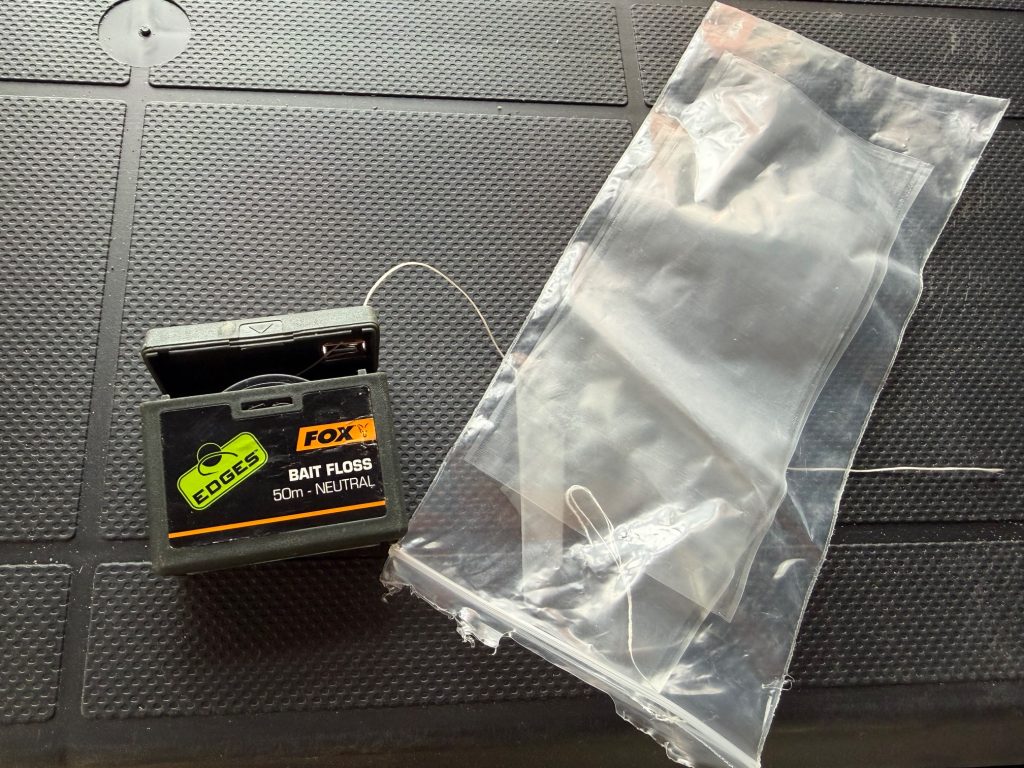
Bait floss is a thin, strong material used primarily to attach hookbaits to carp rigs.
Unlike a conventional hair rig, which often involves threading a boilie onto a hair and securing it with a stop, bait floss can hold a pop-up without passing anything through its center.
This is particularly useful with presentations such as chod rigs, D-rigs, and spinner rigs, where the bait may be attached to a small ring or micro swivel.
There are several reasons anglers use it:
- It can secure pop-ups without piercing them.
- It provides a flexible connection between the bait and rig.
- It can grip round or hard hookbaits.
- Certain types allow the ends to be melted into a retaining blob.
- It works with various rig rings and micro swivels.
There is an important distinction between waxed and unwaxed bait floss. Unwaxed versions can provide better grip when tightened around the outside of a hookbait, while some waxed versions are particularly convenient when threading baits and melting the tag ends.
That means a substitute should be judged by how well it performs the specific attachment method, rather than simply whether it resembles fishing floss.
The 7 Best Bait Floss Alternative Options
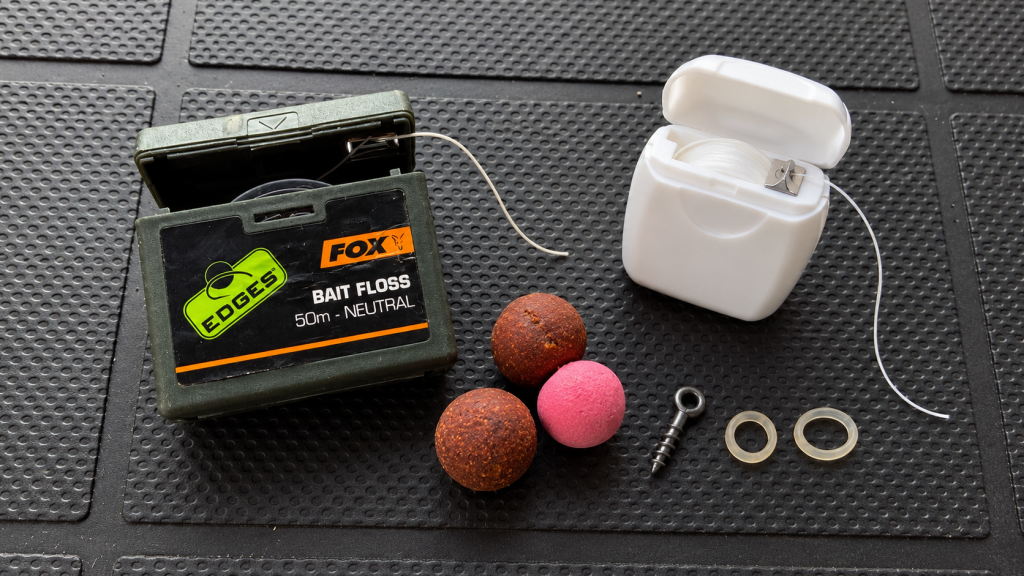
Several materials and attachment systems can replace bait floss, although they are not all interchangeable.
1. Unscented Dental Floss
For anglers who need something similar to traditional bait floss, plain dental floss is often the simplest substitute.
It is thin, flexible, widely available, and can be tied around a pop-up or another suitable hookbait.
Look for an unscented, unflavored variety without unnecessary additives. There is no particular reason to introduce mint or other flavorings into a bait presentation when a neutral alternative is available.
A straightforward approach is to form a loop around the bait, tighten it carefully, and secure the remaining ends to the appropriate rig ring.
However, ordinary dental floss isn’t manufactured specifically for fishing. Different products have different fiber constructions, coatings, and strengths.
Some may become slippery when wet, while others may fray or stretch more than dedicated bait floss.
Do not assume that ordinary dental floss can be melted and secured in the same way as a purpose-made fishing product.
Best for: A temporary substitute when attaching pop-ups to rig rings or micro swivels.
2. Thin Braided Fishing Line
A small piece of supple braided fishing line can also be used to secure a hookbait.
Braided line is flexible and available in numerous diameters, making it practical when you already have spare braid in your tackle box.
It can be used to create a loop around a suitable hookbait or, with an appropriate bait stop, help retain a bait that has been pierced.
However, not every braid will perform equally well.
A thick braid can create an unnecessarily bulky attachment, while a very smooth or thin braid might slip around a hard, round pop-up.
Braided fishing line also lacks some of the handling properties of purpose-made bait floss. Certain braided fibers can fray, and knots need to be properly secured.
Best for: Anglers who have fine, supple braid available and can make a reliable attachment without specialized floss.
3. Thin Monofilament Line
Monofilament is another material that can work when dedicated bait floss is unavailable.
Its biggest advantage is availability. Many anglers already carry spare monofilament for leaders, hooklinks, or other fishing applications.
Thin mono can secure a bait to a rig ring, particularly when used with an appropriate knot or bait stop.
The main disadvantage is that monofilament is generally stiffer than soft floss. It may retain bends, slip against smooth surfaces, or cut into softer hookbaits when tightened excessively.
It also does not behave like a soft, flat-profile bait floss when wrapped around a round pop-up.
If using mono, choose a diameter suitable for the attachment rather than automatically using the same heavy line as your mainline.
Best for: Occasional hookbait attachments when no floss or alternative mounting accessory is available.
4. Bait Bands
Bait bands are one of the easiest ways to avoid tying floss around a hookbait.
These small elastic bands grip the bait and can be attached to a suitable rig ring or mounting point.
They are particularly useful with pellets, small boilies, floating baits, and certain other firm hookbaits.
The biggest advantage is convenience. Instead of tying a new piece of floss every time you change bait, you can often remove one hookbait and fit another.
However, bait bands must match the size and shape of the bait.
A band that is too loose may allow the bait to slip out. One that is too tight can damage a soft hookbait or make it difficult to position correctly.
Best for: Pellets, boilies, and anglers who frequently change hookbaits.
5. Bait Screws and Bait Spikes
Bait screws provide a completely different solution.
Rather than wrapping material around the hookbait, a small threaded screw is inserted into it. The screw is connected to the rig through a suitable swivel or mounting arrangement.
This makes changing hookbaits straightforward.
Bait screws can work particularly well with pop-ups and other firm baits that grip the screw securely.
Their effectiveness depends on the bait’s consistency.
A very soft or crumbly hookbait may tear, while repeated removal and reinsertion can weaken the attachment point.
Another consideration is buoyancy. Different screw sizes and weights may affect how a balanced or floating bait behaves.
Best for: Firm pop-ups, artificial hookbaits, and quick bait changes on compatible rigs.
6. A Traditional Hair Rig With a Bait Stop
Sometimes the best alternative is not another material but a simpler attachment method.
A conventional hair rig can secure a boilie or other suitable hookbait without using bait floss.
The bait is threaded onto the hair, and a small bait stop prevents it from sliding off.
This arrangement is particularly useful for bottom baits and many wafters.
It is familiar, straightforward, and doesn’t require repeatedly tying a separate piece of floss to a small rig ring.
However, a traditional hair rig is not a direct replacement for every pop-up presentation. Changing the bait attachment can also change the way the hookbait moves relative to the hook.
Best for: Bottom baits, wafters, and straightforward carp fishing presentations.
7. Bait Elastic or Elastic Bait Thread
Elastic bait thread can be useful when the hookbait is too soft or awkward to hold using more conventional methods.
It is often used to bind fragile natural baits and prevent them from falling apart during casting.
For example, an angler using soft bait may be able to secure it with several wraps of fine elastic thread.
But elastic bait thread should not automatically be treated as a replacement for floss on a chod rig or spinner rig.
Its ability to stretch, combined with the way it wraps around bait, makes it better suited to securing soft or irregular bait than creating a precise pop-up attachment.
Best for: Soft or fragile natural baits that need extra support.
Bait Floss Alternatives Compared
| Alternative | Best Use | Main Limitation |
|---|---|---|
| Unscented dental floss | Tying pop-ups onto rig rings | Coating and strength vary |
| Thin braided line | Flexible hookbait attachment | Can slip or fray |
| Thin monofilament | Emergency hookbait attachment | Stiffer and less forgiving |
| Bait bands | Pellets, boilies, firm hookbaits | Must match bait size |
| Bait screws or spikes | Firm pop-ups and artificial baits | May damage soft bait |
| Hair rig and bait stop | Bottom baits and wafters | Changes the attachment style |
| Elastic bait thread | Soft or fragile natural bait | Poor match for many pop-up rigs |
The most important distinction is between replacing the floss material and using an entirely different method to attach the bait.
Dental floss, fine braid, and mono belong in the first group.
Bait bands, bait screws, and hair rigs belong in the second.
Neither approach is automatically superior. What matters is whether the finished hookbait remains secure and behaves correctly.
Can You Use PVA String Instead of Bait Floss?
PVA string and bait floss can look similar when they are wound onto small spools, but they perform fundamentally different jobs.
Bait floss is designed to remain attached to the hookbait during fishing.
PVA, or polyvinyl alcohol, is a water-soluble material. Fishing products made from PVA are designed to dissolve after entering the water.
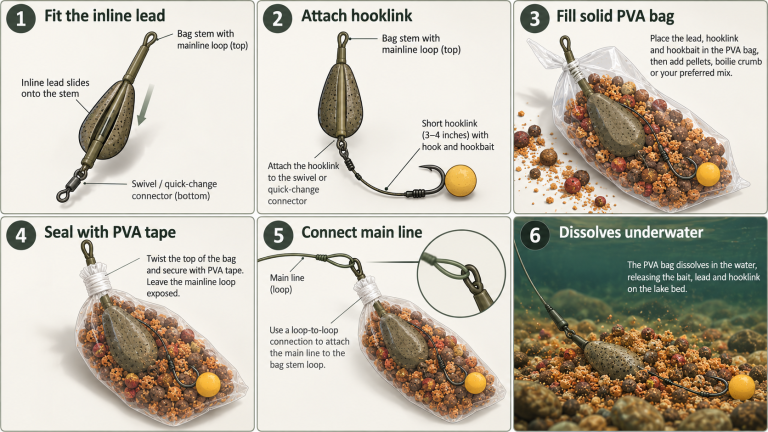
PVA string is useful for making boilie stringers, while PVA tape can secure PVA bags or hold certain components temporarily during casting.
Neither should be used as the permanent attachment between a hookbait and a rig ring.
For example, imagine securing a pop-up to a spinner rig using PVA string.
The bait may initially appear secure. Once the rig enters the water, however, the PVA starts dissolving.
If nothing else is holding the pop-up in place, it can detach from the rig.
That defeats the entire purpose of using a secure hookbait attachment.
PVA remains extremely useful in carp fishing, but its role is bait delivery and temporary restraint, not permanent hookbait retention.
For PVA bag fishing, another important distinction is how the complete bag rig is attached to the main line. That connection must remain secure after the bag dissolves.
How to Use Dental Floss as a Bait Floss Substitute
If the goal is to attach a pop-up to a rig ring without purpose-made bait floss, plain dental floss is worth considering.
A simple lasso-style attachment avoids relying on the material to melt into a retaining blob.
- Choose plain dental floss. Select a thin, unscented variety that can be knotted securely.
- Cut a manageable length. Leave enough material to form a loop around the hookbait and secure it to the rig.
- Form a loop around the pop-up. Use a suitable adjustable loop or noose arrangement and position the bait inside it.
- Tighten the loop carefully. The floss should grip the bait firmly without cutting deeply into its surface.
- Attach it to the rig ring. Secure the remaining floss ends with a reliable knot appropriate for the material and mounting point.
- Trim the excess. Leave the connection neat, but don’t cut the ends so short that the knot becomes insecure.
- Test the attachment. Apply a gentle pull and check whether the bait can slip out of the loop.
This method is best suited to a firm hookbait that provides enough resistance for the loop to grip.
Avoid tightening so hard that the floss cuts through the bait.
Before casting, lower the completed rig into water to check that the bait stays attached and that the presentation behaves as intended.
This is especially important with balanced hookbaits and pop-ups, where small changes in attachment weight or positioning may affect buoyancy.
Choosing the Right Substitute for Your Rig
The type of rig often determines which bait floss alternative makes the most sense.
Chod Rigs and Spinner Rigs
These presentations commonly use small rings, swivels, or other dedicated hookbait mounting components.
Dental floss can work where a properly tied loop or attachment is suitable.
Bait screws are another practical option, provided the mounting arrangement is compatible with the hook and the bait.
Avoid changing several rig components just to accommodate a substitute. A new attachment can affect how the bait moves and how the rig sits.
Conventional Bottom-Bait Rigs
With bottom baits, a hair rig and bait stop are often the most straightforward answer.
There is usually no reason to add a separate floss connection if the existing hair already provides an appropriate presentation.
Pellet and Small-Bait Presentations
Bait bands are particularly useful for pellets and other small, firm hookbaits.
They allow relatively quick bait changes and avoid forcing a needle through a bait that might split.
Soft or Fragile Baits
Elastic bait thread can provide additional support when presenting soft bait that might otherwise fall off.
It should be used with a suitable rig rather than improvised as a replacement for a structural connection.
Common Mistakes When Replacing Bait Floss
An alternative may look perfectly secure on the bank and still fail during fishing.
The following mistakes are worth avoiding.
Using PVA for a permanent connection. PVA material dissolves in water. It cannot be relied upon to retain a hookbait throughout a session.
Assuming all dental floss behaves identically. Coatings, textures, and fiber construction vary. A knot that holds with one product may slip with another.
Melting unsuitable materials. Purpose-made bait floss may allow the ends to be blobbed with a lighter, but that does not make heating every substitute safe or effective.
Overtightening around a pop-up. Thin materials can damage the bait’s outer surface and eventually cut through it.
Using the wrong bait screw. A screw that is too large or aggressive for a soft hookbait may cause it to split.
Skipping the water test. A pop-up that behaves correctly with floss may sit differently when attached using a heavier screw or another mounting arrangement.
The simplest precaution is to test a complete rig before casting. The hookbait should remain attached, move as intended, and present the hook correctly.
Frequently Asked Questions
Can You Use Regular Dental Floss for Carp Fishing?
Yes, plain, unscented dental floss can work as a substitute for bait floss when tying suitable hookbaits onto a rig. However, dental floss products vary, so inspect the material, secure the knots properly, and test the attachment before casting.
Is Dental Floss as Strong as Bait Floss?
Not necessarily. Purpose-made bait floss is designed with hookbait attachment in mind, while ordinary dental floss is made for oral hygiene. Its strength, stretch, coating, and wet grip may differ.
Can You Use Fishing Line Instead of Bait Floss?
Thin braided line or monofilament can be used in some hookbait attachments. Fine, supple braid is generally more flexible, while monofilament may be stiffer. Neither is guaranteed to grip a pop-up as effectively as dedicated floss.
Can You Use PVA Tape to Tie On Pop-Ups?
PVA tape should not be the permanent connection holding a pop-up to a rig. It dissolves in water. It can be used for temporary tasks such as securing PVA bags or arranging bait for delivery.
Is a Bait Screw Better Than Bait Floss?
A bait screw can be faster and more convenient, particularly when repeatedly changing firm pop-ups. Bait floss remains useful for different attachment methods, including securing baits without piercing them. The better choice depends on the rig, bait, and required presentation.
Final Takeaway
The most practical bait floss alternative depends on what you are trying to attach.
Plain dental floss is a reasonable temporary substitute when a floss-style connection is needed. Bait bands, bait screws, and conventional hair rigs are often better choices when changing the attachment method is acceptable.
Whatever you choose, make sure the bait remains secure and behaves correctly in water. And keep PVA string for its intended job: delivering bait, not holding a hookbait permanently in place.