
A 6000 vs 8000 reel comparison looks simple until two actual reels are placed next to each other. An 8000 sounds like it should automatically be much larger, stronger and better suited to big fish, but fishing reel sizes do not work that neatly.
The number is primarily a manufacturer’s size designation. It can give a useful indication of spool capacity and overall reel size within the same product range, but it is not a universal measurement that can be compared blindly between different brands.
That means the better question is not simply whether 6000 or 8000 is bigger. It is whether the extra line capacity, spool size and possible increase in weight of an 8000 actually benefit the fishing you do.
What Does 6000 vs 8000 Reel Size Actually Mean?
A reel marked 8000 will normally sit above a 6000 in the same manufacturer’s range. The larger model will commonly have a larger or deeper spool and therefore greater line capacity.
That is where the simple rule ends.
There is no universal industry measurement that says every 6000 reel must have a certain spool diameter, hold a certain amount of line or weigh a certain amount. One manufacturer’s 6000 can therefore overlap significantly with another manufacturer’s 8000.
Even within one range, increasing the size number does not necessarily mean every part of the reel changes.
For example, Sonik lists both a VaderX RS 6000 and 8000 with the same 4.1:1 gear ratio. The listed weights are 604 g and 620 g respectively, while their 0.35 mm line capacities increase from 200 m to 280 m. In that particular reel family, the capacity difference is far more significant than the 16 g increase in weight.
6000 vs 8000 Reel: What Actually Changes?
When comparing two reels, five specifications tell you far more than the number printed on the spool.
| Feature | 6000 Reel | 8000 Reel |
|---|---|---|
| Line capacity | Usually lower | Usually higher |
| Physical size | Usually more compact | Usually larger, but not always dramatically |
| Weight | Often lighter | Often heavier |
| Best reason to choose it | Enough capacity without unnecessary bulk | Extra capacity or larger spool genuinely needed |
| Drag strength | Model dependent | Model dependent |
| Casting performance | Depends heavily on spool and line lay | Larger spool can help, but size alone does not guarantee distance |
Line Capacity
This is usually the most important difference.
A larger spool can hold more line of the same diameter. That becomes useful when fishing at significant range, using thick monofilament, fishing large waters, or wanting a comfortable reserve after a long cast.
Imagine two anglers both using 0.35 mm mono. One normally fishes 50 metres from the bank while the other regularly fishes at 150 metres or more.
The first angler gains very little from carrying hundreds of metres of unused line. The second has a much stronger reason to choose the reel with greater capacity.
Always compare capacities using the same line diameter where possible. Comparing one reel’s capacity with 0.30 mm line against another’s capacity with 0.40 mm line tells you very little.
Reel Weight and Rod Balance
Larger reels often weigh more, although the difference can vary enormously.
Weight matters particularly when the rod is held for long periods. A reel that feels perfectly reasonable on a carp rod sitting on alarms may feel unnecessarily heavy when repeatedly casting lures.
Rod balance matters too.
A heavier reel can actually balance some long or powerful rods well because its weight sits behind the angler’s hand. On a lighter rod, the same reel may simply make the outfit cumbersome.
The same balance question applies to longer two-piece carp rods, where transport convenience matters but the finished rod-and-reel setup still needs to feel right in the hand.
Do not choose reel size in isolation. Consider the completed rod-and-reel combination.
Drag
An 8000 reel is not automatically better because it has a bigger number.
Maximum drag is an independent specification.
Some 6000 reels can produce as much or more usable drag than larger reels. More importantly, anglers rarely need the maximum figure printed on the box.
Smooth adjustment, reliability and using an appropriate drag setting are usually more useful than chasing the highest possible number.
Gear Ratio and Line Retrieve
Gear ratio tells you how many times the rotor turns for one handle rotation, but that still does not tell the entire story.
Spool diameter also affects how much line is retrieved with each turn.
For fishing at long range, retrieve per handle turn can become surprisingly important. Bringing a rig back 120 metres repeatedly feels very different with a reel retrieving close to a metre of line per turn than with one retrieving substantially less.
Look at retrieve per handle turn as well as gear ratio when manufacturers provide both.
Spool Design and Casting
An 8000 reel does not automatically cast farther than a 6000.
A wide, long spool can allow line to leave the reel efficiently, but casting distance also depends on line diameter, how full the spool is, line lay, rod action, casting technique, sinker or lead weight and the shape of the spool lip.
A well-filled 6000 can easily be the better casting tool than a poorly matched 8000.
When a 6000 Reel Makes More Sense
A 6000 reel is often the better choice when the additional capacity of an 8000 would simply sit unused.
This can include medium-distance carp fishing, river fishing, specimen fishing, larger feeder setups and other situations where relatively heavy tackle is useful but extreme line capacity is not.
A 6000 can also make sense when portability matters. Smaller bodies and spools generally take up less room in luggage and rod bags.
Most importantly, there is no benefit in deliberately choosing a larger reel simply because larger sounds safer.
If the 6000 holds enough of the line you actually use, balances the rod properly and has an appropriate drag system, moving to an 8000 may solve a problem that never existed.
When an 8000 Reel Makes More Sense
An 8000 becomes more attractive when capacity is genuinely valuable.
Long-range carp fishing is an obvious example. A larger spool can provide considerably more reserve once a long cast or baited rig has already removed a substantial amount of line from the reel.
The same applies when thicker mainline is required. Increasing line diameter consumes spool capacity quickly.
If you are choosing that mainline for carp, this guide to what lb line for carp fishing explains when 12, 15, 18 or 20 lb makes sense.
An 8000 can also suit heavier and longer rods where its additional mass does not negatively affect balance.
Large lakes, powerful river fishing and situations where fish can make long runs may all justify greater capacity.
The key word is justify.
The purpose of the larger reel should be identifiable before buying it.
What the Sonik 8000 and Prologic 6000 Show
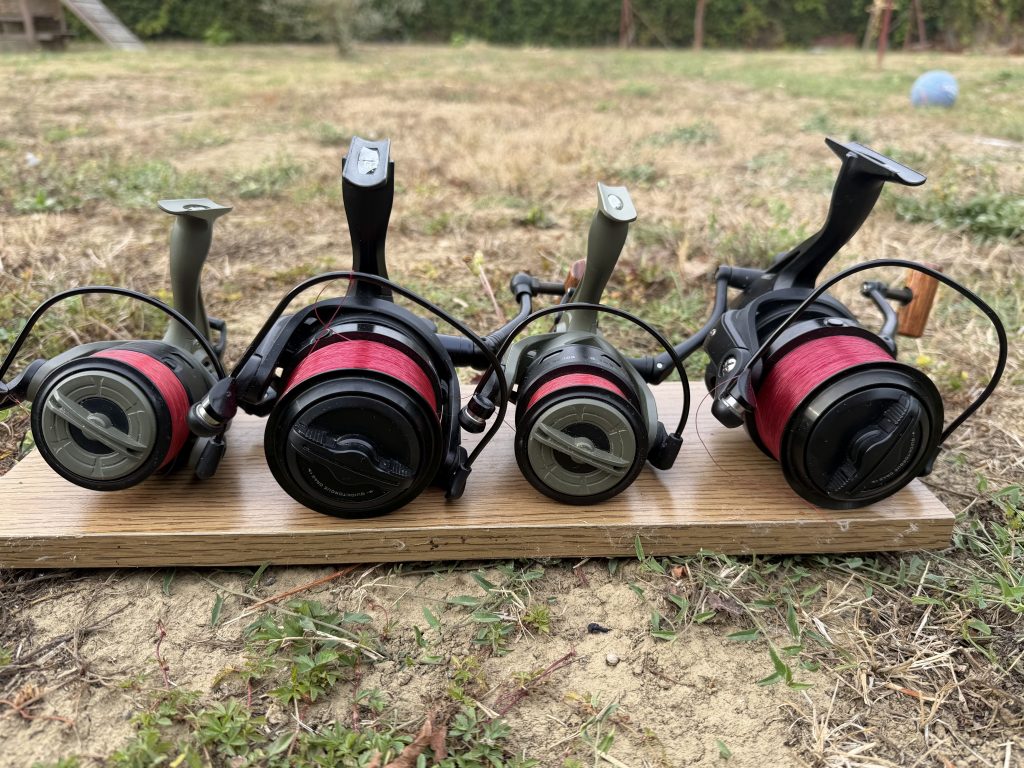
The reels pictured in this article are useful because they make the biggest lesson visible.
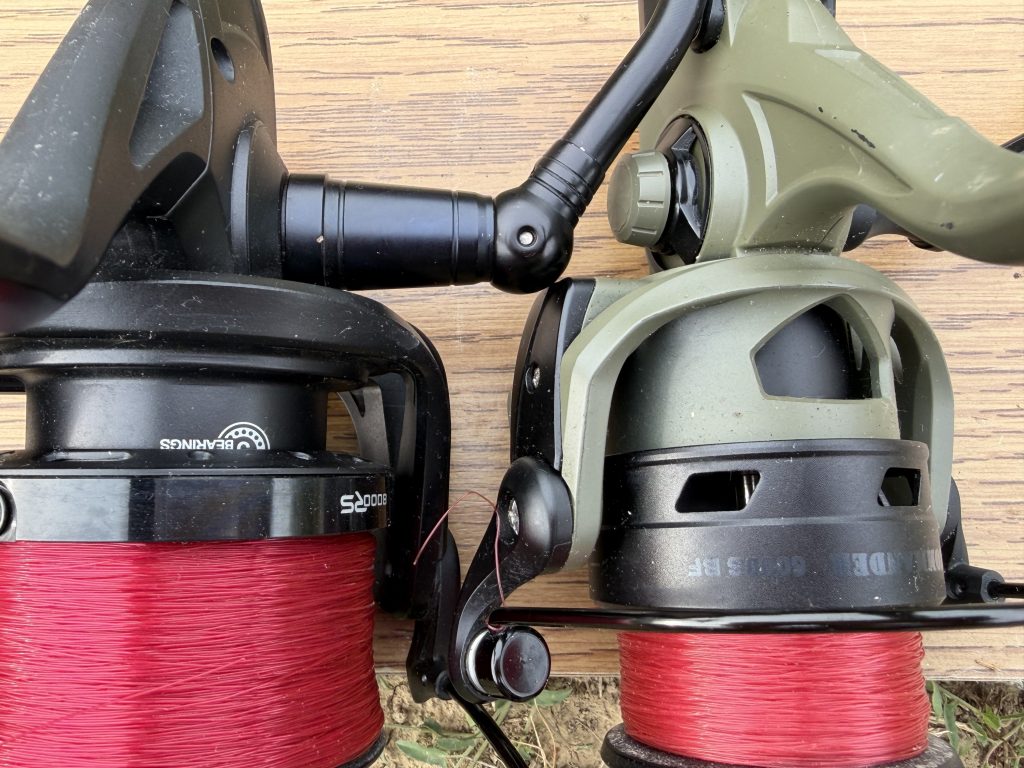
The black reels are Sonik VaderX RS 8000s, while the green reels are Prologic Commander BF 6000S models.
Placed beside each other, the difference is obvious, but it is also clear why the number alone cannot describe everything about a reel.
The Prologic is built around a different design, including a Bite & Fight freespool system. Published specifications list the Commander BF 6000S at about 410 g, with 300 m capacity using 0.33 mm line, a 5.1:1 gear ratio and 96 cm retrieve per turn.
The Sonik VaderX RS 8000 is a larger big-pit-style carp reel listed at 620 g with a 4.1:1 ratio and 280 m capacity using 0.35 mm line.
Those figures should not be used to declare one reel better than the other. They are different reel designs from different manufacturers.
They do show why shopping by the number alone is a mistake.
One has a freespool system and significantly lower listed weight. The other uses a larger big-pit design and accommodates thicker line at substantial capacity.
The right choice depends on what the reel needs to do.
6000 vs 8000 Reel for Carp Fishing
Both sizes can be perfectly sensible for carp.
For relatively small waters and normal casting distances, a 6000 with sufficient line capacity can provide everything required without moving to a larger reel.
On bigger waters, particularly when fishing at long range or using thicker mono, the additional capacity of an 8000 becomes much easier to justify.
Reel size matters, but it is only one part of a dependable night carp fishing setup. Accurate casting, suitable line, correctly adjusted drag and having the rest of the swim organized properly remain just as important after dark.
Another consideration is whether a freespool reel or conventional front-drag/big-pit design better suits the way the rods are fished.
That decision can matter more than whether the spool says 6000 or 8000.
How to Choose Between a 6000 and 8000 Reel
Before buying either size, check the exact reel rather than the category number.
Start with line capacity. Decide what mainline diameter you intend to use and how much line you realistically need.
Then check the reel’s weight against the rod it will be paired with.
After that, compare drag design, retrieve per turn, gearing and spool shape.
For most anglers, the decision becomes straightforward once those questions are answered.
Choose the 6000 if:
- it comfortably holds enough of your chosen line;
- you do not regularly fish extreme distances;
- the smaller reel balances your rod better;
- lower weight or a more compact setup is useful.
Choose the 8000 if:
- additional line capacity is genuinely required;
- you fish at long range;
- you use relatively thick mainline;
- the larger reel balances a heavy or long rod well;
- you specifically want the spool characteristics of the larger model.
Do not upgrade purely because 8000 appears more powerful on paper.
Frequently Asked Questions
Is an 8000 reel stronger than a 6000 reel?
Not necessarily. Reel size can correlate with larger components and greater capacity within a particular range, but strength and maximum drag depend on the exact reel. Compare specifications rather than assuming the 8000 number guarantees greater strength.
Does an 8000 reel cast farther than a 6000?
Not automatically. Larger or longer spools can help line leave the reel efficiently, but line diameter, spool fill, line lay, rod choice and casting technique all affect distance.
Is a 6000 reel big enough for carp fishing?
Yes, in many situations. If the reel holds enough of the chosen mainline and suits the fishing distance and rod, a 6000 can be an effective carp reel. Bigger waters and long-range fishing may make the additional capacity of an 8000 more useful.
What is an 8000 size reel good for?
An 8000 reel is commonly useful when anglers need substantial line capacity, heavier mainline or a larger spool for long-range fishing. Depending on the design, that can include carp fishing, heavy specimen fishing and some shore or saltwater applications.
Are fishing reel sizes standardized?
No. Size numbers are useful within a manufacturer’s own range, but a 6000 from one company should not automatically be assumed equivalent to a 6000 from another.
Final Takeaway
In a 6000 vs 8000 reel decision, the 8000 is normally the choice when additional capacity has a real purpose. Otherwise, a suitable 6000 can provide the same practical fishing ability in a smaller package.
Ignore the number for a moment and compare line capacity, weight, rod balance, drag and retrieve.
Whichever reel fits those requirements is the right size.
