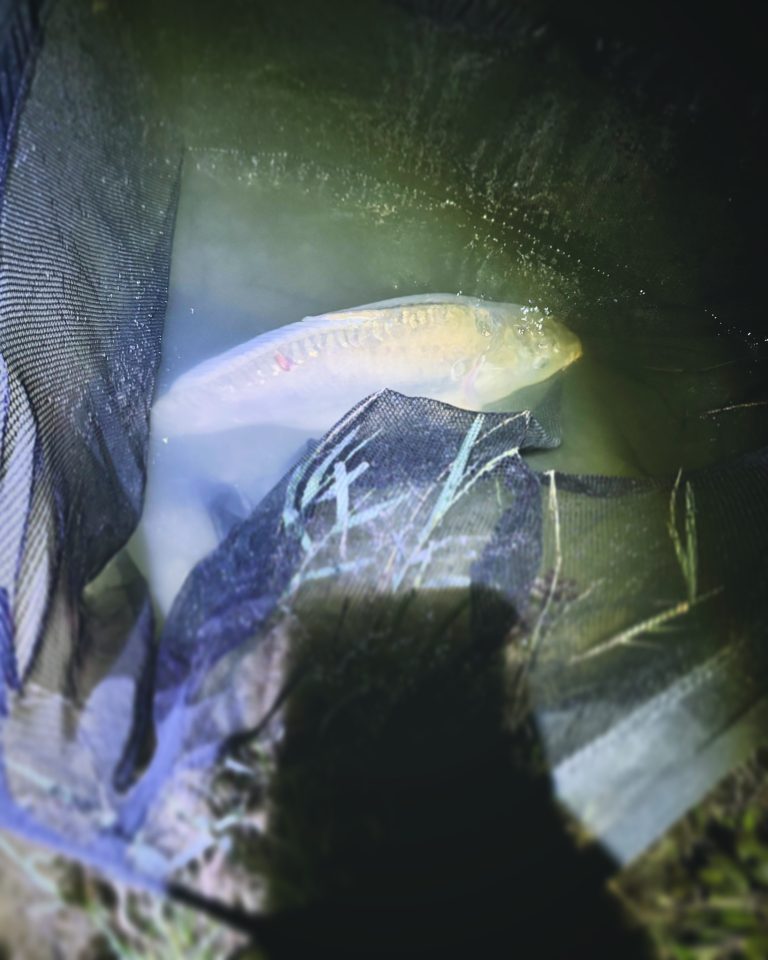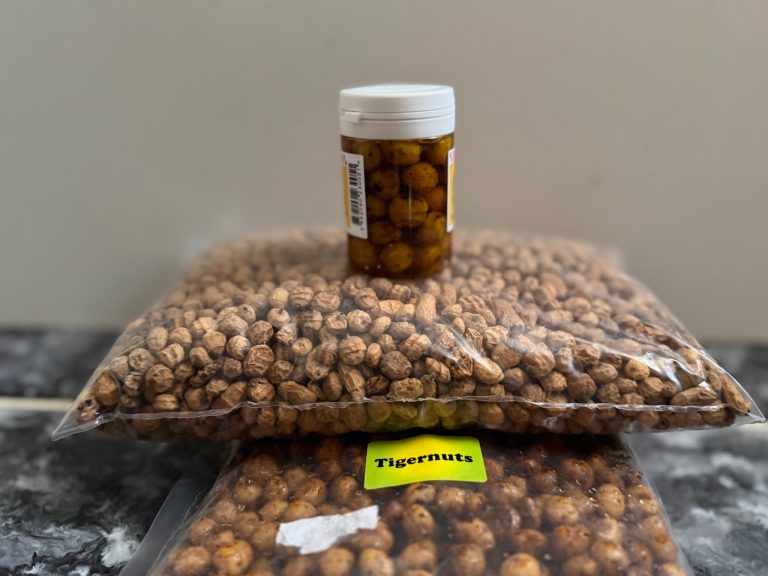
Choosing the best common carp bait sounds simple until you start looking at the options. One angler swears by fishmeal boilies, another catches regularly on sweetcorn, and someone else refuses to fish without tiger nuts.
They can all be right.
Common carp are adaptable feeders, and a bait that works brilliantly on one lake can be surprisingly ineffective on another. The difference often comes down to fishing pressure, available natural food, water temperature, nuisance fish, and how the bait is presented.
Boilies are an excellent all-around option for dedicated carp fishing. Sweetcorn is inexpensive and accessible, while maize, tiger nuts, pellets, and natural baits each have advantages worth understanding.
Rather than declaring one bait the winner, this guide compares seven reliable options and explains when each makes the most sense.
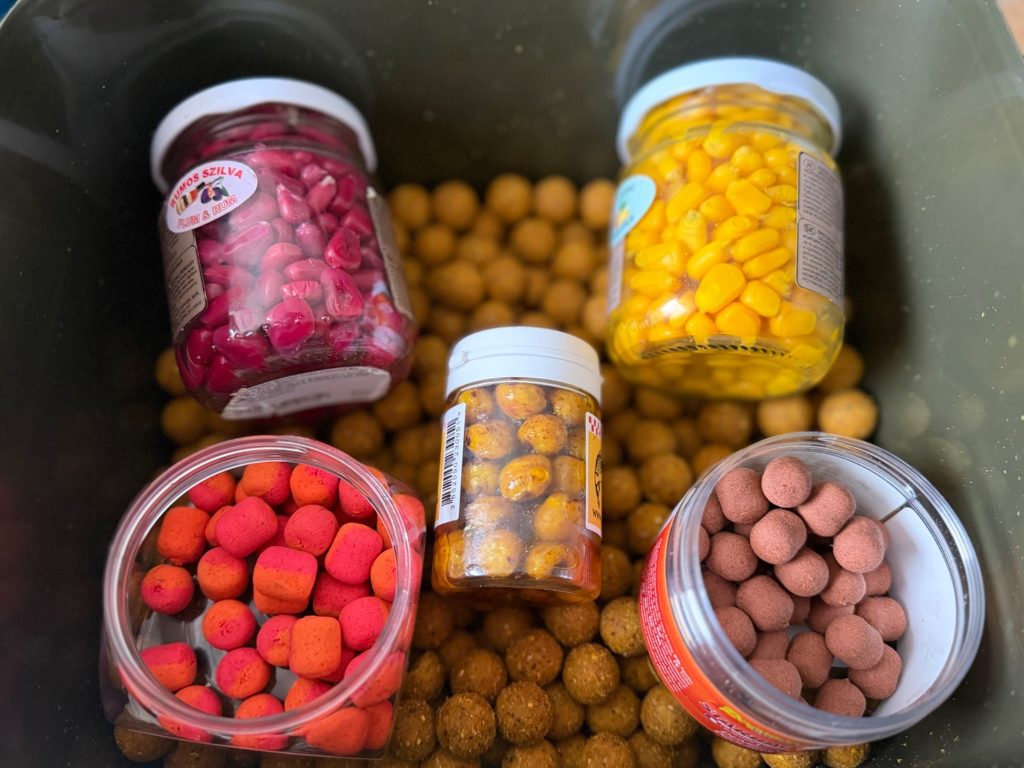
What Makes the Best Common Carp Bait?
A successful carp bait needs to do more than smell attractive.
It must be something the fish will investigate and accept, remain in a suitable condition long enough to be eaten, and work with the way you intend to fish.
Common carp are omnivores. Their natural diet includes insect larvae, small crustaceans, worms, mollusks, plant material, seeds, and organic debris.
That helps explain why very different fishing baits can all produce bites.
A fish that regularly searches soft sediment for small invertebrates may readily accept a worm. Another carp feeding over a bed of introduced boilies might become accustomed to picking up those round food items.
Neither behavior proves that the fish has a permanent preference for one particular bait.
Four practical questions help narrow the options:
- Will smaller fish remove or damage the bait before carp find it?
- Are the carp already familiar with the bait?
- How long must the hookbait remain in the water?
- How much loose feed is appropriate for the conditions?
These considerations are often more useful than comparing flavor names on different bait packets.
The 7 Best Common Carp Bait Options
1. Boilies — Best All-Around Carp Bait
Boilies are one of the most versatile baits available to carp anglers.
They are usually manufactured from ingredients such as fishmeal, grain-based flours, proteins, and flavoring compounds. The mixture is formed into balls and cooked to create a relatively firm outer surface.
Their biggest advantage is durability.
A properly mounted boilie can remain intact for hours, making it suitable for longer sessions, overnight fishing, and waters containing smaller fish that quickly destroy softer bait.
Boilies are also easy to introduce accurately using a throwing stick, catapult, baiting spoon, or other suitable method.
A practical starting point is a 15–18 mm bottom boilie. This is a versatile size for many carp waters, although smaller or larger baits may be preferable depending on the fish and nuisance species present.
Fishmeal, sweet, fruity, and birdfood-based varieties can all catch carp. There is no reliable universal rule that one flavor family must be used in a particular season.
A good approach is to choose a quality bait, fish it consistently, and adjust the feeding quantity based on the activity you observe.
Larger boilies can reduce interference from certain smaller fish, but they do not guarantee that only large carp will be caught.
Best for: Longer sessions, dedicated carp fishing, overnight fishing, and situations requiring a durable hookbait.
2. Sweetcorn — Best Budget and Beginner Bait
Ordinary canned sweetcorn is one of the simplest common carp baits.
It is inexpensive, widely available, and requires no cooking or specialist preparation before use.
A few kernels can be presented directly on a suitable hook or threaded onto a hair rig, leaving the hook point unobstructed.
Sweetcorn is particularly useful when fishing short sessions or introducing someone to carp fishing.
It can also be very effective when carp are feeding cautiously and a large boilie presentation attracts little interest.
However, sweetcorn has limitations.
Its soft texture makes it easy for smaller fish to remove. A hookbait may disappear without producing an obvious carp bite, particularly on waters containing large numbers of roach, bream, or other nuisance species.
Loose sweetcorn also tends to attract a wide variety of fish rather than targeting carp exclusively.
For a simple starting presentation, try two or three kernels on a hair rig with a small amount of loose corn nearby.
Best for: Beginners, short sessions, inexpensive fishing, and cautious carp willing to feed on small food items.
3. Maize — Best for Affordable Particle Fishing
Although maize and sweetcorn both come from corn, they are not interchangeable as fishing baits.
Canned sweetcorn is already cooked and soft. The dried maize commonly used by carp anglers has larger, firmer grains and must be properly prepared before fishing.
Once soaked and thoroughly cooked, maize provides a relatively inexpensive option for creating a feeding area.
Its firmer texture can make it more durable than canned sweetcorn, although nuisance fish may still eat it.
Maize can be useful on waters where anglers introduce particles regularly, particularly when fishing over a modest bed of mixed feed.
A couple of prepared maize grains can also make an effective hair-rig hookbait.
The important distinction is preparation. Never assume hard, dried maize is ready to put into the water. Follow established soaking and cooking instructions or buy professionally prepared, ready-to-use fishing maize.
Best for: Particle-based fishing, longer sessions, and anglers who want an economical alternative to feeding exclusively with boilies.
4. Tiger Nuts — Best Durable Particle Hookbait
Tiger nuts are another established carp bait, especially on waters where they are already familiar to the fish.
Despite their name, tiger nuts are tubers rather than true nuts.
Their firm texture gives them a useful advantage over softer baits.
A properly prepared tiger nut can remain attached to a hair rig even when small fish are active around the bait.
One or two tiger nuts are often enough for a hookbait, and they can be presented over a modest amount of matching loose feed.
However, there is a significant restriction.
Some fisheries prohibit tiger nuts entirely or impose specific preparation and feeding rules.
These restrictions should always be checked before fishing.
Dried tiger nuts also require appropriate soaking and thorough cooking. The safest option for anglers unfamiliar with their preparation is to purchase ready-prepared fishing tiger nuts from a reputable supplier.
Tiger nuts do not need to be introduced in enormous quantities to be effective. Their durability is often more important than the amount being fed.
For more detail on the restrictions, see why tiger nuts are banned on some carp waters.
Best for: Fisheries where tiger nuts are permitted, nuisance-fish pressure, and situations where a firm particle hookbait is desirable.
5. Pellets — Best for Creating an Attractive Feeding Area
Pellets are especially useful as loose feed or as part of a compact bait presentation.
They are manufactured in various sizes and formulations, including grain-based and fishmeal-based varieties.
Their behavior in water depends on their composition, size, and manufacturing process.
Some break down relatively quickly, releasing small particles into the surrounding water. Others remain firm considerably longer.
This makes pellets particularly useful when building a small feeding area around a hookbait.
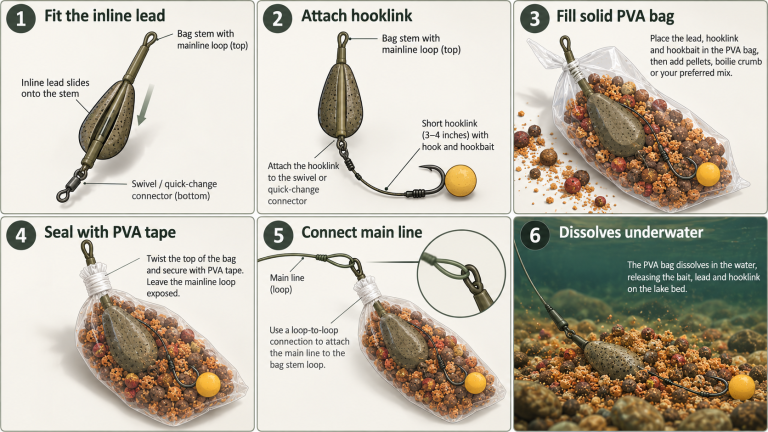
For example, a small solid PVA bag containing suitable dry pellets and boilie crumb can deliver an attractive parcel of food close to the hook.
The hookbait might be a boilie, wafter, or appropriately mounted pellet.
Not every pellet is suitable for direct hooking or hair-rigging. Some soften rapidly, while harder varieties may require a bait band or another suitable mounting method.
If you use solid bags, the guide on attaching a PVA bag rig to the main line explains how the rig components connect.
Best for: Small concentrated feeding areas, solid PVA bags, method feeders, and supplementary loose feed.
6. Worms and Maggots — Best Natural Alternatives
Natural baits deserve a place in a carp angler’s selection.
Worms and insect larvae are closely related to food that common carp encounter naturally.
That does not guarantee a bite, but it makes them sensible alternatives when conventional baits are not producing results.
A lively worm can be especially useful when fishing close to visible carp activity with a suitable float or bottom-fishing presentation.
Maggots can also work with appropriately sized tackle or specialist carp presentations.
The problem is selectivity.
Many other freshwater fish readily eat worms and maggots, meaning these baits may generate constant nuisance bites before a carp gets anywhere near them.
They can also be less convenient when fishing at long range or leaving a bait in position for extended periods.
Best for: Short sessions, close-range fishing, difficult bites, and waters where natural bait is permitted and nuisance fish are manageable.
7. Bread — Best for Surface and Margin Fishing
Bread is easy to overlook when surrounded by shelves of specialized carp bait.
Yet a piece of bread crust or flake can be highly effective under the right conditions.
Its greatest strength is versatility.
Bread can be presented on the surface when carp are visibly taking floating food, or used in a suitable sinking presentation.
On a warm day, watching a carp approach and take floating bread can be one of the most exciting ways to catch one.
However, bread is fragile.
It can become waterlogged, detach during casting, or be removed by smaller fish.
Surface fishing also requires close attention to presentation, line position, wind, and the behavior of the fish.
Never continue feeding large quantities of bread when fish are ignoring it or when venue rules prohibit it.
Best for: Surface feeding, stalking carp in the margins, and inexpensive short-session fishing.
Common Carp Baits Compared
The following table provides a quick starting point for choosing between these options.
| Bait | Biggest Advantage | Main Limitation | Best Situation |
|---|---|---|---|
| Boilies | Durable and versatile | More expensive than basic particles | General carp fishing and longer sessions |
| Sweetcorn | Cheap and ready to use | Easily removed by small fish | Beginners and short sessions |
| Maize | Economical bulk particle bait | Dried grains require preparation | Particle feeding and longer sessions |
| Tiger nuts | Firm, durable hookbait | Restricted on some waters | Nuisance-fish pressure |
| Pellets | Useful as attractive loose feed | Breakdown rate varies | PVA bags and concentrated feeding |
| Worms and maggots | Natural food presentation | Attract numerous other species | Close-range and difficult fishing |
| Bread | Excellent surface presentation | Fragile and short-lived | Surface feeding and stalking |
There is no need to carry all seven baits on every trip.
For most general carp sessions, boilies and one alternative such as sweetcorn or prepared tiger nuts provide enough flexibility to handle several situations.
How to Choose Carp Bait for Different Conditions
The best common carp bait changes with the situation. Often, the first adjustment should be the size of the presentation or the amount of feed rather than the bait itself.
Cold Water: Small Presentations and Limited Feed
When water temperatures fall, carp activity and feeding demand can decline.
This does not mean they stop eating. It means that large quantities of bait may be unnecessary or counterproductive.
A small boilie, a single balanced hookbait, or a few sweetcorn kernels can be a sensible starting point.
Try a modest amount of loose feed and avoid introducing more simply because several hours have passed without a bite.
The priority is finding fish that are willing to feed.
Warm Water: More Feeding Options
In warmer conditions, carp may feed actively for longer periods and visit multiple areas.
Boilies, prepared maize, pellets, and other particles can all be useful.
If fish are repeatedly visiting a baited spot, carefully increasing the amount of feed may help keep them interested.
However, warm water alone does not justify putting several kilograms of bait into a swim.
Observe what the carp are actually doing.
If they are cruising near the surface rather than searching the bottom, floating bread might be more effective than any bottom bait.
Heavily Fished Waters: Focus on Presentation
Carp on frequently fished waters can become cautious around familiar feeding spots and presentations.
Changing from a boilie to corn or a natural bait may sometimes help.
But the solution is not automatically a different flavor.
A poorly positioned rig, excessive line disturbance, or a hookbait sitting unnaturally among the free offerings can also reduce the likelihood of a successful bite.
Before purchasing another expensive bait, consider making the existing presentation less intrusive.
Waters With Many Nuisance Fish
When small fish repeatedly remove corn or damage softer baits, durability becomes particularly valuable.
A firm boilie or permitted, prepared tiger nut can remain effective for longer.
A larger hookbait may help discourage certain nuisance fish, although it will not prevent every unwanted bite.
Avoid choosing a bait solely because it is hard. It still needs to be appropriately prepared, palatable, and presented on a suitable rig.
How Much Bait Should You Feed?
One of the most common mistakes in carp fishing is assuming that more bait automatically creates more bites.
Loose feed has an important purpose: attracting carp into an area and encouraging them to search for food.
But once the fish arrive, they still need to encounter the hookbait.
Introducing too much food can make that less likely, especially when only a few fish are feeding.
For a short session or cold-water approach, a single hookbait with a small quantity of crushed boilies, pellets, or corn may be enough.
During a longer session with several carp feeding confidently, more substantial baiting can become worthwhile.
The important thing is to respond to evidence.
Repeated bites, feeding bubbles, fish activity, and consistent visits to the same area may justify adding more bait.
Several hours without a bite do not necessarily justify another large bucket of feed.
Accurate bait placement matters as well.
A modest quantity delivered precisely around the hookbait can be more useful than a large amount scattered across an area the carp are not visiting.
After dark, it becomes especially important to understand where the feeding area is located. The guide explaining whether carp feed at night covers how their activity can change after sunset.
How to Present Your Carp Bait Properly
Even a well-chosen bait can fail if the presentation is poor.
For conventional bottom-bait fishing, a hair rig allows the boilie, tiger nut, or suitable particle to sit separately from the hook.
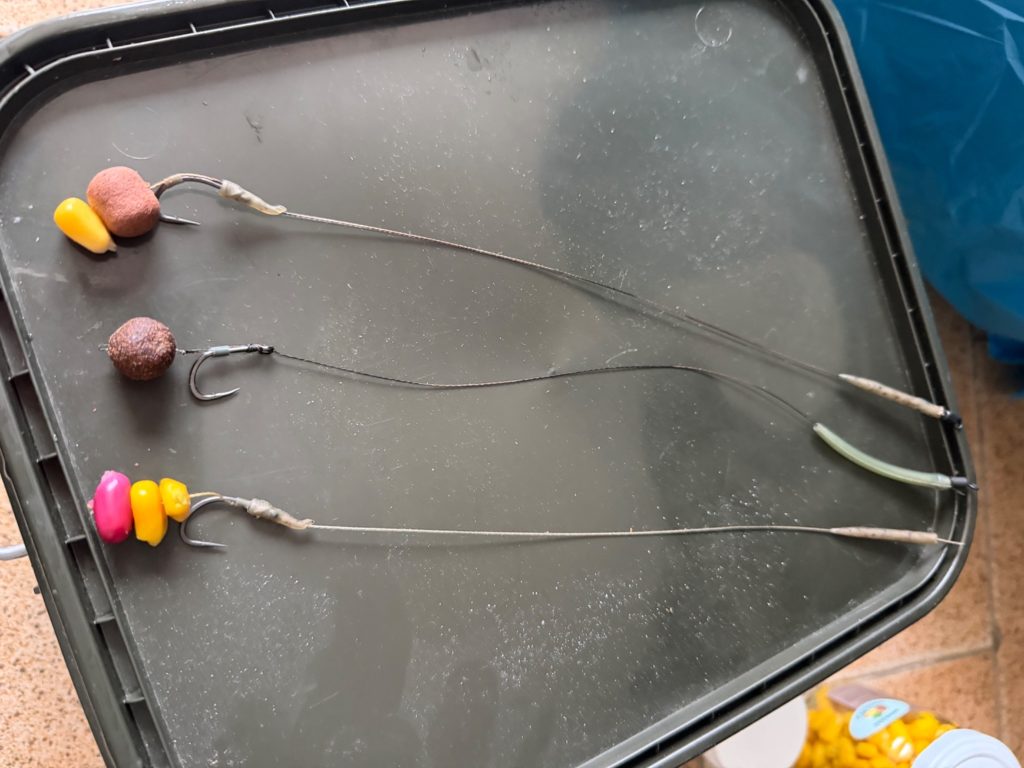
This arrangement leaves the hook point unobstructed and allows the bait to be taken into the fish’s mouth.
The exact hook size, hair length, and rig arrangement should suit the bait and fishing conditions.
For softer baits such as sweetcorn, make sure the kernels are securely mounted without preventing the hook from working properly.
For floating bread, choose a presentation that allows the bait to behave naturally on the surface.
Where the bottom is very soft or covered by light debris, a balanced wafter or suitably presented pop-up may be worth trying instead of a conventional sinking bait.
Before casting, check the rig in shallow water or a suitable container.
The bait should sit as intended, the hook should remain unobstructed, and the complete setup should be safe for the fish.
Common Mistakes When Choosing Carp Bait
Constantly Changing Flavors
Switching between five different boilie flavors during one session makes it difficult to determine what actually changed.
Location, feeding activity, and presentation may be more important than flavor.
Make one meaningful adjustment at a time.
Using Unprepared Particles
Dry maize and tiger nuts are not equivalent to ready-to-use canned corn.
Hard, dried particles require the appropriate preparation before use.
Check the supplier’s instructions, confirm the bait is fully prepared, and follow the venue’s regulations.
Ignoring the Fishery Rules
Some waters restrict nuts, particles, surface bait, or the quantity of loose feed.
Check the regulations before preparing a large quantity of bait.
Feeding Too Much Too Early
Introducing a large amount of food before confirming that carp are present can make a difficult session even harder.
Start conservatively when the conditions are uncertain.
Blaming the Bait Instead of the Location
A carp cannot eat a hookbait it never encounters.
If there are no signs of fish in the area, finding a more productive location may achieve more than buying another packet of boilies.
Frequently Asked Questions
What is the best common carp bait for beginners?
Canned sweetcorn is an excellent starting option because it is affordable, easy to prepare, and works with straightforward fishing methods. Ready-made boilies are another good choice when using conventional carp rigs.
Are boilies better than corn for carp fishing?
Not in every situation. Boilies are generally more durable and convenient for longer sessions, while sweetcorn can be highly effective during short sessions or when carp prefer smaller food items. Both are worth carrying.
Do common carp prefer sweet or fishy bait?
There is no universal preference. Common carp can accept baits with very different ingredients and aromas. Local feeding conditions, bait familiarity, presentation, and fish activity matter more than assuming one flavor category always wins.
Can you use tiger nuts instead of boilies?
Yes, where the fishery permits them. Properly prepared tiger nuts provide a durable alternative to boilies and are especially useful when smaller fish interfere with softer bait. They are not necessarily more effective on every water.
What is the best bait for big common carp?
Boilies are a practical choice for targeting larger carp because their durability and available sizes help anglers maintain a presentation while reducing some nuisance-fish interference. However, large common carp can also be caught on corn, prepared particles, and natural baits. Bait size alone does not determine fish size.
Final Takeaway
The best common carp bait is the one that suits the fish, the water, and the way you are fishing.
For a versatile starting point, choose a quality boilie. Carry sweetcorn for a simple alternative, and consider prepared tiger nuts, maize, or pellets when the conditions justify them.
Above all, prioritize locating feeding carp and presenting your bait correctly. A simple bait in the right place is worth far more than an expensive one where there are no fish.