Most anglers know that catfish can live and grow in ponds, but do catfish spawn in ponds naturally, or do pond owners have to keep introducing new fish?
The answer is more complicated than it first appears. Catfish are capable of reproducing in ponds, but successful reproduction is not guaranteed. In fact, many stocked ponds contain healthy adult catfish without producing enough young fish to maintain the population.
The reason is usually a combination of nesting habitat and survival. Catfish need suitable places to lay their eggs, and even when spawning occurs, the young fish may never survive long enough to become catchable adults.
Understanding that distinction explains why some ponds support generations of catfish while others depend almost entirely on regular stocking.
Do Catfish Spawn in Ponds Naturally?
Yes. Channel catfish can reproduce in ponds without human assistance, provided the conditions are suitable.
However, this does not mean every pond containing adult catfish will develop a naturally reproducing population.
Unlike bluegill and largemouth bass, which commonly reproduce in managed fishing ponds, channel catfish have more specific nesting requirements. They prefer enclosed spaces where their eggs can be deposited and protected.
A typical pond may have plenty of food, suitable water temperatures, and healthy adult fish but very little appropriate spawning cover.
Without that cover, reproduction can be limited or absent.
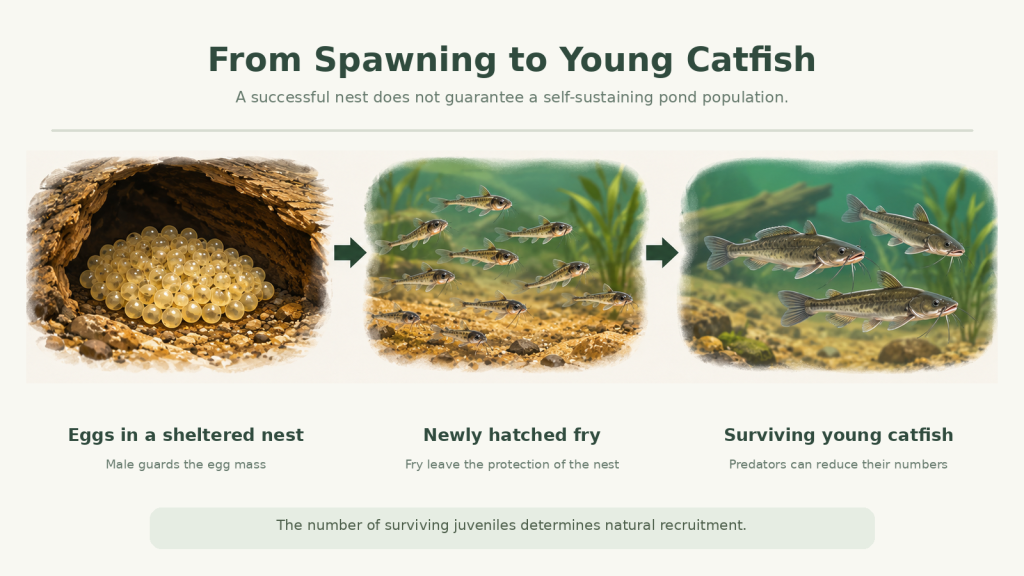
Even if the fish manage to spawn, there is another problem: survival.
Young catfish are vulnerable to predation, especially in ponds containing established populations of bass and bluegill.
This explains why a pond can support large channel catfish for years without producing noticeable numbers of smaller, naturally born fish.
For pond owners and anglers, the important distinction is between three separate events:
- Adult catfish successfully spawning.
- Eggs hatching into young catfish.
- Young catfish surviving to become established members of the population.
One event does not guarantee the next.
Why Catfish Often Fail to Reproduce in Ponds
There are several reasons why a pond containing healthy adult catfish may not develop a self-sustaining population.
1. Not Enough Suitable Nesting Locations
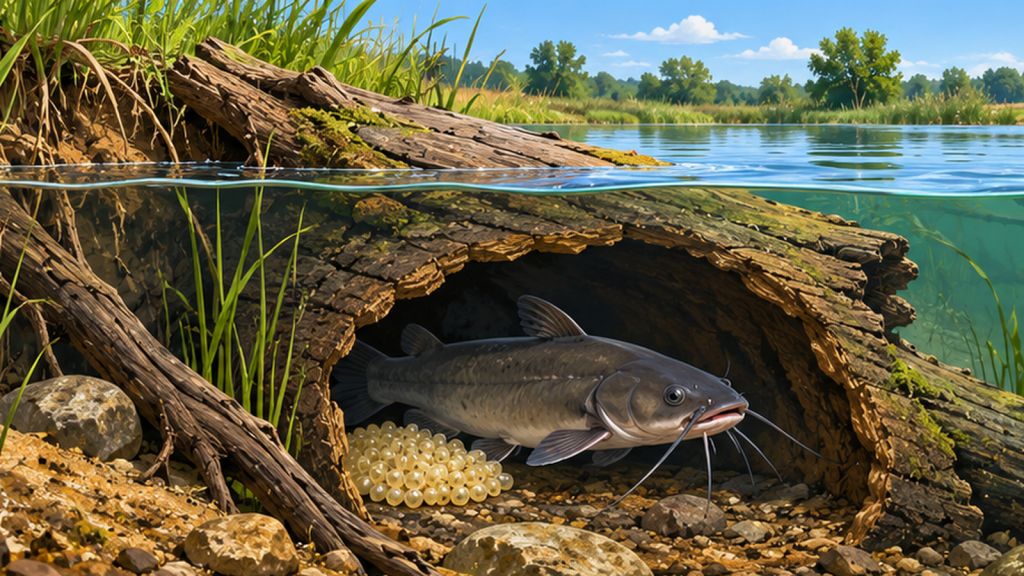
Channel catfish are cavity spawners.
Rather than depositing eggs across an open gravel bed like some other freshwater fish, they generally seek an enclosed location that provides protection.
Natural nesting locations include hollow logs, undercut banks, submerged cavities, and spaces between large rocks.
A pond with a smooth, featureless bottom may provide few of these opportunities.
That is particularly common in recently constructed or heavily managed ponds where submerged timber and other structures have been removed.
The absence of nesting cavities can prevent catfish from reproducing successfully even when everything else appears suitable.
2. Predators Eat the Eggs and Young Fish
Predation is another major obstacle.
Bluegill and other small fish may consume exposed eggs or newly hatched catfish, while largemouth bass can prey on juvenile catfish after they leave the nest.
Male channel catfish guard their nests, but they cannot protect their offspring indefinitely.
Once young fish disperse into the pond, they face the same dangers as other small fish.
In a pond containing a well-established bass population, relatively few young channel catfish may survive to adulthood.
This is one reason pond management recommendations frequently include periodic channel catfish restocking.
3. The Catfish May Not Be Mature Enough
A pond stocked with small catfish may contain no fish capable of reproducing during its first few years.
Channel catfish generally require several growing seasons to reach reliable reproductive maturity, although this depends on growth conditions.
Warmer climates and productive ponds can support faster development than colder waters.
A pond full of young, healthy catfish is therefore not necessarily a pond ready for spawning.
4. Poor Water Quality or Unfavorable Conditions
Suitable habitat is essential, but water quality still matters.
Catfish need adequate dissolved oxygen and conditions that support normal reproductive development.
Extremely low oxygen, severe temperature fluctuations, and other environmental stressors can interfere with reproduction and reduce survival.
A pond that supports adult catfish under ordinary conditions may still provide poor conditions for developing eggs or young fish during stressful periods.
What Conditions Do Catfish Need to Spawn in Ponds?
Successful channel catfish reproduction depends on several conditions occurring together.
Warm water provides the seasonal trigger, while suitable habitat and the presence of mature fish make spawning possible.
Catfish Spawning Conditions Table
| Factor | Favorable Condition | Why It Matters |
|---|---|---|
| Water temperature | Generally above 70°F (21°C), with spawning often beginning around 72–75°F | Encourages reproductive activity |
| Season | Spring to early summer, depending on location | Provides suitable seasonal conditions |
| Nesting habitat | Hollow logs, cavities, undercut banks, protected structures | Offers shelter for eggs |
| Water quality | Adequate oxygen and stable conditions | Supports developing eggs and young fish |
| Mature fish | Reproductively mature males and females | Both are required for spawning |
| Predation | Lower losses of eggs and fry | Improves the chances of recruitment |
| Population balance | Appropriate fish numbers and management | Helps avoid overcrowding and poor reproduction |
These are favorable conditions, not a guarantee.
A pond may meet most of them and still produce few surviving young catfish.
The availability of protected cavities and the survival of newly hatched fish are particularly important.
When Do Catfish Spawn in Ponds?
Channel catfish generally reproduce during spring and early summer as water temperatures rise.
In many parts of the United States, spawning occurs between April and July, although local temperatures and latitude influence the timing.
Water temperature is a more useful indicator than the calendar.
According to the U.S. Fish and Wildlife Service, channel catfish commonly begin spawning when water temperatures reach approximately 72–73°F (22–23°C).
Mississippi State University Extension describes spawning beginning once pond water consistently warms to around 75°F (24°C).
These figures are not contradictory. They reflect variation between populations, local conditions, and managed production systems.
Why Water Temperature Matters More Than the Month
Two ponds located relatively close together may warm at different rates.
A shallow pond exposed to plenty of sunlight can warm faster than a deeper pond surrounded by trees.
Cold inflows, weather patterns, pond depth, and seasonal temperature changes can all influence the timing.
A few unusually warm afternoons do not necessarily trigger spawning.
A sustained warming trend is more meaningful.
If you are trying to understand spawning activity in a particular pond, recording water temperatures over several weeks will usually tell you more than relying on a fixed date.
Where Do Catfish Lay Their Eggs in a Pond?
Channel catfish usually choose enclosed or partially enclosed nesting locations.
These areas provide a sheltered place for the female to deposit eggs and allow the male to defend the nest afterward.
Potential nesting sites include:
- Hollow or submerged logs.
- Cavities beneath large rocks.
- Undercut shoreline banks.
- Openings within submerged root systems.
- Protected spaces in substantial artificial structures.
A suitable nesting cavity generally provides some degree of overhead protection and a limited entrance.
This is different from the shallow, exposed spawning beds commonly associated with bass and bluegill.
Channel catfish do not normally need a broad, open gravel bed to reproduce.
They need somewhere that allows the eggs to remain protected.
The precise depth varies with the pond and nesting location. There is no single depth that every spawning catfish uses.
An enclosed cavity in somewhat deeper water can be more useful than an exposed area close to shore.
What Happens After Catfish Lay Their Eggs?
Once a female channel catfish deposits her eggs, the male takes over much of the parental care.
The eggs form an adhesive mass within the nest.
The male guards the nesting area and moves water around the eggs with his fins, helping maintain suitable conditions during development.
Under favorable temperatures, channel catfish eggs commonly hatch in approximately five to eight days.
After hatching, the young fish initially rely on their yolk sacs for nourishment.
They remain vulnerable throughout this period, especially if the nesting cavity is disturbed or predators gain access.
As the young fish develop and begin swimming and feeding independently, they gradually move away from the protected nest.
This is when survival becomes especially uncertain.
Even a successful nest containing thousands of eggs may contribute relatively few fish to the adult pond population.
Why Spawning Does Not Guarantee a Growing Catfish Population
Imagine a stocked pond containing several mature male and female channel catfish.
The fish find suitable nesting cavities, and multiple successful spawning events occur during early summer.
That sounds like the beginning of a self-sustaining population.
However, the pond also contains numerous bluegill and largemouth bass.
Some eggs may be eaten, and many young catfish may disappear through predation after leaving their nests.
By the following season, only a small proportion of the original offspring may remain.
The adult catfish successfully reproduced, but the number of surviving young fish may be too low to replace adults removed through harvesting or natural mortality.
This is why observing spawning is not enough to establish that a pond has a sustainable breeding population.
Do All Catfish Species Reproduce in Ponds?
Not every catfish species behaves identically, and this is important when discussing pond reproduction.
Channel Catfish
Channel catfish are one of the most commonly stocked catfish species in North American recreational ponds.
They can reproduce naturally but often struggle to establish strong populations of offspring without suitable habitat and favorable survival conditions.
Many managed ponds depend on periodic stocking rather than natural recruitment.
Bullhead Catfish
Bullheads are also members of the catfish family, but their behavior and pond management implications are different.
They can reproduce successfully in ponds and sometimes develop very large populations.
In smaller ponds, excessive bullhead numbers may contribute to overcrowding, poor growth, and reduced water clarity.
Therefore, the statement that “catfish do not reproduce in ponds” is especially misleading when applied to bullheads.
Blue and Flathead Catfish
Blue and flathead catfish are generally associated with larger waters, although their presence in ponds depends on the specific fishery and stocking history.
Both have reproductive behaviors involving nesting and protection of offspring.
However, recommendations developed for channel catfish ponds should not automatically be applied to these species.
For most privately stocked fishing ponds, channel catfish are the most relevant species to consider.
How Can You Tell If Catfish Are Reproducing in Your Pond?
Determining whether catfish are reproducing naturally can be surprisingly difficult.
Adult fish becoming active around the shoreline during summer is not reliable proof of spawning.
Similarly, catching a small catfish does not automatically mean that it was born in the pond.
A fish may simply be an individual from a previous stocking event.
More useful evidence includes regularly observing very small juvenile catfish in a pond that has not received recent fingerling stockings.
Repeatedly finding different sizes of young fish over several seasons can provide stronger evidence of natural recruitment.
However, identifying the fish correctly is essential. Small bullheads and channel catfish can be confused, especially by inexperienced observers.
If you manage a pond and want to know whether natural reproduction is occurring, keep records of:
- When catfish were stocked and their approximate size.
- How many fish have been harvested.
- Whether small juvenile catfish appear in subsequent years.
- Any major changes in predator populations or nesting habitat.
These records can reveal patterns that would otherwise be difficult to recognize.
A local fisheries biologist can also help assess whether reproduction and recruitment are occurring.
Should You Add Spawning Structures to a Catfish Pond?
Adding suitable nesting structures can encourage channel catfish spawning in ponds where natural cavities are limited.
Fisheries agencies have documented the use of structures such as large pipes, enclosed boxes, and specially designed spawning containers.
The principle is straightforward.
Channel catfish are attracted to protected cavities where they can deposit eggs and defend them.
An appropriately positioned artificial cavity can provide a similar function to a submerged log or natural bank opening.
However, there is an important management consideration.
More spawning is not always better for a managed fishing pond.
If your goal is to maintain a predictable population of large, harvestable channel catfish, encouraging unrestricted reproduction may not be necessary or desirable.
In some ponds, naturally produced young fish survive poorly anyway.
In others, particularly catfish-only ponds with suitable habitat, excessive recruitment could eventually increase competition for food and contribute to overcrowding.
This is why pond management should begin with a clear objective.
If you want a naturally reproducing catfish population, suitable nesting habitat may be beneficial.
If you want to maintain a controlled number of adult fish for recreational fishing, planned restocking may be the more practical option.
Do not add artificial structures indiscriminately. Their design and placement should be appropriate for the pond, and advice from a local fisheries professional is preferable to experimenting with unsuitable materials.
What Does Catfish Spawning Mean for Pond Fishing?
For anglers, pond catfish spawning can affect where fish spend their time and how consistently they feed.
Before spawning, warming water can encourage increased activity and movement.
During active spawning, mature fish may spend more time around protected nesting habitat.
Male fish guarding nests are not necessarily following the same feeding patterns they used earlier in the season.
That can make fishing temporarily less predictable.
However, not every catfish in the pond will be spawning simultaneously.
Young fish, non-spawning adults, and individuals that have already completed spawning may continue feeding.
If fishing slows during early summer, spawning is one possible explanation, but it should not automatically be blamed for every unsuccessful session.
Water temperature, oxygen conditions, bait availability, and changing fish locations also matter.
For practical advice on finding fish and choosing productive locations, see the FishingChief guide to fishing tips for catfish.
If channel catfish are the target, catfishing with stink bait also covers a simple bait approach that can be effective in stocked ponds.
Frequently Asked Questions
Will channel catfish reproduce in a small pond?
Yes, channel catfish can reproduce in small ponds if mature males and females have suitable nesting habitat and environmental conditions. However, successful reproduction does not guarantee that enough young fish will survive to maintain the population.
Do stocked catfish reproduce naturally?
Stocked channel catfish are capable of natural reproduction once they reach maturity. Many stocked ponds still require periodic restocking because nesting habitat is limited or predation prevents enough young fish from surviving.
What temperature do catfish spawn in ponds?
Channel catfish commonly begin spawning once water temperatures reach approximately 70–75°F (21–24°C), although timing varies. A consistently warming pond is more likely to support spawning than one experiencing brief warm periods followed by cold conditions.
Do catfish need running water to reproduce?
No. Channel catfish can reproduce in still-water environments, including ponds. Suitable nesting cavities, water quality, and seasonal temperature conditions are more important than having flowing water.
How long does it take for catfish eggs to hatch?
Channel catfish eggs commonly hatch in approximately five to eight days under favorable incubation conditions. The exact time depends on water temperature and other environmental factors.
Can catfish overpopulate a pond?
Yes, some catfish populations can become excessive, particularly bullheads and channel catfish in ponds where reproduction and juvenile survival are high. Poor population balance can contribute to competition, reduced growth, and management problems.
Final Takeaway
So, do catfish spawn in ponds?
Yes. Channel catfish are fully capable of reproducing in ponds, but spawning successfully is only the beginning.
Suitable nesting cavities, mature fish, and warm water make reproduction possible. Predator pressure and juvenile survival determine whether that reproduction contributes meaningfully to the pond’s population.
For anglers, the most important lesson is that a pond containing adult catfish does not necessarily contain a naturally reproducing population.
For pond owners, understanding that difference is essential before deciding whether to encourage spawning or rely on periodic restocking.