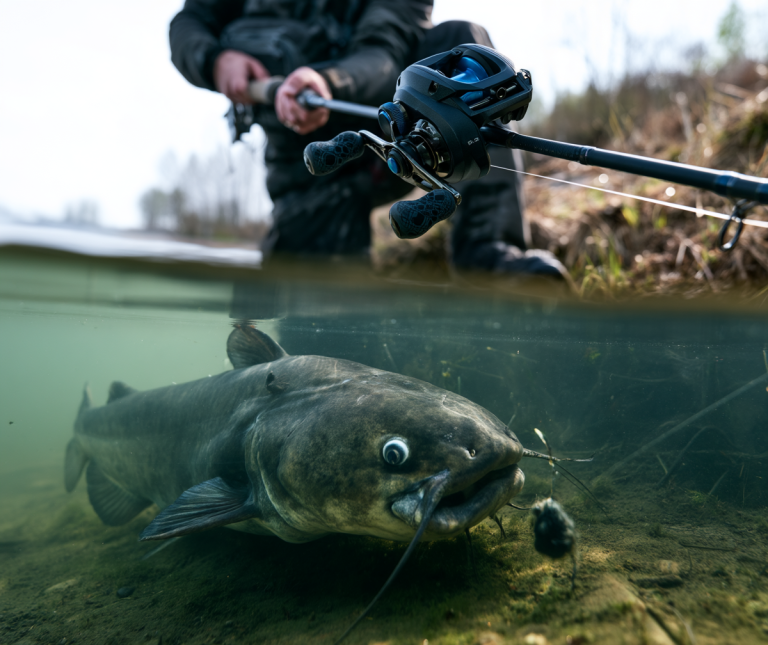
If you’ve ever landed a catfish and heard a croak, squeak, grunt, or strange grinding sound, the obvious question is: why do catfish make noise?
The sound can be surprisingly loud when the fish is out of the water. It may even seem as though the catfish is somehow vocalizing.
In many cases, however, the sound is not coming from the mouth at all.
Catfish have developed several ways of producing sound, and one of the best studied involves the large spine at the front of the pectoral fin. Movement at the base of that spine can create a rapid series of audible pulses.
That also helps explain why anglers so often hear the noise immediately after catching a fish.
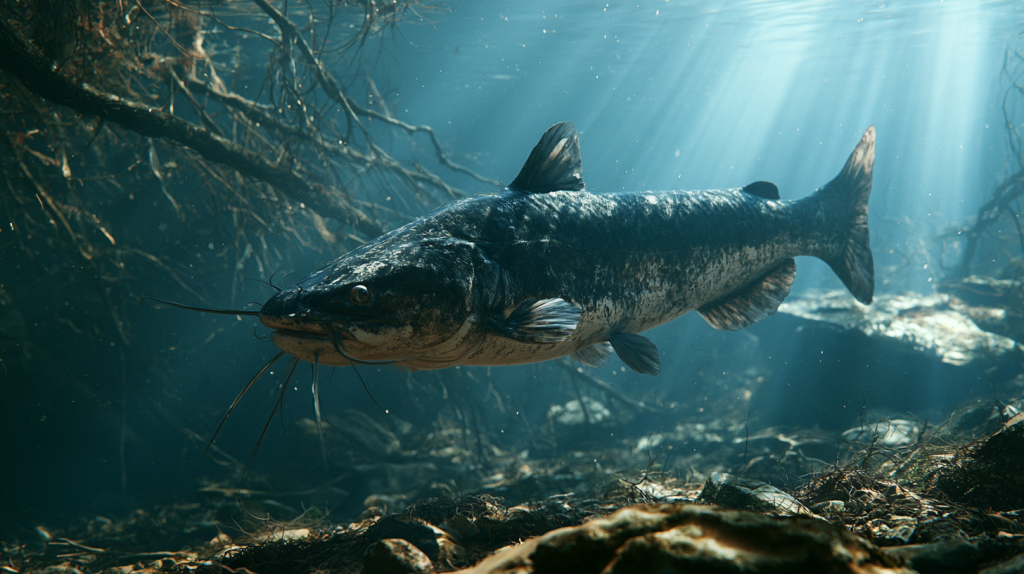
Why Do Catfish Make Noise When Caught?
Landing a catfish creates exactly the type of situation in which sound production is commonly noticed.
The fish has suddenly been removed from its normal environment, restrained by a net or angler, and prevented from swimming away.
Many catfish also spread and lock their pectoral spines when disturbed.
Sound production can happen at the same time.
Blue catfish research has recorded pectoral-spine sounds when fish were attacked or held, describing them in a disturbance or distress context.
With channel catfish, researchers have also observed sound-producing pectoral movements during encounters with predators.
That makes disturbance and defensive behavior a much better explanation for the croaking sound heard on the bank than the common idea that the fish is simply “complaining.”
It is important not to push that interpretation too far.
A sound does not allow an angler to determine exactly what a fish is experiencing. It simply tells us that sound production can form part of the catfish’s behavioral response to a disturbing situation.
How Do Catfish Make Noise?
The mechanism varies between different groups of catfish, but the one most relevant to many freshwater anglers is called stridulation.
Stridulation sounds complicated.
The basic idea is not.
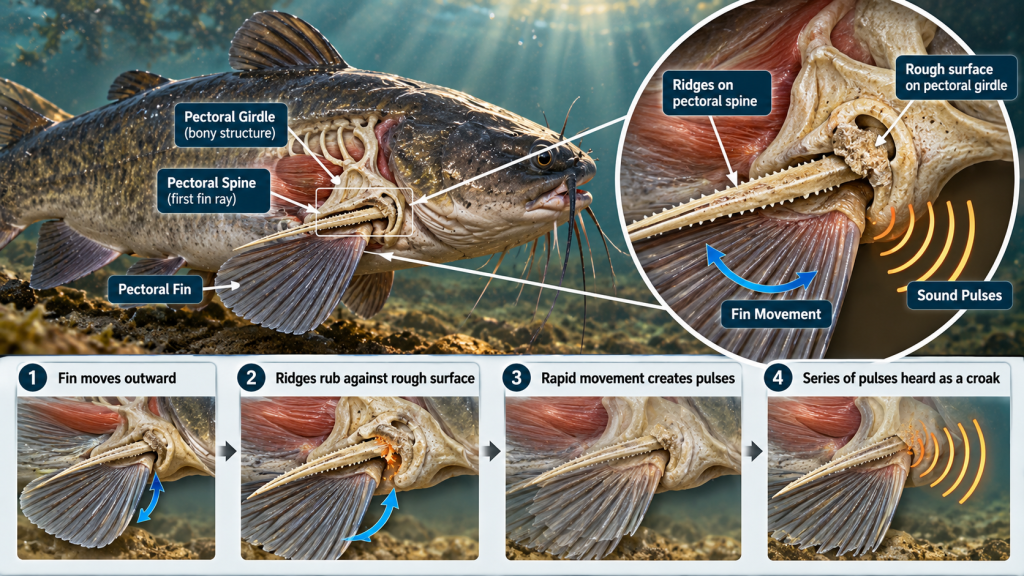
Pectoral Spine Stridulation
Look at the large fin immediately behind a catfish’s head on either side of its body.
That is the pectoral fin.
The first ray of the fin is modified into a strong spine. At its base are specialized surfaces that interact with the catfish’s pectoral girdle—the bony structure supporting the fin.
When the fish moves the spine, ridged surfaces at its base can rub against a rough surface in the girdle.
That mechanical contact creates sound.
Research on channel catfish found that the noise consists of a rapid series of pulses produced while the pectoral fin is moved outward.
To a person standing beside the fish, those pulses can merge into something that sounds like:
- a croak;
- a squeak;
- a grunt;
- a short grinding noise;
- or a series of clicks.
The catfish does not need to open its mouth to make it happen.
Some Catfish Can Make Sound Another Way
Pectoral stridulation is not the only mechanism found across catfish.
Some species can also produce lower-frequency sounds using specialized muscles or structures that cause the swim bladder to vibrate.
This is often described as drumming.
Researchers studying thorny catfishes and several other groups have recorded both pectoral stridulation and swim-bladder-related sounds.
That is why statements such as “catfish make noise by rubbing their fins” are useful as a starting point but should not be treated as a rule covering every species.
Catfish are an enormous and diverse group of fishes.
Their sound-producing equipment is diverse too.
What Sound Does a Catfish Make?
There is no single universal catfish noise.
What a person hears depends on the species, fish size, sound-producing mechanism, environment, and behavior.
| What You Hear | What May Be Happening | Typical Situation |
|---|---|---|
| Croak or squeak | Pectoral spine stridulation | Fish has been caught, restrained or disturbed |
| Rapid clicking or grinding pulses | Repeated movement of the pectoral spine | Defensive or disturbance behavior |
| Lower grunt or drumming sound | Swim-bladder-related sound production in species capable of it | Disturbance or communication depending on species |
| No audible noise | Fish is simply not producing sound | Completely normal |
The important part is that words such as croak, grunt, and squeak describe what the noise resembles to us.
They are not separate biological categories with one fixed meaning.
Why Does Moving the Pectoral Spine Make So Much Noise?
The movement involved in stridulation is more specialized than simply waving a fin through the water.
Studies using high-speed recording have shown that catfish can move the spine in short, rapid jerks.
Each movement can generate a pulse.
A sequence of those pulses creates the rough croaking or squeaking sound an angler hears.
The size of the fish can also affect characteristics of the sound.
Research on blue catfish, for example, found differences in pulse characteristics as fish grew.
So two catfish do not necessarily need to sound identical even when using the same general mechanism.
There is another strange detail.
Channel catfish can produce the sound using either pectoral fin, but research has found that some individuals show a preference for one side.
Among fish that showed a preference in one study, the right pectoral fin was overwhelmingly favored.
Interesting—but probably not something that will help choose tomorrow’s bait.
Is a Croaking Catfish Warning You About Its Spines?
Possibly not in the simple way people often assume.
The pectoral spine itself certainly has an important defensive function.
A catfish can spread and lock its strong spines, making the fish more difficult for a predator to swallow.
It is therefore tempting to assume that the sound acts as an audible warning telling a predator to stay away.
Experiments with channel catfish and largemouth bass found a more complicated picture.
The spines made catfish harder for bass to consume, but researchers did not find evidence that the stridulation sound prevented the initial attack. The authors suggested that the sound could instead function as a distress call, while acknowledging that its precise biological role is more complicated than a simple warning signal.
For an angler, there is no need to decide what message the fish is trying to send.
The useful lesson is simply that sound production and defensive pectoral-spine movement can occur together.
Does Catfish Noise Mean the Fish Is Hurt?
Not necessarily.
A catfish producing sound after capture does not by itself prove that it has been injured.
Sound production has been recorded in healthy fish during handling and disturbance experiments.
At the same time, that is not a reason to keep provoking the fish simply to make it croak.
Once the fish is landed, normal fish-care principles still apply:
- prepare tools before handling the fish;
- keep unnecessary handling to a minimum;
- be careful around the dorsal and pectoral spines;
- support the fish appropriately;
- remove the hook efficiently;
- and return a fish promptly when it is being released.
The interesting noise is secondary to safe handling.
Be Careful Around a Catfish That Is Croaking
There is a practical connection between the noise and something anglers should actually pay attention to.
The sound-producing pectoral spine is also a strong, pointed structure.
When a catfish becomes active on the bank, those spines can suddenly change position.
A small catfish can be particularly awkward because the angler’s hand naturally ends up close to several sharp spines at once.
Do not assume that a smaller fish cannot cause a painful puncture.
Control the fish without squeezing blindly around the bases of the fins, and pay attention to where the pectoral and dorsal spines are before removing the hook.
The strange croaking noise may be interesting.
The sharp object producing part of it deserves more immediate attention.
Does Catfish Noise Tell You Anything Useful About Fishing?
Usually, not much.
A catfish making noise after being caught tells you far more about what the fish is doing after capture than about why it took the bait.
It does not mean a particular bait attracted the fish because of sound, that the entire school is feeding aggressively, or that noisy catfish are easier to catch.
If the goal is to understand where to find fish, what bait to use, and how to present it, the broader fishing tips for catfish are much more useful.
Treat the croak as an interesting piece of catfish biology rather than a secret bite indicator.
Common Myths About Catfish Sounds
“The catfish is purring”
It may sound surprisingly similar.
But the mechanism is completely different from a cat purring.
A pectoral stridulation sound is created mechanically around the fin and pectoral girdle.
“The noise comes from the catfish’s mouth”
Not necessarily.
The familiar croak or squeak produced by channel catfish originates from movement of the pectoral spine, not from vocal cords in the throat.
“Every catfish makes the same noise”
No.
Catfish species differ considerably.
Some rely on pectoral stridulation, some possess additional sound-producing mechanisms, and the sounds themselves vary.
“A loud croak means the fish is injured”
The noise alone does not establish that.
Sound production commonly occurs in disturbance situations and can be generated by normal movement of the pectoral sound-producing mechanism.
Frequently Asked Questions
Why does a catfish croak when you catch it?
The fish is being disturbed and may move its pectoral spines as part of its response. In species such as channel catfish, those movements can create a series of sound pulses through pectoral stridulation.
What sound does a catfish make?
Depending on the species and mechanism, catfish sounds may be described as croaks, squeaks, grunts, clicks, grinding noises, or drumming sounds.
Do catfish make noise with their mouths?
The common croaking sound of channel catfish is not produced by the mouth. It comes from mechanical interaction between the pectoral spine and pectoral girdle.
Do all catfish make noise?
No single sound-producing mechanism applies to every catfish. Sound production and the structures used to create it differ between families and species.
Can catfish make noise underwater?
Yes. Catfish sound production is not simply something that happens once a fish reaches the bank. Researchers have recorded catfish sounds underwater as well as during handling.
Final Takeaway
So, why do catfish make noise?
In many of the catfish anglers encounter, the croaking or squeaking sound comes from movement of the pectoral spine. Specialized surfaces at the base of the spine interact with the pectoral girdle and generate a rapid series of sound pulses.
Anglers commonly notice it after a fish has been caught because sound production is associated with disturbance and defensive behavior.
Enjoy the strange noise, but do not overinterpret it.
The important practical detail is simpler: when a catfish starts croaking and spreading its fins, pay attention to the sharp pectoral spines and handle the fish efficiently and carefully.