Choosing the wrong fishing line can make walleye jigging unnecessarily difficult. A line that is too thick may reduce casting distance and create extra drag in current, while a line that is too light can lead to breakoffs around rocks and submerged structure.
If you’re wondering what pound test for walleye jigging works best, the answer depends on the type of line, the water you’re fishing, and how you’re presenting the jig.
For most situations, 10-pound braided mainline with a 6–10-pound fluorocarbon leader is an excellent starting point. However, anglers using straight monofilament or fluorocarbon can also catch plenty of walleye with lighter setups.
The goal isn’t simply to use the strongest line available. It’s to find a balance between sensitivity, manageable diameter, abrasion resistance, and the natural movement of your jig.
What Pound Test for Walleye Jigging Works Best?
For most everyday walleye jigging, a 10-pound braided mainline paired with an 8-pound fluorocarbon leader is a dependable starting combination.
It’s strong enough for ordinary walleye fishing, thin enough for many light presentations, and sensitive enough to transmit subtle changes in tension.
The braided mainline provides direct contact with the jig, while the fluorocarbon leader adds abrasion resistance near the lure and is generally less visually conspicuous underwater.
However, that combination isn’t necessary for every situation.
Anglers working small jigs in shallow, relatively snag-free water may prefer 6-pound monofilament. Someone vertically jigging in deeper water could benefit more from thin braid and a slightly heavier leader.
The following recommendations provide practical starting points rather than strict rules.
| Fishing Situation | Mainline | Leader | Why It Works |
|---|---|---|---|
| General walleye jigging | 10 lb braid | 8 lb fluorocarbon | Good balance of sensitivity and strength |
| Shallow, clear, open water | 6–8 lb mono or fluorocarbon | Usually unnecessary | Simple, light presentation |
| Deep vertical jigging | 8–12 lb braid | 8–10 lb fluorocarbon | Thin diameter and better contact at depth |
| Rivers with moderate current | 10 lb braid | 8–12 lb fluorocarbon | Helps control line bow and protect against abrasion |
| Rocky bottom or frequent snags | 10–15 lb braid | 10–12 lb fluorocarbon | Extra abrasion margin near structure |
| Light finesse jigging | 6–8 lb mono or fluorocarbon | Usually unnecessary | Suitable for small jigs in open water |
These are starting ranges. The right choice can also depend on the actual diameter and construction of the line, not just its labeled strength.
Why Line Strength Matters for Walleye Jigging
Walleye jigging depends heavily on maintaining contact with the lure.
Unlike steadily retrieving a crankbait, jigging involves lifting, lowering, pausing, and occasionally dragging a weighted lure along or close to the bottom.
A walleye might strike aggressively, but it can also pick up a jig without producing an obvious pull.
Your line affects how easily those changes can be detected.
Line Diameter and Water Resistance
Line diameter becomes particularly important when fishing deeper water or rivers.
As current moves against the line, it creates drag. A thicker line generally encounters more water resistance than a thinner line under otherwise similar conditions.
This can cause the line to bow away from the jig, making it harder to maintain direct contact.
The result may be difficulty detecting the bottom, controlling the jig, or recognizing subtle strikes.
Thin braided line can reduce that problem.
However, pound test and diameter are not interchangeable measurements. A 10-pound braid from one manufacturer may have a different diameter from another product with the same rated strength.
Compare actual diameter specifications rather than assuming every 10-pound line behaves identically.
If you’re unsure how different line strengths compare, our guide to braid to mono equivalent explains the relationship between breaking strength and line diameter.
Stretch and Bite Detection
Different fishing lines stretch differently under tension.
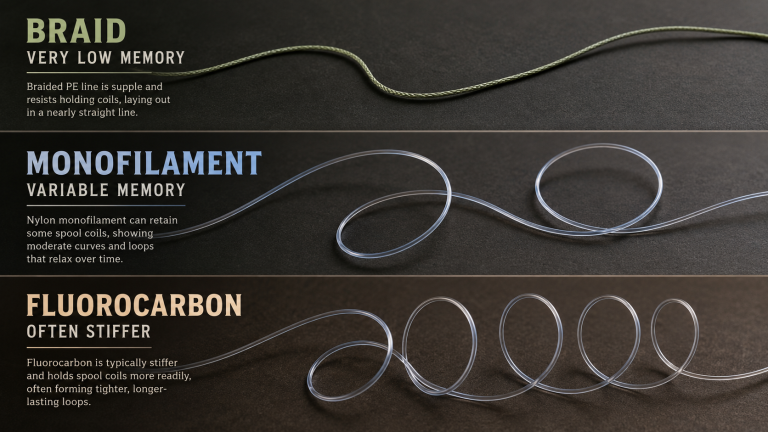
Braided line has very little stretch compared with typical monofilament, which helps transmit contact with rocks, gravel, and fish.
This is especially valuable when a jig is directly beneath a boat in deeper water.
Monofilament stretches more and can cushion sudden movements, potentially helping prevent hooks from pulling free.
Fluorocarbon varies by formulation and can provide a compromise between direct contact and some shock absorption.
None of these materials is automatically superior in every situation.
Abrasion Resistance
Walleye frequently occupy areas where anglers encounter rock, gravel, and other bottom structure.
Those features can damage fishing line.
Thin braid may transmit bites extremely well, but exposed rock edges can still abrade or cut it. Fluorocarbon leaders are commonly used to provide additional protection near the jig.
Even abrasion-resistant line must be checked regularly.
A slightly damaged 12-pound leader can be less reliable than a fresh, properly tied 8-pound leader.
Braid vs. Fluorocarbon vs. Monofilament for Walleye Jigging
Each line material has advantages worth considering.
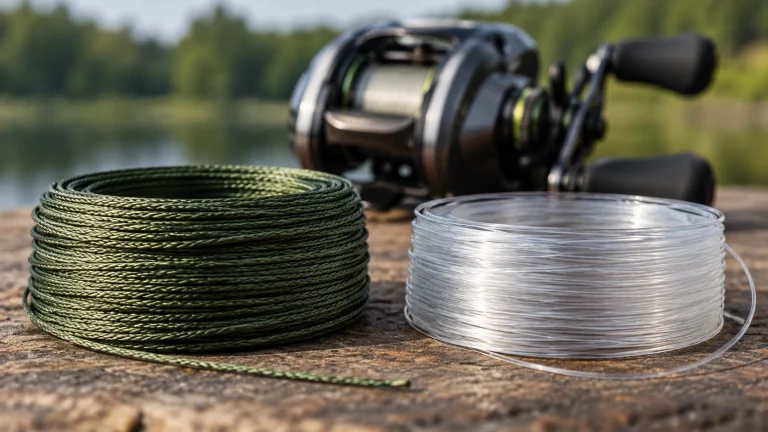
Braided Line: Best for Sensitivity and Deep Water
Braid is an excellent choice when maintaining contact with the jig is the main priority.
Its relatively thin diameter and low stretch make it particularly useful for:
- Vertical jigging in deeper water.
- Fishing rivers with moderate current.
- Detecting subtle bites.
- Casting small jigs over longer distances.
- Maintaining contact during wind-driven drifts.
For most ordinary walleye jigging, 8–12-pound braid offers enough versatility without making the setup unnecessarily heavy.
A 10-pound version is a sensible starting point.
Stronger braid isn’t always more useful. Moving to a substantially thicker line can increase water resistance and reduce the advantages of a finesse presentation.
Braid can also be unforgiving when combined with an overly stiff rod and tightly set drag.
A balanced rod and properly adjusted drag are important.
Fluorocarbon: A Useful Leader Material
Fluorocarbon is popular for walleye leaders because of its underwater optical properties and abrasion resistance.
It is not literally invisible to fish, despite common marketing claims.
However, it generally has a refractive index closer to water than nylon monofilament, helping reduce its visual contrast in many conditions.
A 6–10-pound fluorocarbon leader covers many standard walleye jigging situations.
Choose the lighter end when fishing small jigs in open, clear water.
Move toward 10–12 pounds when the jig regularly contacts rough rock, mussel-covered structure, or other abrasive surfaces.
A practical starting leader length is approximately 2–4 feet.
Longer leaders can be useful in exceptionally clear water, while shorter leaders may simplify some vertical presentations.
There is no universal leader length that produces the most bites.
Monofilament: Still a Good Choice
Monofilament is sometimes overlooked because braid has become so popular.
But mono remains a practical choice for walleye jigging, particularly in shallow water.
A 6–8-pound monofilament mainline can work well when casting smaller jigs or fishing relatively open areas.
Its additional stretch may help cushion sudden head shakes and aggressive hooksets.
Mono is also convenient because it allows a straightforward connection directly to the jig without requiring a separate leader.
The main disadvantages become more noticeable with increasing depth and distance.
Line stretch can make subtle bites harder to detect, while thicker line can produce additional drag in current.
For anglers fishing mostly shallow lakes, these drawbacks may be relatively minor.
How to Choose Walleye Jigging Line for Different Conditions
The same fishing line doesn’t necessarily behave equally well in every environment.
Before choosing pound test, consider water depth, current, bottom structure, and the size of your jig.
Shallow Water and Light Jigs
In shallow, relatively open water, heavy line is rarely necessary.
Small jig heads paired with minnows or soft plastics can be fished effectively on 6–8-pound monofilament or fluorocarbon.
For anglers who prefer braid, 8–10-pound mainline with a light fluorocarbon leader is another option.
The advantage of lighter line is that it generally allows small jigs to move without the additional resistance associated with thicker line.
However, going extremely light isn’t automatically better.
Four-pound line may have a place in specialized finesse situations, but it introduces a smaller margin for abrasion, damaged knots, and unexpected larger fish.
For general walleye fishing, 6 pounds is a more forgiving lower starting point.
Deep Water and Vertical Jigging
As depth increases, line diameter and stretch become more influential.
Vertical jigging is particularly sensitive to these factors because anglers need to recognize when the jig touches bottom, lifts away, or gets picked up by a fish.
A thin braided mainline in the 8–12-pound range is particularly useful here.
Pair it with an 8–10-pound fluorocarbon leader, adjusting for the roughness of the bottom.
The objective is to keep the line reasonably vertical and maintain controlled contact with the jig.
If strong wind or current continually pushes the line sideways, changing jig weight or boat positioning may matter more than increasing line strength.
Rivers and Moving Water
River jigging adds another variable: current constantly pushes against the line.
A relatively thin 10-pound braid is a sensible starting choice for moderate river current.
In areas with gravel and smooth bottom, an 8-pound fluorocarbon leader may be sufficient.
Where sharp rocks, submerged timber, and other abrasive structure are common, increasing the leader to 10 or 12 pounds can provide a useful margin.
Pay attention to the direction of the current and the position of the jig.
Even an excellent line setup becomes difficult to manage if the current creates excessive slack or carries the jig far from the intended fishing area.
Clear Water and Pressured Fish
In very clear water, some anglers prefer lighter leaders and more subtle presentations.
A 6–8-pound fluorocarbon leader may be appropriate when the area is relatively free of abrasive structure.
However, avoid assuming that every missed bite is caused by line visibility.
Jig size, fall speed, depth, lure movement, and fish activity can also influence whether a walleye strikes.
Change one variable at a time rather than immediately replacing all your line.
Rocks, Snags, and Larger Predators
Around abrasive structure, the leader often becomes the most important component.
An 8–12-pound fluorocarbon leader is a reasonable range, with heavier options reserved for particularly demanding conditions.
Remember that walleye fishing locations can also contain northern pike.
If pike are regularly encountered, a suitable bite-resistant leader may be needed to avoid bite-offs. Increasing fluorocarbon pound test slightly is not equivalent to using a reliable pike-resistant leader.
The correct setup depends on which predators are realistically present.
Does Jig Head Weight Affect Fishing Line Choice?
Jig head weight and fishing line should be considered together.
A small jig relies on relatively little weight to pull the line through the water. Heavy, thick line can make it harder to cast or maintain contact with that presentation.
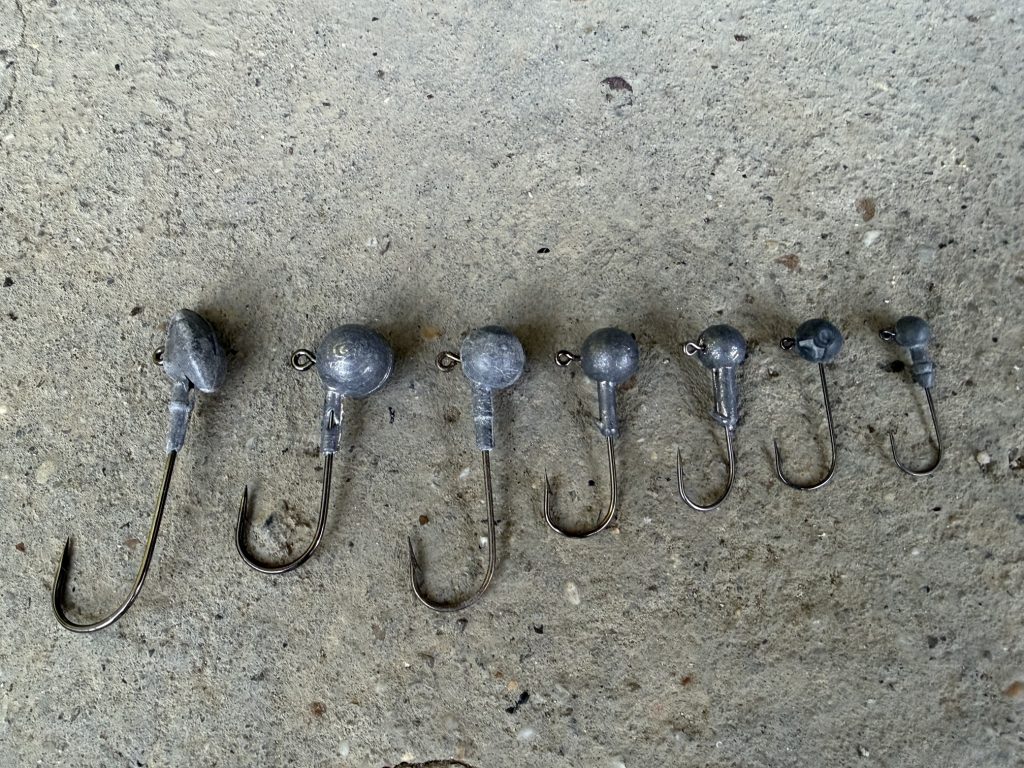
A larger jig head generally has an easier time maintaining tension against water resistance.
For example:
Light jigs around 1/16–1/8 oz: Often pair well with lighter line in shallow or calm conditions.
Medium jigs around 1/4 oz: Work with many general-purpose 8–10-pound braid setups.
Heavier jigs around 3/8–1/2 oz: Can help maintain contact in deeper water or moving current.
These aren’t strict combinations, and jig weight does not dictate line strength by itself.
A 1/4-ounce jig can work perfectly well on heavier braid when the diameter, depth, and conditions are suitable.
The more important principle is using the lightest jig that still provides reliable control and bottom contact for the technique being fished.
A jig that’s too light may drift unpredictably or make it difficult to feel the bottom.
One that’s unnecessarily heavy may fall faster than intended and become more likely to wedge into bottom structure.
The combination should allow the jig to reach the desired depth while still behaving naturally.
How to Set Up Braid and Fluorocarbon for Walleye Jigging
A braid-to-fluorocarbon setup doesn’t need to be complicated.
For a versatile starting arrangement:
- Spool a suitable spinning reel with 10-pound braided line, using backing if needed to prevent slipping.
- Cut approximately 2–4 feet of 8-pound fluorocarbon leader.
- Connect the lines with a carefully tied Alberto, FG, or double-uni knot.
- Tie the fluorocarbon directly to the jig head using a reliable knot appropriate for the line.
- Moisten and tighten knots according to the knot instructions, then test both connections.
- Set the reel drag so the line can release under excessive pressure rather than forcing the weakest connection to absorb everything.
The precise leader length isn’t critical for every technique.
Some anglers use shorter leaders to simplify vertical jigging. Others prefer longer leaders in clear water or when making extended casts.
Use a connection knot you can tie consistently.
A perfectly selected line combination is of little value if the joining knot regularly slips or weakens the line.
Check the final few inches of leader after contact with rocks or after landing a fish.
Damaged line should be cut back or replaced rather than trusted for another session.
Common Walleye Jigging Line Mistakes
Using Heavier Line Than Necessary
An oversized mainline can make light jigging more difficult without providing a meaningful advantage.
Using 20-pound braid for ordinary open-water walleye jigging isn’t automatically disastrous, but a thinner 10-pound line will often provide better handling for this technique.
Ignoring the Leader
A strong braided mainline doesn’t protect the last few inches of line from sharp rocks.
When repeated breakoffs occur near the jig, inspect the leader and its connection before assuming the entire mainline needs replacing.
Choosing Line Without Considering Jig Weight
A light jig that works beautifully with thin line may behave differently when attached to thicker tackle.
If bottom contact is inconsistent, consider the jig weight, line diameter, current, and casting angle together.
Setting the Drag Too Tight
Low-stretch braided line can transmit sudden force directly to hooks and knots.
The reel drag should provide a controlled release before excessive pressure damages the tackle.
Overlooking Rod Guide Damage
A damaged guide insert can quickly weaken any fishing line.
If braid repeatedly becomes fuzzy or monofilament develops unexplained damage, inspect the guides carefully.
A small chip can be difficult to see.
Our guide to identifying and repairing damaged rod guide inserts explains how to check them before more line is lost.
Frequently Asked Questions
Is 10 lb braid good for walleye jigging?
Yes. Ten-pound braided line is an excellent all-around option for many walleye jigging techniques. Its low stretch and relatively thin diameter make it particularly useful for detecting bites and maintaining contact in deeper water. Pair it with a suitable fluorocarbon leader.
Is 6 lb line too light for walleye?
Not necessarily. Six-pound monofilament or fluorocarbon can work well for light jigging in relatively open water. Around sharp rocks and heavy cover, a stronger leader or mainline may be more practical.
Should you use a fluorocarbon leader for walleye jigging?
A fluorocarbon leader is usually a useful addition when fishing braided mainline. It provides abrasion resistance near the jig and can reduce line visibility. When fishing straight mono or fluorocarbon, a separate leader is often unnecessary.
What color braid is best for walleye jigging?
Bright braid can make it easier for anglers to watch the line and detect subtle movements, particularly when jigging with slack line. Green and other subdued colors are also common. A fluorocarbon leader can separate the more visible braid from the jig.
Can you jig for walleye with straight fluorocarbon?
Yes. Straight fluorocarbon can be effective, particularly for finesse applications in clear water. Six- to eight-pound line is a reasonable starting range. However, some fluorocarbon lines are stiffer and harder to manage on spinning reels than braid or supple monofilament.
Is braided line better than mono for jigging?
Braid generally offers better direct contact because it stretches less and can have a considerably smaller diameter at a given breaking strength. Mono remains useful when a little stretch and a simpler setup are preferred, especially in shallower water.
Final Takeaway
For anglers asking what pound test for walleye jigging works best, 10-pound braid paired with an 8-pound fluorocarbon leader is a reliable starting point.
Lighter 6–8-pound setups work well in open, shallow water, while rocky bottoms and stronger current may justify a heavier leader.
Pay particular attention to line diameter and bottom contact. The right line isn’t necessarily the strongest one available—it’s the one that allows your jig to work naturally while providing enough strength for the conditions.