Knowing how to attach PVA bag rig to main line is straightforward once you understand which part of the setup actually makes the connection. The confusing part is that PVA bags can be fished in several ways, and not every bag system connects to the line in the same way.
A ready-made solid PVA bag may have a small loop or bag stem sticking out of the top. Another setup might use a conventional inline lead already attached to the main line, with the bag built around the lead and hooklink.
Both can work, but mixing components without understanding their purpose can create weak connections, casting problems, or unsafe rigs.
The important thing is to connect the main line to the proper rig component, not to the dissolvable PVA material itself.
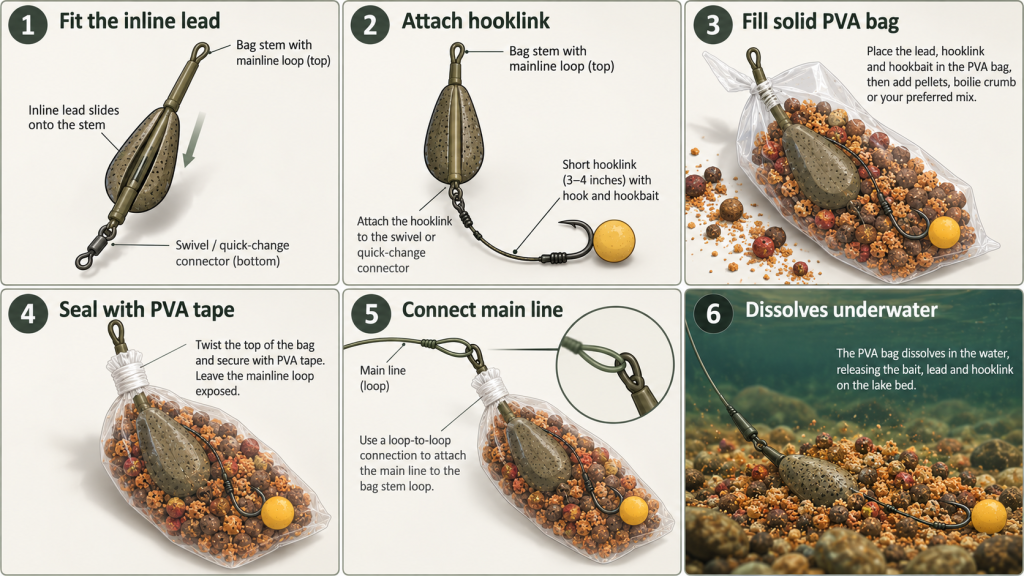
How Does a PVA Bag Rig Connect to the Main Line?
A PVA bag is not part of the permanent connection between your rod and the hook.
It is a temporary container that carries bait and, in the case of a typical solid-bag setup, also contains the lead and short hooklink. After the bag reaches the water, the PVA dissolves and releases its contents.
The fishing line, lead system, and hooklink remain in place.
That distinction is important because anglers sometimes think they need to tie the main line directly to the PVA bag.
They do not.
The connection is normally made through one of three arrangements:
- A PVA bag stem: A short, purpose-made component with a loop or eye at the upper end.
- A pre-tied leader: A complete section of rig material with a connection point designed to attach to the main line.
- A conventional inline lead system: The rig is already connected to the main line, and the solid bag is built around it.
The correct method depends on the equipment being used.
A bag stem designed for direct mainline attachment is particularly convenient when making several solid bags before a fishing session.
How to Attach PVA Bag Rig to Main Line Step by Step
For a beginner using solid PVA bags, a purpose-made bag stem is one of the easiest arrangements to understand.
It provides a connection point outside the bag while keeping the lead and short hooklink organized inside.
Step 1: Choose the Correct Bag Stem or Leader
Start by checking the connection system supplied with your PVA bag setup.
Some bag stems have a molded loop or eye at the top. Others use a short leader ending in a loop, while certain systems are designed to connect using a specific knot or connector.
Check whether the stem is intended for direct attachment to monofilament mainline or requires a particular leader arrangement.
This matters especially on fisheries that prohibit leadcore, shock leaders, or certain other leader materials.
A leader ban does not automatically mean that every PVA stem is permitted. The manufacturer’s instructions and the fishery’s rules should both be checked.
Step 2: Prepare the Lead and Hooklink
A typical solid PVA bag arrangement uses an inline lead and a relatively short, supple hooklink.
The hooklink attaches to the appropriate swivel or quick-change connection at the lead.
A short hooklink, commonly around 3–4 inches, is convenient because it folds neatly inside a small solid bag.
The exact length can vary with the hookbait, bag size, and presentation.
Make sure the hooklink is properly secured and any quick-change connector has its intended sleeve fitted.
Do not substitute random swivels or beads for parts of a manufacturer’s lead system. Different components may fit together physically without providing the intended lead-release behavior.
Step 3: Prepare the Solid PVA Bag
Place the hookbait and hooklink into the bag, then begin filling it with suitable dry bait.
Small pellets, boilie crumb, and appropriately prepared dry mixes are commonly used because they pack tightly around the rig.
Position the lead inside the bag as intended by the system, and continue filling until the contents are reasonably compact.
Leave the bag stem or leader’s upper connection point accessible.
This is essential if you want to connect a prepared bag to the main line afterward.
Twist and secure the top using the appropriate PVA tape or sealing method.
Avoid wetting the bag while preparing it. Even moisture transferred from your hands or wet bait can begin dissolving the material.
Step 4: Connect the Main Line to the Exposed Loop or Eye
This is the step that answers the central question.
Once the bag is prepared, identify the connection point sticking out of the top.
If the bag stem has an eye or loop designed to accept a knot, attach the main line using a suitable knot recommended for that connection.
A Palomar knot is one common option where the connector’s design and size allow it. A correctly tied grinner-style knot may also be suitable for compatible eyes or loops.
If using a Palomar knot with a prepared bag, remember that the entire bag must pass through the knot’s large loop. This can be inconvenient with bulky bags, so it may be easier to attach the stem before filling.
Alternatively, some PVA bag systems permit a loop-to-loop connection.
For that method:
- Tie a correctly formed loop in the end of the main line.
- Pass the mainline loop through the compatible loop on the bag stem.
- Pass the prepared bag through the mainline loop.
- Pull the loops together until the connection is properly seated.
This only works conveniently when the loops and bag stem have been designed or sized appropriately.
A large loop is not automatically the best option for every setup, especially when it creates a bulky connection that could interfere with the lead system.
Follow the manufacturer’s connection instructions rather than forcing a particular knot onto incompatible components.
Step 5: Inspect the Connection Before Casting
Before making the cast, check the complete arrangement.
The main line should connect securely to the stem or leader, the hooklink should be properly attached, and the lead should be seated exactly as intended.
Check that no loose line is wrapped around the bag.
Pay particular attention to any knots, sleeves, beads, or other components that could prevent the lead from releasing or moving safely after a mainline break.
Give the connection a firm, controlled pull to confirm that the knot is properly seated.
Only cast once you are confident the entire system is secure.
Can You Attach a PVA Bag Rig Without a Leader?
Yes. A solid PVA bag can be fished without a separate shock leader or leadcore leader, provided the chosen terminal tackle is designed for that arrangement.
A compatible bag stem can connect directly to the main line.
Another approach is to assemble a suitable inline lead arrangement directly on the main line and build the solid bag around it.
Neither method automatically requires a long leader.
This is useful on carp waters where shock leaders are prohibited.
However, eliminating a leader does not eliminate the need to consider casting strength.
A filled PVA bag can be considerably heavier than the lead alone, particularly when using larger bags packed with dense pellets.
The main line must be suitable for the total casting weight, the distance, and the conditions.
For more detail on choosing line strength, see this guide to what lb line for carp fishing.
What If Your Fishery Bans Shock Leaders?
First, check the exact wording of the rules.
Some fisheries prohibit shock leaders but allow certain short bag stems. Others also restrict leadcore, coated leaders, or particular forms of terminal tackle.
Do not assume that a short section of stronger line becomes acceptable simply because it is attached to a PVA bag.
Use a mainline and terminal arrangement that complies with the rules and is properly rated for casting the complete loaded bag.
If the required casting weight cannot be handled safely without a prohibited leader, reduce the bag size, shorten the cast, or use another permitted method.
The solution should never be to compromise line strength or fish safety.
Solid PVA Bags vs PVA Mesh: Does the Connection Change?
Yes, and this is one of the most common sources of confusion.
Solid bags and PVA mesh serve a similar purpose, but they are not necessarily attached in the same way.
A solid PVA bag often contains the lead, hooklink, hookbait, and loose feed together.
PVA mesh usually holds a separate parcel of bait, which can be attached to an otherwise conventional rig.
| Setup | Mainline Connection | Where the PVA Goes |
|---|---|---|
| Solid PVA bag with bag stem | Main line connects to the stem’s compatible eye or loop | Around the lead, hooklink, hookbait, and loose feed |
| Solid PVA bag with short leader | Main line connects to the leader using its specified connection | Around the lead and hooklink |
| Solid PVA bag built on main line | Main line is already connected to the inline lead system | Built around the lead, hooklink, and bait |
| PVA mesh bag | Normal rig remains connected to the main line | Separate bait parcel attached to the hook, hooklink, or compatible rig component |
The essential difference is that a PVA mesh bag generally does not need a special mainline connection.
For example, an angler fishing a conventional hair rig might attach a small mesh bag of pellets near the hookbait using PVA string or another suitable attachment method.
The mainline-to-rig connection remains unchanged.
With a solid bag, the arrangement is often more compact because the lead and hooklink are enclosed within the dissolvable bag itself.
Which Is Better for Beginners?
Neither is universally better.
Solid bags are useful when you want the hookbait and a concentrated amount of feed presented together in a compact package.
PVA mesh is convenient when you already have a reliable rig and simply want to introduce a small amount of bait around the hook.
If the main challenge is learning how to connect everything safely, PVA mesh can be easier to understand initially because it does not necessarily require changing the lead arrangement.
Common Mistakes When Connecting PVA Bag Rigs
Tying the Main Line to the PVA Material
The PVA itself is temporary.
It dissolves after contact with water, so it should never be relied on as the structural connection between the main line and hooklink.
Always connect to the intended stem, leader, swivel, or lead system.
Using Incompatible Terminal Tackle
A swivel that fits inside an inline lead does not necessarily form a safe lead system.
Some inline arrangements are designed to release the lead under particular conditions. Others allow the lead to slide free if the main line breaks.
Combining unrelated parts can prevent these systems from working.
Choose compatible components and follow the intended assembly instructions.
Making the Bag Too Heavy
Adding more pellets and groundbait may appear beneficial, but a heavier bag places additional stress on the main line and its connection during casting.
This becomes especially relevant when trying to cast farther without a shock leader.
Start with a compact bag and make sure your rod, line, and complete rig are suitable for the loaded weight.
Using a Weak or Poorly Seated Knot
Even a correctly chosen knot can fail if it is tied carelessly.
Dry friction, crossed turns, damaged line, or a loose knot can all weaken a connection.
Moisten the knot where appropriate, tighten it carefully, inspect it, and trim the tag end without cutting excessively close.
Allowing Moisture Into the Bag
PVA begins breaking down when exposed to water.
Wet hands, damp pellets, or certain water-based liquids can damage the bag before the cast.
Keep spare bags and prepared bait dry. When using liquid additives, check that they are specifically suitable for PVA.
Forgetting About Fish Safety
The most serious mistake is creating a setup that a carp cannot safely shed if the main line breaks.
A lead or leader that becomes permanently trapped can leave a fish towing dangerous tackle.
Use a properly designed fish-safe lead arrangement, paying particular attention to how the system behaves after line failure.
How to Check That Your PVA Bag Rig Is Ready to Cast
A useful final check takes only a few seconds:
- Is the main line attached to the correct connection point?
- Has the knot or loop connection been tested?
- Is the inline lead arranged correctly?
- Is the hooklink securely attached?
- Are the PVA contents compact and dry?
- Is the bag free from obvious tears?
- Can the lead system function safely if the main line breaks?
- Is the complete loaded bag within the safe limits of the tackle?
If anything looks questionable, rebuild the setup before casting.
An extra minute on the bank is preferable to losing a complete rig on the cast.
Frequently Asked Questions
Can you tie a PVA bag directly to the main line?
You can attach a solid PVA bag rig directly to the main line when it uses a compatible bag stem or inline lead system. However, the connection is made to the rig component, not the dissolvable PVA bag material itself.
What knot should you use for a PVA bag rig?
A Palomar knot or suitable grinner-style knot can work with compatible eyes or loops. Some systems also allow loop-to-loop attachment. The correct choice depends on the connection provided by the specific bag stem or leader.
Do you need a swivel for a PVA bag rig?
Many solid PVA bag arrangements use a swivel or quick-change connector between the hooklink and lead system. However, you should not add an unrelated swivel simply because one appears in another manufacturer’s setup.
Can you make PVA bags before going fishing?
Yes. Prepared solid PVA bags can be stored in a dry container and attached at the bank using a suitable bag stem or leader connection. Make sure the bait and bag remain dry during storage.
Can you use PVA bags with monofilament mainline?
Yes. Monofilament mainline can be used with compatible solid PVA bag systems. The important considerations are the line’s strength, the total loaded casting weight, knot security, and the safety of the complete arrangement.
Final Takeaway
Understanding how to attach PVA bag rig to main line comes down to identifying the correct connection point.
For ready-made solid bags, that is normally the exposed loop or eye on a compatible bag stem or leader. For bags built directly around an inline lead, the main line is already part of the rig before the bag is packed.
Choose compatible components, use a suitable knot or loop connection, and check that the lead system remains fish-safe.
A simple, properly connected PVA bag rig is far more valuable than a complicated arrangement that only looks secure.