A broken line clip might seem like a minor problem, but it can make an otherwise perfectly good fishing reel frustrating to use.
The small clip attached to a spinning reel’s spool serves two useful purposes. It keeps loose line under control when the reel is stored, and on suitable reels, it helps anglers return to a consistent casting distance.
Unfortunately, line clips can crack, become loose, lose their spring tension, or disappear entirely.
The good news is that fishing reel line clip replacement is possible on many reels, and a broken clip does not automatically mean buying a new spool.
However, not every reel uses the same attachment mechanism. Some clips are straightforward to replace, while others require model-specific parts or professional servicing.
Knowing which type you have is the first step toward getting it fixed without damaging the spool.
What Does a Fishing Reel Line Clip Actually Do?
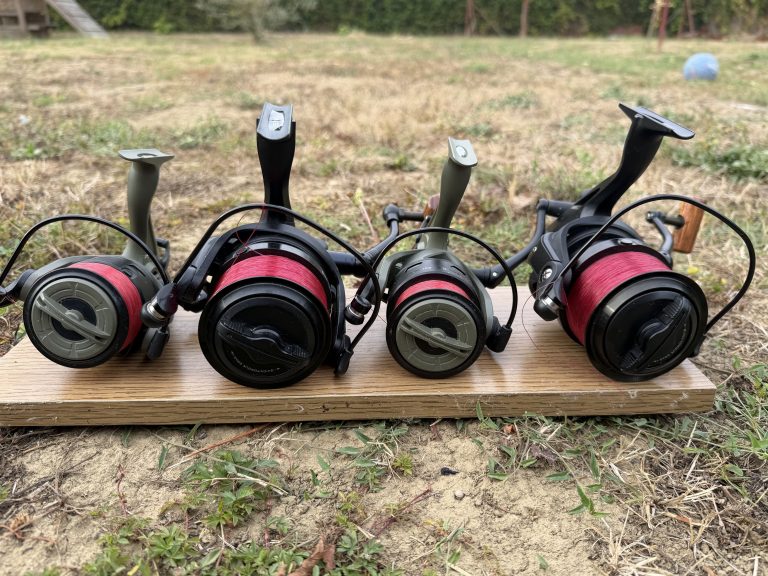
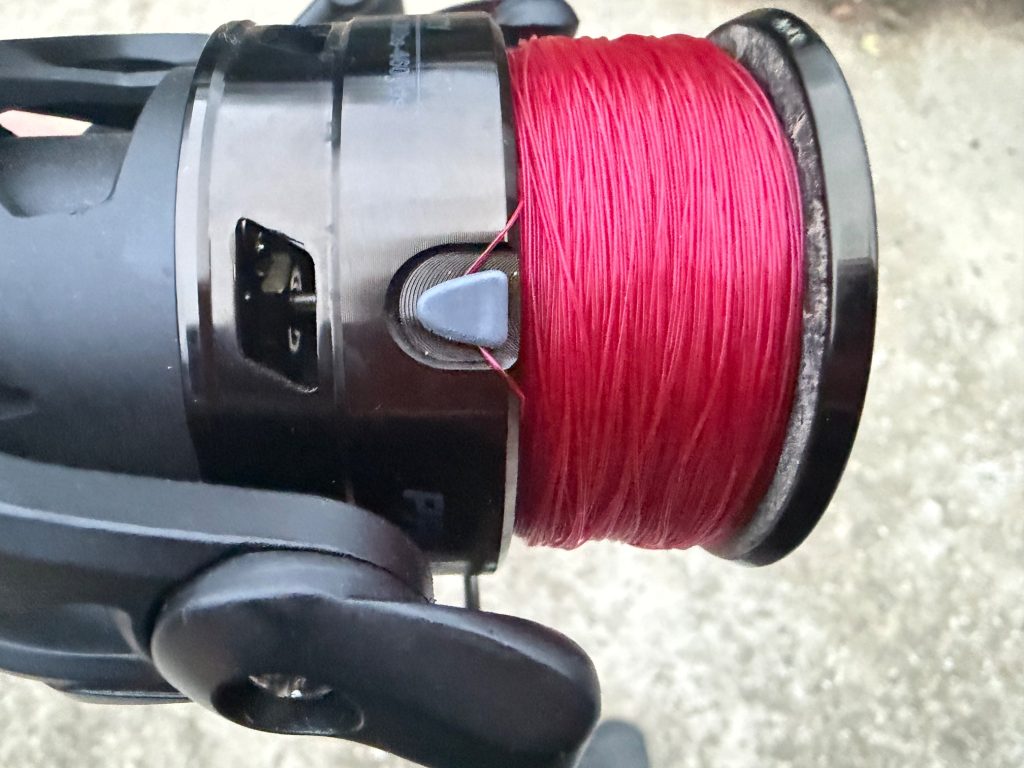
The line clip is a small fitting usually located on the outside of a spinning reel’s spool, commonly around its skirt.
It is designed to hold a section of fishing line in place.
Although small, it performs two distinct jobs.
Keeping Fishing Line Secure During Storage
When a fishing reel is not being used, the loose end of the line can unwind from the spool.
This creates loops that may become tangled, catch on other equipment, or develop into an annoying mess before the next fishing session.
The line clip provides a convenient place to secure the line.
Instead of wrapping the line around the reel handle or leaving it hanging loose, the angler can tuck it beneath the clip.
This is particularly useful when storing reels separately from their rods.
However, a damaged clip with sharp edges can cut or weaken the line. A smooth, properly fitted clip is important even when it is only used for storage.
Helping With Accurate Casting Distance
Line clips are also useful when repeatedly casting to the same fishing spot.
For example, an angler targeting carp or bream at a specific distance may measure the required casting range and use the line clip as a stopping point.
When the line reaches the clip during the cast, it stops paying out.
This technique is particularly common in feeder fishing and certain carp fishing applications.
However, there is an important distinction between controlling a cast and controlling a hooked fish.
A line clip is not a substitute for the reel’s drag system.
If a fish runs while the line remains trapped beneath a conventional clip, the line may break because the drag cannot release line normally.
Specialized clips and techniques may behave differently, but a standard spool clip should never be assumed to release safely under fishing pressure.
Fishing Reel Line Clip Replacement: What Can Actually Be Replaced?
Whether a line clip can be replaced depends primarily on how it is attached to the spool.
Different reels use different designs, and even models from the same manufacturer may have different components.
Fixed or Simple Plastic Line Clips
Some reels use relatively simple plastic or composite clips secured into the spool.
Depending on the design, the clip may be held by a small pin, retainer, or molded attachment.
A broken clip may be replaceable individually, but this is not guaranteed.
The important question is whether the clip was designed to be removed without damaging the spool.
A part that appears to be pressed into place should not automatically be treated as removable.
Forcing it out can enlarge the mounting hole or crack the surrounding material.
Spring-Loaded Line Clips
Many carp, feeder, and long-casting reels use spring-loaded line clips.
These allow limited movement when the line is placed underneath them.
Some designs contain several small components:
- The external line clip
- A small spring
- A retaining washer or spacer
- A retaining clip, sometimes an E-clip
The exact arrangement varies.
On certain reels, the components can be accessed from inside the spool and replaced using an appropriate repair kit.
Other models have more complicated retaining mechanisms that are not suitable for casual disassembly.
Integrated or Non-Serviceable Clips
Some spool designs do not offer a straightforward way to replace the clip separately.
The clip may be integrated into the spool structure, difficult to access, or unavailable as an individual spare part.
In these situations, replacing the complete spool may be the better option.
Before purchasing anything, consult the manufacturer’s reel schematic or contact an authorized service provider.
How to Tell Whether Your Reel Line Clip Is Broken
Not every clip that looks unusual is necessarily damaged.
Some clips are intentionally low-profile, while others have a more pronounced shape.
The most useful approach is to inspect the clip’s actual condition and operation.
Common Signs of Damage
A line clip may need attention if:
- Part of the plastic or metal clip has snapped off.
- The clip moves freely when it should remain secured.
- A spring-loaded clip no longer returns to its normal position.
- The line repeatedly slips out during ordinary storage.
- The clip has a sharp edge that catches or damages the line.
- The clip is completely missing from its mounting position.
If the clip still holds the line securely and has no visible damage, replacement may not be necessary.
However, an apparently functional clip should not be used if its edge has become sharp enough to damage line.
Quick Diagnosis Table
The following table can help determine the next step.
| Problem | Possible Cause | Recommended Action |
|---|---|---|
| Clip completely missing | Lost or broken attachment | Identify the reel model and order a compatible replacement |
| Plastic clip cracked | Impact, age, or excessive force | Replace the clip rather than gluing it |
| Spring-loaded clip stays loose | Damaged spring or retainer | Inspect the model-specific assembly |
| Clip catches or damages line | Sharp edge or deformation | Stop using it until repaired |
| Clip moves excessively | Loose or missing securing component | Check the schematic before disassembly |
| Spool cracked around clip | Structural damage | Consider replacing the complete spool |
| Clip holds line poorly | Wear, incorrect fit, or unsuitable line diameter | Check the clip condition and model specifications |
A loose clip does not always mean the spring is broken. The fault could also be a missing retainer, damaged mounting point, or an incorrect replacement part.
How to Replace a Fishing Reel Line Clip
The precise installation procedure depends on the reel model.
There is no universal method that safely applies to every spinning reel.
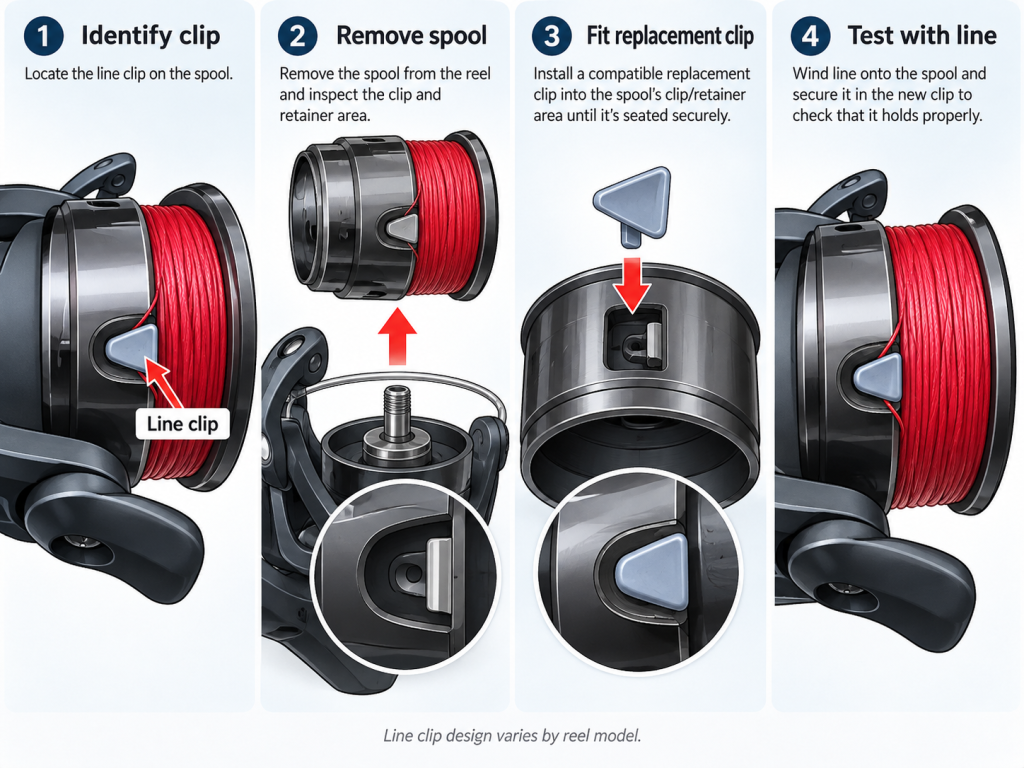
However, most successful replacements follow the same basic process: identify the mechanism, obtain the correct parts, remove the damaged components, and test the repaired clip.
Step 1: Identify Your Reel and Spool
Before touching the damaged clip, record the reel’s exact model information.
Check the reel body, spool, packaging, or manufacturer’s website.
Important details include:
- Manufacturer
- Model name
- Reel size
- Model generation or production year, when available
- Any spool-specific identification number
For example, knowing that a reel is a Shimano 6000 is not necessarily enough to identify the correct clip.
The precise model and spool version matter much more.
Reel sizes can also be misleading when comparing components. The differences between common sizes are explained in FishingChief’s 6000 vs 8000 reel comparison.
Step 2: Remove the Spool for Inspection
On many front-drag spinning reels, the spool can be removed by unscrewing the front drag knob and lifting the spool from its shaft.
Only follow this procedure if it matches the manufacturer’s instructions for your reel.
Place the spool on a clean, well-lit surface.
Inspect the clip from the outside and, where accessible, from the inside.
Look for retaining pins, spring mechanisms, or components that match the manufacturer’s parts diagram.
Removing the spool is not the same as dismantling its internal drag assembly.
Avoid removing drag washers, internal retainers, or other components unless the official servicing instructions specifically require it and you are comfortable performing the work.
Small parts can easily be lost or reinstalled incorrectly.
Step 3: Find the Correct Replacement Clip
The safest starting point is an original manufacturer replacement part.
Consult the reel’s exploded schematic or contact the manufacturer’s service department.
If the clip is listed separately, use its exact part number when ordering.
For some reels, compatible aftermarket clips are also available.
These can be useful when original parts are discontinued, but compatibility must be confirmed for the specific spool.
A replacement that looks similar in a photograph is not necessarily the correct size.
Differences in shaft diameter, retaining mechanism, spring dimensions, or seating depth can make installation impossible.
Step 4: Remove the Damaged Clip
Only proceed with removal once the attachment mechanism has been identified.
For an accessible spring-loaded assembly using a removable retainer, the model-specific instructions may call for releasing the retaining component before withdrawing the old clip.
For a pin-secured clip, a manufacturer or technician may specify a particular tool and removal direction.
Do not improvise this step.
Avoid prying against the spool lip, drilling out a clip, or striking an unidentified pin with force.
These actions can damage a spool that would otherwise be perfectly usable.
If removal requires dismantling the drag assembly or driving out a tightly fitted pin, professional servicing is usually the safer choice.
Step 5: Install the Replacement
Fit the replacement according to the instructions supplied with the part or the reel’s service documentation.
Check that:
- The clip sits in its intended position.
- The correct retaining mechanism is fully engaged.
- Any spring operates as designed.
- The clip does not move excessively.
- No sharp metal or plastic edges contact the line.
- The assembly does not interfere with normal spool operation.
Do not force a replacement component into a mounting hole that appears too small.
Likewise, a clip that fits loosely should not be secured using an improvised adhesive.
An incorrect fit is a reason to stop and verify compatibility.
Step 6: Test the Line Clip Before Fishing
Once the spool is reassembled, test the clip using a short, accessible section of fishing line.
Gently secure the line beneath the clip and check that it holds as intended.
With a spring-loaded clip, check that the mechanism returns normally when released.
Examine the line afterward for visible abrasion, flattening, or other damage.
If the clip moves excessively, catches the line, or does not sit properly, do not use it for casting.
Finally, reinstall the spool and verify that the reel’s normal operation and drag adjustment remain unaffected.
A successful repair should restore the intended function without introducing a new problem.
Where Can You Buy Replacement Reel Line Clips?
Replacement clips are not always sold alongside ordinary fishing tackle.
Many small reel components are distributed through service departments, specialist repair businesses, or authorized dealers.
The best places to check are:
Manufacturer Service Departments
Start with the reel manufacturer.
Brands such as Daiwa provide reel schematics and channels for ordering replacement components.
This is usually the most reliable way to obtain the correct original part.
Availability can depend on the age of the reel, model, and regional distribution arrangements.
Authorized Reel Repair Shops
A specialist repair shop may be able to source original or compatible parts.
Some shops also offer installation services.
This can be particularly useful when the repair involves tiny retaining components or tools that are not commonly found in a fishing tackle box.
Aftermarket Replacement Kits
Some repair specialists sell model-specific replacement line clip kits.
Depending on the design, these may include the clip, spring, washer, and retaining component.
However, aftermarket does not mean universal.
Check the exact compatibility list rather than purchasing a kit simply because it is advertised for a familiar brand.
Can You Fix a Broken Line Clip Without Replacing It?
Sometimes anglers attempt temporary repairs rather than replacing the damaged component.
That is understandable, particularly when an older reel has no readily available spare parts.
However, not every repair idea is worth attempting.
Why Superglue Is a Poor Solution
A cracked plastic clip may look like an ideal candidate for superglue.
The problem is that the clip experiences repeated pressure as line is inserted and removed.
A glued joint may fail again.
Adhesive can also create rough surfaces or small hardened edges that damage fishing line.
Even if the repair initially seems successful, its long-term reliability may be questionable.
For a component that directly contacts the mainline, replacement is preferable.
Why Homemade Metal Clips Can Be Risky
Another tempting solution is bending a small piece of wire or metal into a replacement clip.
Although this might hold loose line during storage, the contact surface can be problematic.
Sharp edges, rough bends, or excessive pressure may damage monofilament, fluorocarbon, or braided line.
A homemade clip can also interfere with the spool if it is incorrectly positioned.
Avoid modifying the spool unless the repair method is specifically designed for that reel.
What About Using a Rubber Band?
A suitable spool band or other soft line-retaining accessory can provide a temporary way to control loose line during storage.
That can be useful while waiting for a replacement clip.
However, this should not be confused with repairing the original clip.
A storage band does not necessarily provide a suitable or safe casting-distance stop.
Remove storage accessories before casting unless the accessory is specifically designed for that use.
Does a Broken Line Clip Affect Fishing Performance?
The answer depends on how the reel is being used and whether the damage creates other problems.
General Spinning and Lure Fishing
An angler who mainly uses a spinning reel for continuous casting and retrieving may rarely use the spool clip.
If the clip is missing and the mounting area is smooth and undamaged, the reel may still operate normally.
The clip is not responsible for retrieving line or controlling drag.
However, any exposed sharp edge or loose component should be addressed before fishing.
Carp Fishing
For carp anglers, line clips can be particularly useful when returning to a precisely measured fishing spot.
This becomes important when repeatedly casting rigs to a baited area.
An unreliable clip can make distance control more difficult, while an overly aggressive or damaged clip can create unnecessary stress on the line.
A reliable casting-distance system should also account for the force generated when the line reaches the clip.
A properly controlled cast, suitable tackle, and appropriate technique matter more than simply having a strong clip.
Feeder Fishing
Feeder anglers often use line clips to achieve repeatable casting distance.
Consistently reaching the same area can help concentrate loose feed and hookbait.
A broken clip therefore removes a useful tool for accuracy.
However, fishing can continue without a functioning clip by using measured-distance references and alternative casting-distance techniques.
The main disadvantage is reduced convenience and repeatability.
What to Do While Waiting for a Replacement Clip
If the clip has broken shortly before a fishing trip, there may be no immediate way to obtain a replacement.
Whether the reel is still usable depends on the damage.
If only the clip is missing, the spool remains intact, and there are no exposed sharp components, the reel may still be suitable for ordinary fishing.
If the damaged mounting point could catch or cut the line, do not continue using that spool.
For safe storage, consider a suitable spool band or line-retaining accessory.
For distance fishing, use distance sticks or another reliable way of measuring the intended casting range. Line markers can provide a visual reference, although they do not physically stop line leaving the spool.
Do not rely on a damaged clip to stop a powerful cast.
A temporary workaround should reduce risk, not introduce another point where the line can break.
Common Mistakes During Reel Line Clip Replacement
Most unnecessary damage occurs when anglers rush the process or assume that visually similar clips are interchangeable.
Ordering by reel size alone: A replacement advertised for a 5000-size reel may not fit another 5000-size model.
Forcing a clip out: Not every clip uses the same retaining mechanism. Excessive force can damage its mounting point.
Losing small components: Springs and retaining clips can be difficult to replace if they disappear during disassembly.
Using the wrong replacement: Even small dimensional differences can prevent a clip from seating properly.
Ignoring line damage: A clip that holds line but abrades it is not functioning safely.
Using glue instead of replacing broken parts: Adhesive repairs may fail and can leave surfaces that damage line.
Skipping the final test: The replacement should be checked before the reel returns to regular fishing.
The most important precaution is simple: identify the exact assembly before attempting to dismantle it.
How to Prevent Future Line Clip Damage
Line clips are small components, but basic handling can help protect them.
Avoid forcing thick line underneath a clip that is not designed to accommodate it.
If the clip is spring-loaded, use only the movement it is designed to provide. Do not bend it open with pliers.
Keep the spool clean and remove grit or dirt that could interfere with the clip mechanism.
When transporting reels, avoid placing heavy equipment directly against the spool.
A padded reel pouch can help prevent accidental impacts.
It is also worth inspecting the clip when cleaning and storing fishing equipment.
FishingChief’s guide on how to store fishing rods covers ways to protect assembled rods and attached reels from unnecessary pressure during storage.
Finally, inspect the section of line that regularly sits beneath the clip.
Any obvious damage should be addressed before that line is placed under casting or fighting pressure.
Frequently Asked Questions
Can you replace a line clip on a Shimano reel?
Replacement may be possible depending on the specific Shimano model and spool assembly. Check the model’s official parts diagram or contact an authorized service provider before attempting removal. Some designs are not straightforward DIY repairs.
Can you replace a Daiwa reel line clip?
Yes, many Daiwa reel spool clips can be replaced individually. Daiwa Italy confirms that most of its spool clips are designed for replacement, although the correct part and its availability depend on the model.
Are fishing reel line clips universal?
No. Line clips vary in size, shape, mounting mechanism, and spring arrangement. A clip that fits one reel may be incompatible with another, even when both reels come from the same manufacturer.
Can you fish with a broken reel line clip?
Potentially, if the only issue is a missing clip and the spool remains smooth, secure, and otherwise undamaged. Do not use a spool with sharp edges, loose components, or structural damage that could affect the line or reel operation.
Can a broken line clip damage braided fishing line?
Yes. Sharp edges, excessive pressure, or damaged retaining surfaces can abrade or weaken braided line. Monofilament and fluorocarbon can also be damaged by a defective clip.
Is replacing the entire spool better than repairing the clip?
Not necessarily. Replacing an individually serviceable clip is often a more sensible solution. A complete spool replacement becomes more appropriate when the mounting area is damaged, the clip cannot be serviced safely, or compatible parts are unavailable.
Final Takeaway
Fishing reel line clip replacement is often possible without replacing the entire reel or spool.
The most important factor is identifying the correct replacement mechanism for your exact reel model.
Inspect the damage, check the manufacturer’s schematic, and choose a compatible part before attempting a repair.
If the clip cannot be removed safely or the spool itself is damaged, professional servicing or a replacement spool is the more reliable solution.
A small damaged component is worth addressing before it becomes a damaged fishing line or a lost fish.