Choosing between braid or mono for baitcaster fishing is not simply a question of which line is stronger.
Both work well on baitcasting reels, but they behave differently when casting, fighting fish, and dealing with the inevitable backlash.
Monofilament offers useful stretch, manageable handling, and a relatively low replacement cost. Braided line provides excellent sensitivity, high strength for its diameter, and more direct control over a hooked fish.
The right choice depends largely on your experience with baitcasters and the techniques you intend to use.
A beginner learning to control a rotating spool has different priorities from an experienced angler casting frogs into heavy vegetation.
Braid or Mono for Baitcaster: The Main Differences
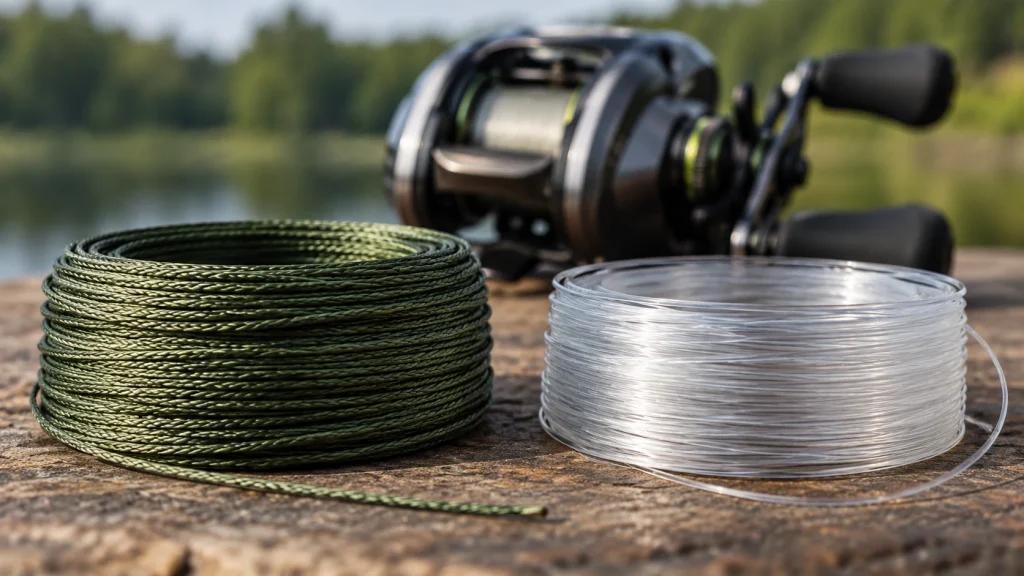
The biggest differences between these two lines are stretch, diameter, sensitivity, memory, and how they behave on a rotating spool.
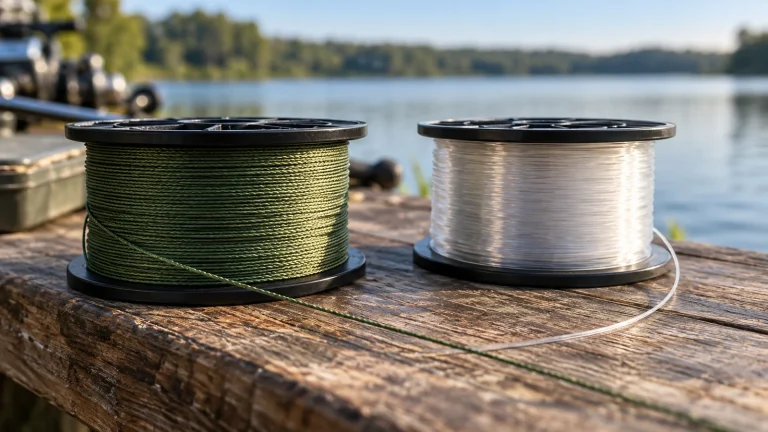
Monofilament is typically made from a single strand of nylon. It stretches under load and is generally thicker than braid of a similar stated breaking strength.
Braided line is made from multiple synthetic fibers woven together. It is normally thinner for its strength and has very little stretch.
These characteristics affect much more than how much line fits onto a reel.
| Feature | Braided Line | Monofilament |
|---|---|---|
| Stretch | Very low | Moderate to high |
| Sensitivity | Excellent | Lower due to stretch |
| Diameter at similar strength | Usually thinner | Usually thicker |
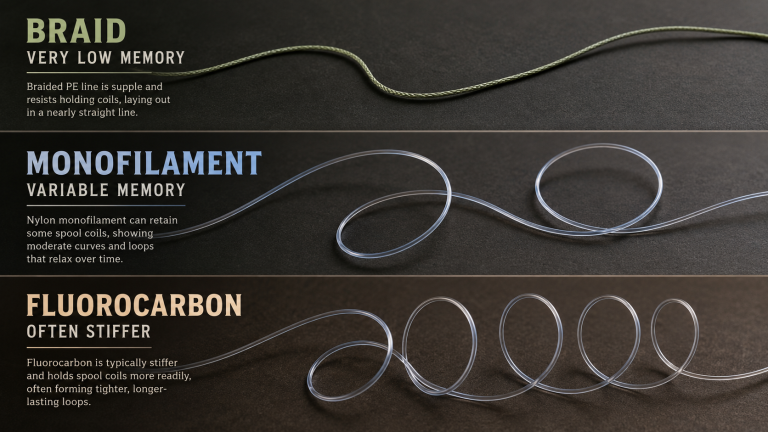
| Line memory | Very low | Higher |
| Backlash management | Thin braid can dig into lower wraps | Often easier and cheaper for beginners to manage |
| Shock absorption | Limited | Better |
| Cost | Usually higher | Usually lower |
| Line visibility | Generally more visible | Clear and low-visibility options available |
| Heavy vegetation | Particularly useful | Can work but offers less strength for its diameter |
| Beginner suitability | Good with suitable diameter and practice | Usually the simpler starting choice |
There is no single category that makes one line superior for every technique.
The differences become important when they are matched to a specific fishing situation.

Why Monofilament Is Often Better for Beginner Baitcasters
The strongest argument for starting with mono is not that it automatically prevents backlashes.
It is that mono is affordable, forgiving under load, and reasonably manageable while learning.
Backlashes Are Part of Learning
A baitcaster releases line from a rotating spool.
During a cast, the spool must release line at approximately the rate the lure pulls it away. If the spool continues rotating too quickly, loose line accumulates and can create a backlash, often called a bird’s nest.
That can happen with either mono or braid.
However, very thin braid may bury into the wraps beneath it when placed under heavy tension. Once that happens, the next cast can stop abruptly or produce another tangle.
Moderately thick mono is generally less prone to this particular problem.
It is also relatively inexpensive to replace if a severe backlash requires cutting away damaged line.
For someone learning to cast, that matters.
Stretch Makes the Setup More Forgiving
Monofilament stretches noticeably more than braid.
This provides some cushioning when a fish suddenly changes direction, jumps, or makes a powerful run.
It can also make the setup less unforgiving when an angler applies too much pressure during a hookset.
Stretch is not always beneficial. It can reduce bite detection and make hooksets less immediate at longer distances.
But when learning how to control a fish with a casting rod and reel, that extra cushioning can be useful.
Mono Does Not Require a Leader for Every Application
For general fishing, monofilament can be used directly from the reel to the lure.
That removes the need for a main-line-to-leader connection.
Fewer knots mean fewer potential points of failure and less equipment to worry about during the learning process.
A leader can still be useful around abrasive structure or when the target species requires specialized terminal tackle.
When Braided Line Is Better on a Baitcaster
Braided line becomes particularly attractive when the fishing technique requires sensitivity, direct contact, or strong line without excessive diameter.
It is not reserved exclusively for experienced anglers. Beginners can learn with braid too, especially when using a suitable diameter and carefully adjusted reel.
Nevertheless, braid’s advantages become easier to appreciate once spool control is consistent.
Better Bite Detection
Because braid stretches very little, small changes in line tension are transferred more directly toward the rod.
That can be valuable when fishing soft plastics, bottom-contact lures, jigs, or deeper water.
A subtle bite that feels vague on stretchy mono may be easier to detect with braid when the line is reasonably tight.
Slack line still reduces sensitivity, regardless of the material.
More Direct Hooksets
Low stretch also means less movement is lost to line elongation when applying pressure.
This can help when setting a substantial single hook or moving a fish away from cover.
But braid does not guarantee better hook penetration.
Rod action, hook sharpness, line angle, distance, and drag setting all influence the result.
With treble-hooked lures, an extremely stiff rod combined with heavy braid and an aggressive hookset can sometimes be unnecessarily harsh.
The entire setup needs to work together.
More Strength Without Excessive Diameter
Braid generally offers considerably greater breaking strength than mono at the same diameter.
This is especially useful when fishing vegetation.
An angler can use a stronger line without necessarily needing the thick diameter associated with equally rated monofilament.
Braid can also cut through some types of soft vegetation effectively.
However, it should not automatically be considered more abrasion-resistant against rocks, sharp shells, or rough concrete.
Abrasion performance depends on the specific line, diameter, and material it contacts.
Less Line Memory
Braided line has very little line memory.
It does not normally retain tight coils from the reel spool in the same way nylon monofilament can.
That contributes to its flexible handling characteristics.
However, low memory does not mean a baitcaster loaded with braid cannot backlash.
Spool momentum, loose wraps, and incorrect braking still create problems.
For a broader explanation of why fishing lines develop coils and what manufacturers mean by memory, see the related FishingChief guide on fishing line with no memory.
What Pound-Test Line Should You Use on a Baitcaster?
Line strength should be chosen around the rod, reel, lure, target species, and fishing environment.
A heavy frog-fishing setup does not need the same line as a general-purpose casting rod used in open water.
Nevertheless, some starting ranges are useful.
Starting Strength for Monofilament
For general freshwater baitcasting, 12–15 lb monofilament is a sensible range for many beginners.
It provides a manageable diameter without immediately requiring an unusually heavy setup.
Lighter line may be appropriate for specialized presentations, while 17–20 lb or heavier mono can make sense for stronger tackle, larger fish, or more demanding conditions.
Always check the line rating of the rod and the capacity recommendations for the reel.
Starting Strength for Braided Line
For a general-purpose freshwater baitcaster, 30 lb braid is a useful starting point.
It is typically more manageable than very thin 10–15 lb braid on a conventional baitcaster and provides ample strength for many bass techniques.
For heavier cover, anglers commonly move toward 40–50 lb braid.
Dense vegetation and specialized frog-fishing applications may justify 50–65 lb braid or more when the rod and reel are designed for it.
These are practical starting ranges, not universal rules.
The actual diameter matters because different manufacturers may rate lines differently.
A 30 lb braid from one manufacturer will not necessarily have precisely the same diameter or behavior as a 30 lb braid from another.
Also, remember that a stronger line does not make the rod, hook, drag, or leader stronger.
Choosing Braid or Mono for Different Fishing Techniques
The right fishing line becomes easier to choose when you start with the lure and water rather than the label on the spool.
Frog Fishing and Heavy Vegetation
Braided line is generally the preferred choice.
The combination of low stretch and high strength helps when pulling fish through weeds or away from thick cover.
A heavier casting rod is normally paired with this approach.
Mono can work in some vegetation, but its stretch and greater diameter for a given strength may be less desirable when immediate control is needed.
Crankbaits and Treble-Hook Lures
Monofilament remains a strong option.
Its stretch can complement a moderate-action rod and reduce the harshness of sudden pressure on small treble hooks.
Braid can also work, particularly with a softer rod and properly adjusted drag.
There is no need to replace mono simply because braid is more sensitive.
Jigs and Texas Rigs
Braid is useful when detecting subtle bites or driving a larger single hook into a fish’s mouth.
It can also offer greater control around vegetation.
However, monofilament remains viable for these techniques, especially at shorter distances or with lighter cover.
In clear water, some anglers prefer a fluorocarbon leader attached to braid.
Moving Baits in Open Water
Spinnerbaits, chatterbaits, and many other moving lures can be fished effectively with either material.
Mono offers extra stretch and straightforward rigging.
Braid offers greater sensitivity and direct contact with the lure.
Rod action and retrieve style are usually more important than insisting on one material.
For anglers choosing presentations rather than line, the FishingChief guide to fishing tips for bass explains how to match lure selection to cover, depth, and fish activity.
Catfishing With a Baitcaster
Both lines can work extremely well for catfish.
Mono provides useful shock absorption and is a practical choice for many bait-fishing situations.
Braid becomes attractive when larger fish, strong currents, longer distances, or difficult cover justify additional strength without excessive diameter.
The exact strength depends on the species and conditions.
For a more complete setup, see the FishingChief guide to catfishing with a baitcaster, including rod choice, heavier rigs, casting technique, and bite detection.
How to Spool a Baitcaster With Braid or Mono
A well-chosen line can still perform badly if it is spooled incorrectly.
The goal is an even line lay, secure attachment, and sufficient tension to prevent loose wraps.
1. Check the Reel’s Line Specifications
Before buying line, inspect the manufacturer’s recommended diameters, capacities, and operating instructions.
Do not assume that every baitcaster is designed for the same line.
Lightweight finesse baitcasters and heavy-duty casting reels have different requirements.
2. Thread the Line Correctly
Mount the reel on the rod and pass the line through the rod guides and the reel’s level-wind guide.
Make sure it passes through the level-wind opening before attaching it to the spool.
Otherwise, the reel may not distribute line properly when winding.
3. Attach the Line Securely
With monofilament, an appropriate arbor knot is a common method for securing the line to the spool.
With braid, attachment requires more attention.
Smooth braid can sometimes slip around a smooth spool arbor, making it appear that the reel’s drag is malfunctioning.
A short layer of monofilament backing is one common solution.
Some reels have braid-ready spools or other manufacturer-approved methods for preventing slippage.
Follow the instructions for the particular reel rather than assuming every spool should be treated identically.
4. Maintain Tension While Winding
Load the line under consistent, moderate tension.
The wraps should lie evenly and firmly without excessive force.
This is particularly important with braid.
Loose wraps may be pulled into the line beneath them when fighting a fish or retrieving a snagged lure.
That can create problems on the following cast.
5. Avoid Overfilling the Spool
Do not fill the reel beyond the manufacturer’s recommended level.
An overfilled spool can make line management more difficult.
A small gap below the spool edge is common on many conventional baitcasters, but the exact amount depends on the reel.
6. Adjust the Brakes Before Fishing
Start with conservative braking and follow the reel’s instructions for spool tension.
Some traditional reels use a lure-drop adjustment, while newer digital or specialized braking systems may have different setup procedures.
Make several controlled casts before attempting maximum distance.
Reduce braking gradually as the casts become consistent.
The aim is to achieve reliable control, not simply the longest possible cast.
Why Does Braid Dig Into a Baitcaster Spool?
Line digging happens when a strand or wrap is pulled beneath the layers already on the spool.
It is more likely when thin braid is wound loosely and then subjected to substantial pressure.
For example, imagine casting a lure, getting snagged, and pulling hard against the line while the spool is loaded with loosely wound braid.
Some wraps may bury into the layers below.
On the next cast, the line can suddenly stop paying out freely when it reaches that trapped section.
This can produce an abrupt stop, another backlash, or a broken line.
To reduce the risk:
- Use a suitable braid diameter for the reel.
- Wind line onto the spool under consistent tension.
- Avoid retrieving loose loops without correcting them.
- Check the spool after freeing a snag or fighting a powerful fish.
- Do not use the reel and rod to force a severe snag free; protect the tackle and pull from a safe position without wrapping line around bare hands.
Using significantly heavier braid is not always necessary, but extremely thin braid can be a poor match for a conventional general-purpose baitcaster.
Should You Use a Leader With Braided Line?
A leader can make a braided baitcasting setup more versatile.
Fluorocarbon and monofilament leaders provide different advantages.
A fluorocarbon leader can offer lower visibility and useful abrasion resistance in certain conditions.
A mono leader adds some stretch and can be useful when shock absorption or buoyancy matters.
However, the leader is not automatically necessary.
When fishing heavy vegetation with an appropriate frog or other lure, straight braid is often a practical option.
In other situations, a leader may help protect the terminal section from abrasion or provide a different presentation.
Remember that a leader knot introduces another connection that must be tied and inspected properly.
It also cannot completely reproduce the stretch characteristics of a full spool of monofilament when only a short section is used.
Common Mistakes When Choosing Baitcaster Line
Buying Extremely Thin Braid for Its Breaking Strength
A thin line may look attractive because it offers high strength without taking up much spool capacity.
But very thin braid can be difficult to manage on some baitcasting reels.
Choose diameter as well as breaking strength.
Assuming Mono Cannot Backlash
Mono can create substantial bird’s nests.
Incorrect braking, uncontrolled spool speed, wind, and abrupt casting motions can all produce tangles.
Line choice does not replace good casting technique.
Using Too Much Force When Casting
A baitcaster does not need to be whipped aggressively to achieve useful distance.
A smooth casting motion lets the rod load and helps the lure pull line away at a manageable rate.
Violent acceleration can make spool control harder.
Ignoring Damage After a Backlash
A severe backlash can kink or weaken line.
Inspect monofilament for sharp bends, flattened areas, and abrasion.
Check braid for damaged fibers, fraying, or sections that appear unusually rough.
Replace compromised line rather than assuming it retains its original strength.
Locking Down the Drag Because Braid Is Strong
Low stretch and high breaking strength do not mean the drag should always be tightened fully.
A suitable drag setting helps protect the rod, knots, hooks, and fish during sudden changes in pressure.
Frequently Asked Questions
Is Braid or Mono Better for a Beginner Baitcaster?
Monofilament is usually the simpler and less expensive starting choice.
A 12–15 lb mono provides a useful balance for many general-purpose baitcasting setups.
Once casting becomes consistent, switching to suitable braid is straightforward.
Does Braid Cast Farther Than Mono on a Baitcaster?
Braid can offer a casting-distance advantage because of its smaller diameter and flexible construction.
However, distance also depends on lure weight, rod action, reel design, braking, spool fill, and casting technique.
Braid does not automatically cast farther in every setup.
Can You Put 20 lb Braid on a Baitcaster?
Yes, provided the line diameter is suitable for the particular reel and technique.
However, 20 lb braid can be relatively thin.
For many conventional baitcasters, 30 lb braid is a more forgiving general-purpose starting point.
Does Braid Cause More Backlashes Than Mono?
Not necessarily.
Both can backlash if the rotating spool releases line faster than the lure pulls it away.
Thin braid can sometimes dig into the spool or create difficult tangles, while mono can develop loops and overruns of its own.
Braking, casting technique, and correct spooling remain essential.
Is Monofilament Good for Bass Fishing With a Baitcaster?
Yes.
Mono works well for many bass techniques, especially moving baits and applications where extra stretch is useful.
It remains a legitimate main-line choice, not merely something anglers use before learning to fish with braid.
Final Takeaway
When choosing braid or mono for baitcaster fishing, start with the technique and your experience rather than assuming one line is always better.
Monofilament is an excellent starting choice for learning to cast, handling backlashes affordably, and fishing presentations that benefit from stretch.
Braid is particularly useful when sensitivity, high strength for its diameter, and direct control are priorities.
For a new baitcaster, 12–15 lb mono is a practical place to begin. Once spool control becomes comfortable, 30 lb braid is a sensible alternative for many general-purpose freshwater applications.
Whichever line you choose, match its diameter to the reel, spool it correctly, and adjust the brakes before chasing maximum casting distance.