The pickerel vs perch comparison becomes confusing surprisingly quickly because the word “pickerel” does not always describe the same fish.
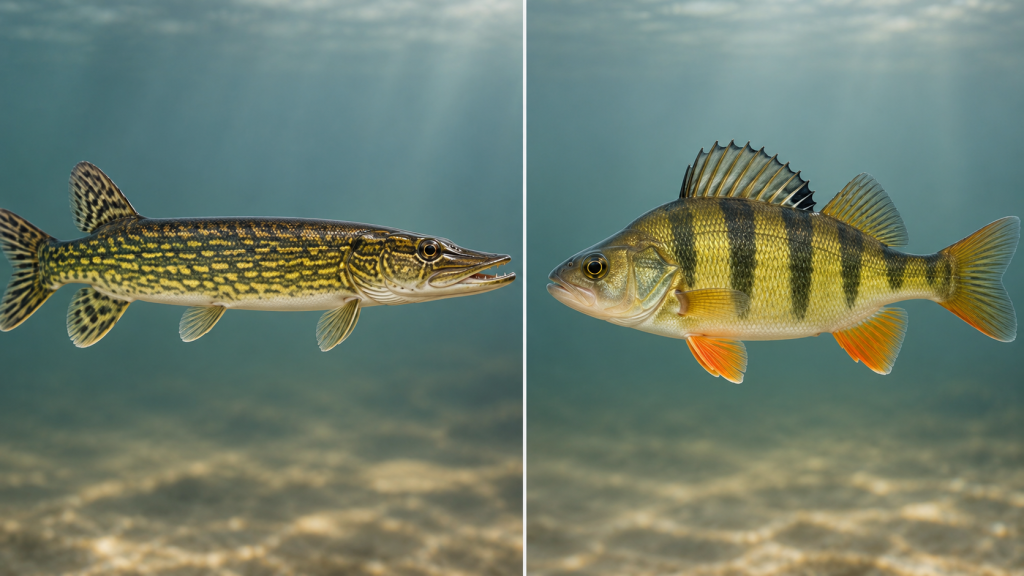
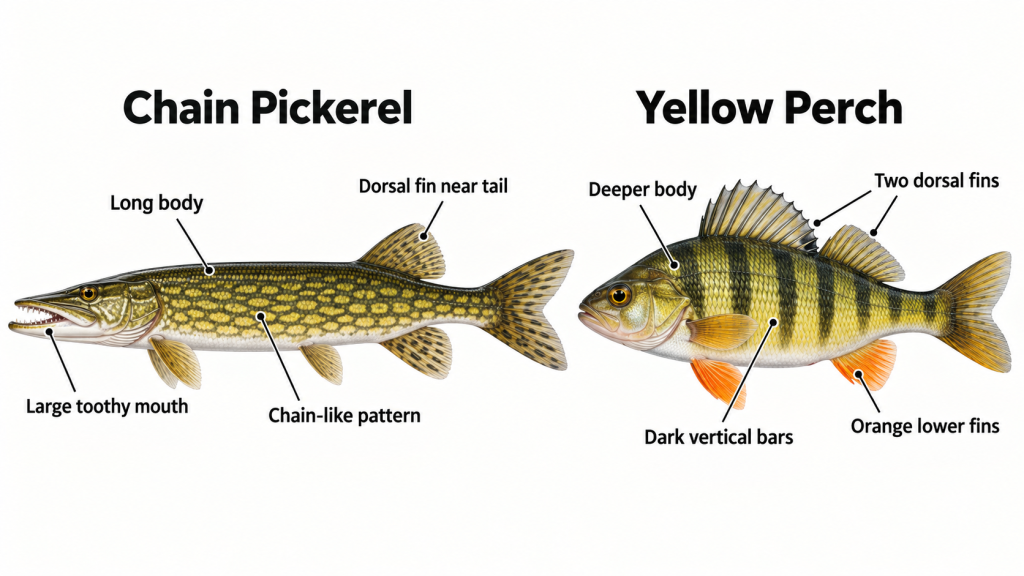
If you mean a true pickerel — particularly the chain pickerel — and compare it with a yellow perch, the two are very different fish. Chain pickerel are long, toothy ambush predators from the pike family. Yellow perch are deeper-bodied schooling fish with dark vertical bars, orange-tinted lower fins and two distinct dorsal fins.
There is one important catch: in parts of Canada, anglers commonly use “pickerel” as another name for walleye. Walleye actually belong to the perch family.
Once that naming problem is cleared up, telling a true pickerel from a perch is usually easy.
First: What Does “Pickerel” Actually Mean?
For this article, pickerel means the chain pickerel (Esox niger), while perch means the yellow perch (Perca flavescens).
That distinction matters.
A chain pickerel is a true member of the pike family, Esocidae. It is closely related to northern pike and other Esox species.
Yellow perch belong to a completely different family, Percidae.
But regional fishing terminology complicates the picture.
In parts of Canada, particularly around the Great Lakes and central Canada, walleye are often called pickerel. Fisheries and Oceans Canada has documented this naming issue and notes that the fish historically called pike-perch or pickerel is actually a member of the perch family rather than the pike family.
So before comparing pickerel and perch, make sure everyone is talking about the same pickerel.
Pickerel vs Perch: Quick Comparison
| Feature | Chain Pickerel | Yellow Perch |
|---|---|---|
| Scientific name | Esox niger | Perca flavescens |
| Family | Esocidae — pikes | Percidae — perches |
| Body shape | Long, narrow and torpedo-shaped | Shorter and noticeably deeper-bodied |
| Main markings | Dark chain-like pattern over greenish sides | Dark vertical bars over yellow-green sides |
| Head | Long snout and large mouth | Shorter head and smaller mouth |
| Teeth | Numerous obvious sharp teeth | No large pike-like teeth |
| Dorsal fins | One dorsal fin positioned far back | Two separate dorsal fins, first one spiny |
| Typical behavior | Solitary ambush predator | Frequently schooling |
| Common habitat clue | Weeds, wood and ambush cover | Vegetation, flats, drop-offs and schooling areas |
| Fastest ID clue | Chain pattern + dark bar below eye | Vertical bars + orange/red lower fins |
The body shape alone usually separates them. A pickerel looks built to accelerate after another fish. A yellow perch has a much deeper profile and looks more like the classic panfish-shaped predator.
How to Tell a Pickerel From a Perch
You normally do not need to count scales or fin rays to separate these two fish.
Several obvious features are enough.
Look at the Body Shape
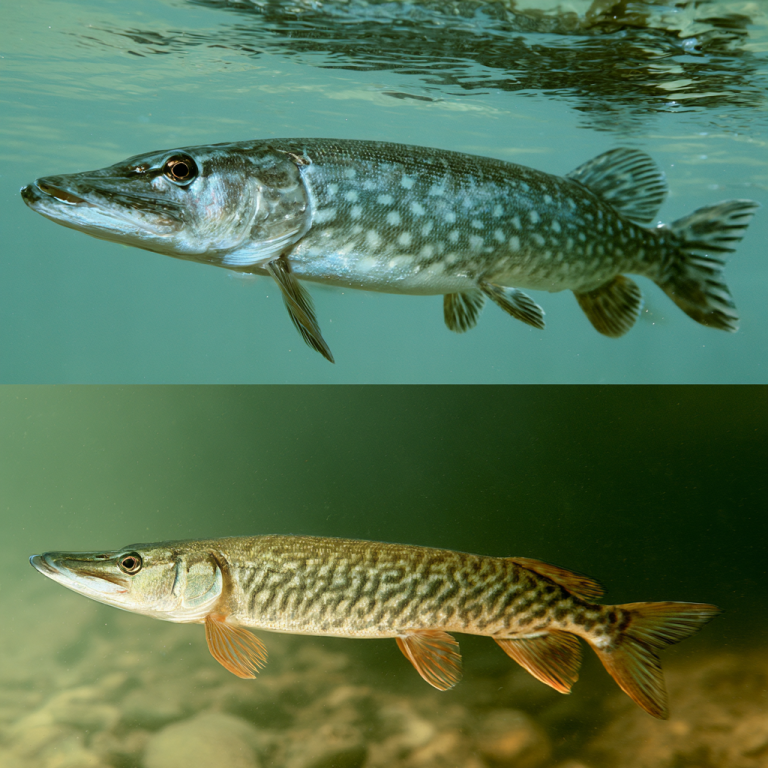
Chain pickerel have the long, streamlined shape typical of the pike family.
The body is narrow and elongated, while the head extends into a broad, flattened snout. The mouth is large in relation to the head.
Yellow perch are noticeably deeper through the body.
They are still elongated compared with very round panfish such as bluegill, but they have nothing resembling the long, almost torpedo-like profile of a pickerel.
Side by side, this is probably the quickest difference to recognize.
Check the Markings
The chain pickerel gets its name from its markings.
Dark lines form an irregular interconnected pattern across a lighter green or yellow-green body. Maryland Department of Natural Resources also lists the dark vertical bar beneath the eye as one of the species’ useful identification features.
Yellow perch have almost the opposite visual pattern.
Rather than a network of narrow lines, they usually carry six to eight dark vertical bars across a brassy-green to yellow body. Their pelvic and anal fins can also show strong orange or reddish coloration.
Do not rely entirely on brightness. Water color, lighting, age and individual variation can make either species look darker or paler than expected.
The pattern and body structure are more useful.
Look at the Dorsal Fins
Fin position makes the difference even more obvious.
A chain pickerel has one dorsal fin located far back on the body, close to the tail.
That rear-positioned fin is characteristic of the elongated ambush-predator shape found throughout the pike family.
A yellow perch has two dorsal fins.
The first contains prominent spines, while the second is soft-rayed. Viewed from the side, this gives the perch a completely different upper-body profile.
Look at the Mouth — Carefully
Nobody should need to put a finger inside the mouth to identify these fish.
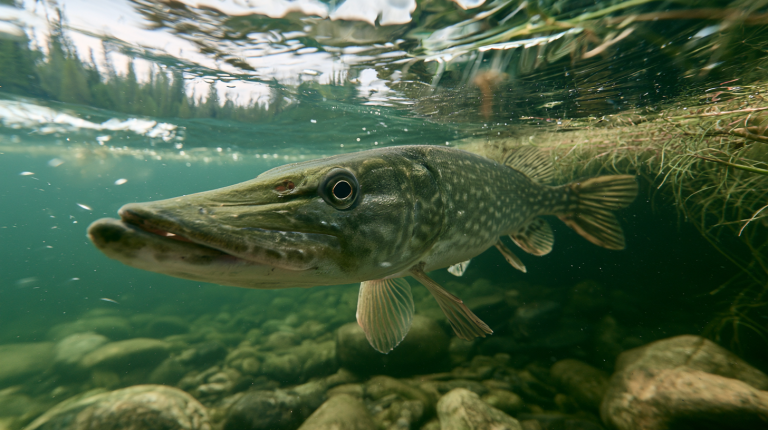
Chain pickerel have a large mouth armed with numerous sharp teeth designed to grab other fish.
Yellow perch are predators too, but they do not have the conspicuous pike-style jaw full of large needle-like teeth.
If the fish in front of you is long, green, heavily toothed and difficult to distinguish from another Esox, the more relevant comparison becomes the FishingChief pickerel vs pike guide.
Do Pickerel and Perch Live in the Same Water?
They can.
Both species can use freshwater lakes, ponds and slower sections of rivers, and both may be associated with aquatic vegetation.
Their behavior around that vegetation is different, however.
Chain pickerel are classic ambush predators. Maryland fisheries guidance describes them using weed growth, submerged vegetation, timber and other structure as cover from which to attack prey.
A pickerel can therefore sit almost motionless near a weed edge before accelerating at a passing fish.
Yellow perch regularly use vegetated nearshore areas as well, but they are much more likely to be encountered in groups. Maryland DNR describes them as a schooling species and notes their use of nearshore areas and vegetation.
That difference affects how anglers search for them.
Finding one pickerel around an isolated weed bed does not necessarily mean twenty more are sitting beside it.
Finding one perch can be the opposite situation. Where conditions are suitable, locating the first fish may mean a school is nearby.
Fishing for Pickerel vs Perch
The tackle used for the two species reflects their feeding style.
Fishing for Chain Pickerel
Pickerel respond well to presentations that move through or alongside ambush cover.
Common choices include:
- spoons;
- spinners;
- spinnerbaits;
- jerkbaits;
- small swimbaits;
- minnows.
The key is usually getting the lure close enough to cover that a waiting fish can react.
Because pickerel have sharp teeth, line protection also deserves consideration. Maryland DNR specifically recommends steel or heavy monofilament leaders when fishing for them.
Long-nose pliers should already be available before a pickerel is landed.
Fishing for Yellow Perch
Perch fishing is generally more finesse-oriented.
Small jigs, worms, small minnows and compact spoons can all work. Once fish are located, keeping the bait at the depth occupied by the school is often more useful than repeatedly covering large amounts of water.
That can mean working vertically beneath a boat, fishing a small bait below a float or slowly searching a flat until bites reveal where the fish are concentrated.
The major difference is therefore not simply lure size.
For pickerel, you are often searching ambush cover for individual predators.
For perch, you are frequently searching for a concentration of fish.
Pickerel vs Perch Taste
Taste is subjective, but pickerel vs perch taste is a common reason people compare the two species.
Yellow perch have a particularly strong reputation as table fish. Maryland DNR notes that their flavor is one of the reasons they are recreationally harvested.
Chain pickerel are edible as well.
The bigger practical difference is often preparation rather than flavor. Pickerel have numerous intermuscular bones that can make filleting more demanding. Missouri’s Department of Conservation describes chain pickerel meat as firm and sweet but notes the many small bones and the additional preparation they require.
So if you are deciding between them for the table:
| Consideration | Chain Pickerel | Yellow Perch |
|---|---|---|
| Flesh | White, firm and mild-to-sweet | White, mild and commonly prized |
| Main preparation issue | Numerous small/intermuscular bones | Generally straightforward small fillets |
| Typical fish size | Larger individual fish | Smaller individual fish |
| Best reason to keep | Good flesh if prepared carefully | Popular table fish with convenient portions |
Always follow local harvest regulations and fish-consumption advisories. Those can vary by species and individual waterbody.
And again, if someone in Canada says pickerel while discussing restaurant fish or fillets, they may actually mean walleye rather than chain pickerel.
That is a completely different comparison.
Common Pickerel vs Perch Identification Mistakes
Mistaking Any Long Green Fish for a Pickerel
Northern pike can look similar to chain pickerel.
Perch cannot.
If the fish has an elongated body and pike-like head, concentrate on distinguishing members of the Esox family rather than deciding whether it is a perch.
Using Color Alone
A dark yellow perch does not stop being a perch, and a pale chain pickerel does not stop being a pickerel.
Body shape, fin arrangement and markings are more dependable than choosing a species because one fish looks greener.
Assuming “Pickerel” Always Means Chain Pickerel
This is probably the biggest source of online confusion.
A Canadian angler may say pickerel and mean walleye.
An angler in the eastern United States may say pickerel and mean chain pickerel.
Those are not regional names for the same biological species.
Assuming Habitat Identifies the Fish
Weedy freshwater does not automatically mean pickerel.
Yellow perch also use vegetation, and both fish can occur in the same broader water system.
Use physical characteristics for identification.
Frequently Asked Questions
Are pickerel and perch the same fish?
No. Chain pickerel and yellow perch belong to different families. Chain pickerel are members of the pike family, while yellow perch are members of the perch family.
Is a pickerel part of the perch family?
A true pickerel such as chain pickerel is not.
However, walleye are sometimes called pickerel in Canada, and walleye actually do belong to the perch family. This regional name is the source of much of the confusion.
What is the easiest way to tell pickerel and perch apart?
Start with body shape.
Chain pickerel are long and narrow with a large toothy mouth and one dorsal fin far back on the body.
Yellow perch are deeper-bodied with dark vertical bars, orange or reddish lower fins and two dorsal fins.
Do pickerel and perch have teeth?
Both are predatory fish, but their mouths are very different.
Chain pickerel have numerous conspicuous sharp teeth capable of cutting skin and damaging fishing line. Yellow perch do not have the large pike-like teeth that make pickerel handling more difficult.
Can pickerel and perch live in the same lake?
Yes. Their ranges and habitat preferences can overlap, particularly in vegetated freshwater systems. They use those environments differently, with pickerel tending toward ambush predation while perch frequently form schools.
Which tastes better, pickerel or perch?
There is no objective winner because taste preference is personal.
Yellow perch are particularly well known as table fish. Chain pickerel can also have good white flesh, but their additional bones usually make preparation more demanding.
Final Takeaway
For pickerel vs perch, the easiest clue is body shape.
A true chain pickerel is long, narrow and toothy, with chain-like markings and a dorsal fin positioned close to the tail. A yellow perch is deeper-bodied, vertically barred and equipped with two distinct dorsal fins.
The only real complication is the name.
Before making the comparison, establish whether “pickerel” actually means a chain pickerel or whether it is being used regionally for walleye. Once that is clear, a true pickerel and a yellow perch are very difficult to confuse.