The best castable fish finder should do more than show a few fish icons on a phone. For shore anglers especially, its real value is revealing depth changes, weed, drop-offs, hard bottom and other features that would otherwise be difficult to locate without a boat.
The current market is dominated by Deeper and Garmin, but the models vary considerably in sonar detail, wireless range, mapping and price. A simple unit can be enough for checking depth around a small lake, while an angler mapping large areas from the bank can justify a much more capable GPS and CHIRP model.
Best Castable Fish Finder: Quick Comparison
The specifications below are based on current manufacturer information. Wireless range, battery life and sonar performance can all change with conditions, phone placement, waves and how the unit is used.
| Model | Best For | Wireless Range | Max Depth | GPS / Mapping | Battery |
|---|---|---|---|---|---|
| Deeper MAX | Best overall | Up to 400 ft / 120 m | 328 ft / 100 m | GPS, 2D and 3D personal maps | Up to 15 hr; up to 9 hr with GPS |
| Garmin STRIKER Cast GPS | Simple GPS mapping | Up to 200 ft / 60 m | 150 ft / 45 m | GPS, Quickdraw Contours | About 10 hr |
| Deeper START | Budget / simple use | Up to 165 ft / 50 m | 165 ft / 50 m | No built-in GPS mapping | Up to 6 hr |
| Deeper CHIRP+ 4 | Advanced mapping | Up to 394 ft / 120 m | 330 ft / 100 m | GPS, 2D/3D maps and additional mapping features | Up to 15 hr |
Deeper lists the MAX with a 400-foot connection range, 100 m scanning depth, three-frequency CHIRP sonar and personal 3D mapping. Garmin specifies a 60 m wireless range, 45 m maximum sonar depth and roughly 10 hours of typical battery life for STRIKER Cast.
What a Castable Fish Finder Actually Does
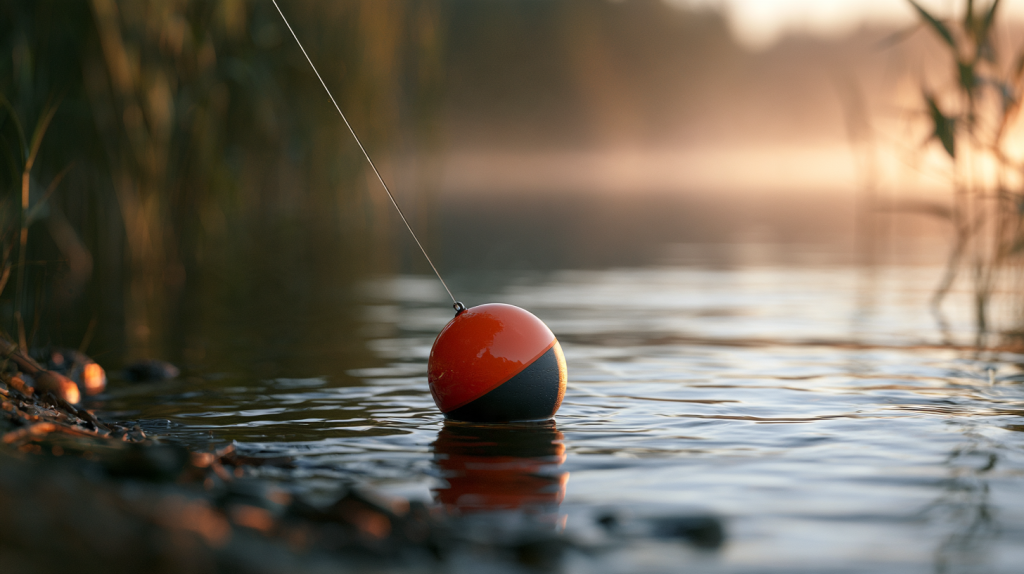
A castable fish finder contains a small sonar transducer inside a floating housing. You attach it to suitable line, cast it onto the water and retrieve it while sonar readings are transmitted to a phone or tablet.
The important part is the sonar rather than the fish icons.
Sonar sends sound into the water and measures echoes returning from the bottom and objects in the water column. That allows the unit to estimate depth and show changes in bottom profile, vegetation and potential fish targets.
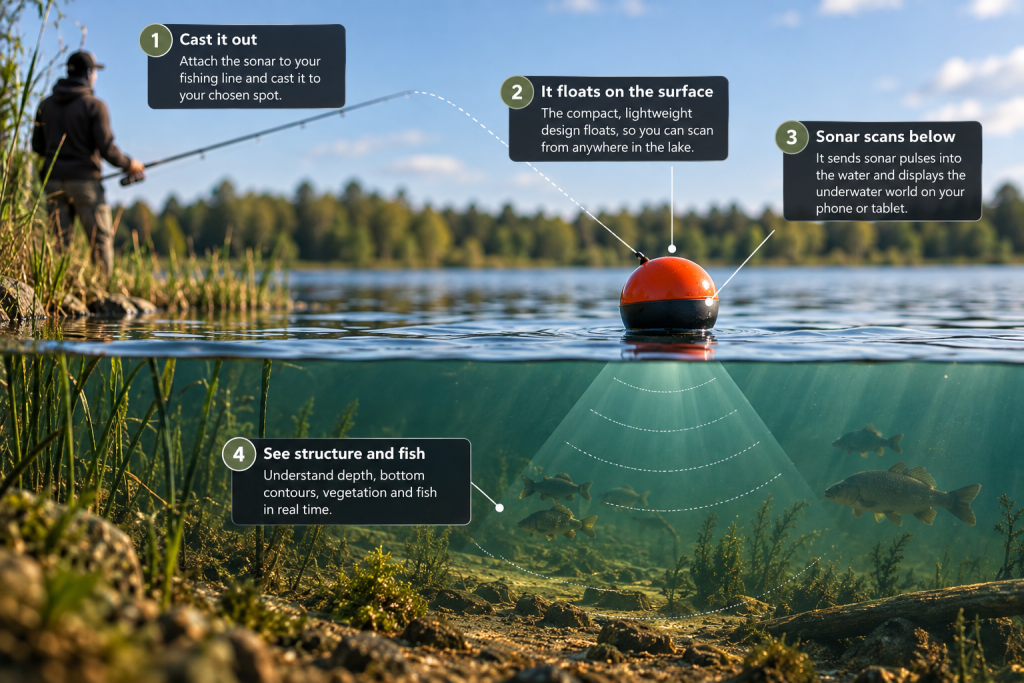
That distinction matters. A castable sonar is most useful when it helps answer questions such as:
- Where does the water become deeper?
- Is there a drop-off within casting range?
- Where does the weed end?
- Is the bottom relatively flat or irregular?
- Are fish consistently holding at a certain depth?
Treating every symbol on the screen as a fish that can immediately be caught is a much less reliable way to use the technology.
1. Deeper MAX — Best Overall Castable Fish Finder
For anglers who seriously want to map water from the bank, Deeper MAX is the strongest all-round option in the current lineup.
It uses three-frequency CHIRP sonar with narrow, medium and wide beams, built-in positioning and a connection range of up to 400 feet. Deeper rates its scanning depth to 100 m and allows personal 3D depth maps to be created from collected sonar data.
Why the MAX Stands Out
Range is one of its biggest advantages.
A fish finder capable of communicating farther than you can comfortably cast leaves useful headroom. It also reduces the likelihood that normal shore-fishing distances place the sonar at the very edge of its advertised connection range.
The three beam widths are useful as well. A wider beam helps survey a larger area, while a narrow beam gives more focused information about what is directly below the sonar.
The biggest reason to buy it, however, is mapping.
If you repeatedly fish the same lake, pit or reservoir, building your own depth information can become more useful than simply watching fish targets scroll across the screen.
Who Should Buy It?
The MAX makes the most sense for anglers who:
- regularly fish from shore;
- revisit the same waters;
- actively look for shelves, channels, weed edges and other features;
- intend to save and use depth maps;
- want more sonar detail than a basic portable unit provides.
It is harder to justify if you only want to check the depth of a swim a few times per year.
2. Garmin STRIKER Cast GPS — Best for Simple GPS Mapping
The Garmin STRIKER Cast GPS takes a simpler approach.
Garmin specifies a wireless range of up to 200 feet and a sonar depth range down to 150 feet. The GPS version can record Quickdraw Contours while you move the sonar around the water, allowing you to build your own depth maps rather than relying only on the scrolling sonar display.
That GPS distinction is important because Garmin also sells a version without GPS.
If mapping is one of the reasons you want a castable fish finder, choose the GPS model rather than assuming both versions provide the same functions. Garmin states that recording Quickdraw Contours requires sonar depth data together with GPS position data.
Why Choose Garmin Instead of Deeper?
The STRIKER Cast GPS suits anglers who want:
- a straightforward sonar display;
- waypoint and mapping capability;
- the Garmin ecosystem;
- less emphasis on maximum range or advanced sonar settings.
Its 60 m connection range is considerably shorter than the longest-range Deeper units, but 60 m is still beyond the normal casting distance of many anglers.
It is therefore worth thinking about how far you actually cast instead of automatically paying for the largest number on the specification sheet.
3. Deeper START — Best Budget Castable Fish Finder
Not everyone needs CHIRP, GPS or detailed bathymetric mapping.
The Deeper START uses a single 120 kHz beam with a 40-degree cone. Its maximum stated connection range is 50 m, maximum depth is also 50 m, and battery life is rated at up to six hours.
Those specifications are modest compared with the MAX, but that does not automatically make the START a bad choice.
For an angler who mainly wants to identify:
- approximate depth;
- obvious drop-offs;
- major vegetation;
- basic bottom changes;
- potential fish activity;
the START may already provide the information that matters.
What you lose is more important than what you gain by upgrading.
The START does not provide the same built-in GPS mapping capabilities as Deeper’s more advanced models. If creating repeatable maps of your fishing water is part of the plan, buying the cheaper unit first may simply lead to replacing it later.
4. Deeper CHIRP+ 4 — Best for Advanced Mapping
The Deeper CHIRP+ 4 sits at the more advanced end of the category.
Deeper lists a 120 m casting range, 100 m scanning depth, three-frequency CHIRP, built-in GPS and up to 15 hours of battery life. It also adds personal bottom-hardness and vegetation maps alongside 2D and 3D depth mapping.
That is a substantial feature set, but more information is only valuable if it changes how you fish.
An angler who spends the season learning one large reservoir from the bank may genuinely use those maps. Someone who fishes a different small pond every weekend may not.
Availability also varies by market, so this is one model where checking current regional stock before publishing or purchasing is sensible.
Are Castable Fish Finders Worth It?
For the right angler, yes.
They are particularly useful when fishing from the bank because they provide access to information normally associated with boat-mounted sonar without needing a boat, permanent transducer or dedicated display.
They are most worthwhile when structure is difficult to read from the surface.
A lake may appear featureless from the bank while having a submerged shelf, old river channel or abrupt weed edge within casting range. Finding that feature can change where you place a bait or retrieve a lure.
This type of scouting can also be useful when bass fishing from shore, where access to likely structure is often limited by casting position.
A castable fish finder is less valuable when the water is already well known or when visual clues make the important structure obvious.
If you primarily fish from a boat or kayak and want a permanently available display rather than repeatedly casting a sonar unit, our fish finder mounting ideas cover removable and permanent alternatives.
GPS Mapping Matters More Than Many Anglers Expect
The difference between seeing depth and remembering where that depth occurred is significant.
Without mapping, you can cast the sonar, notice that a shelf drops from 8 to 14 feet and then try to remember exactly where that transition was.
With GPS mapping, repeated casts can build a much clearer picture of the water.
That is why the difference between a basic castable sonar and a GPS model becomes more important for anglers who revisit the same venue.
Fish move. Underwater features do not.
A saved drop-off, channel or hump remains useful even when the fish are somewhere else during the next session.
Do You Really Need CHIRP Sonar?
CHIRP is useful, but it should not automatically be the first buying criterion.
Traditional sonar may transmit at one frequency at a time. CHIRP sweeps across a range of frequencies, allowing the system to process more returned information and improve target separation and image clarity. Garmin describes this as one of the main advantages of CHIRP sonar.
For anglers comparing basic and premium castable units, the practical question is whether that additional detail matters.
If you mainly need to establish that a margin is 4 feet deep and then drops rapidly to 12 feet, basic sonar can do the job.
If you spend significant time studying bottom transitions, vegetation and targets close to structure, better sonar resolution becomes much more useful.
Wireless Range Is Not the Same as Casting Range
A 120 m wireless specification does not mean most anglers will cast a sonar 120 m.
The device itself adds significant weight compared with a normal lure, and repeatedly launching expensive electronics as far as possible is not necessarily sensible.
Long wireless range is still useful because it provides communication headroom, but your real casting distance will depend on the rod, line, device weight, conditions and casting ability.
Follow the manufacturer’s tackle recommendations.
Garmin, for example, instructs users attaching a STRIKER Cast to a rod to use 20 lb test or stronger line, a #3 barrel swivel with snap, and a medium-action or heavier rod.
What About iBobber and Older Castable Fish Finders?
This is where many castable fish finder reviews become dated.
The ReelSonar iBobber still appears frequently in older buying guides. Its official specification remains respectable for a simple unit, including up to 135 feet of depth and around 100 feet of Bluetooth range, but ReelSonar’s own store currently lists the main iBobber as sold out.
Deeper PRO+ 2 is another model that may still appear in retailer stock and older recommendations. It remains capable, but Deeper’s current lineup now includes newer options such as MAX and CHIRP+ models, and the manufacturer’s U.S. store has recently shown PRO+ 2 as sold out.
That does not make either unit useless.
It simply means a current buying guide should not automatically recommend an older model without checking whether it is still supported, available and priced sensibly.
Common Mistakes When Using Castable Sonar
Chasing Fish Icons Instead of Structure
Start with the bottom.
Finding a shelf, point, channel or weed edge gives you something repeatable to fish. A single apparent fish target does not.
Reeling Too Fast
A slow, steady retrieve generally produces more useful information than rapidly dragging the sonar back to shore.
Using Maximum Sensitivity Immediately
More sensitivity can also mean more clutter.
Learn what the bottom and obvious structure look like first before trying to interpret every return.
Forgetting About the Phone
A castable fish finder relies on another battery: your phone.
High screen brightness, GPS, Wi-Fi and prolonged app use can make phone battery life just as relevant as sonar battery life.
Using Inadequate Tackle
These units are much heavier and more expensive than normal lures.
Use tackle appropriate to the device and follow the manufacturer’s recommended line strength rather than attaching one to whatever rod happens to be assembled.
FAQ
What is the best castable fish finder for shore fishing?
For anglers who want detailed sonar and mapping, Deeper MAX is currently one of the strongest all-round options. Garmin STRIKER Cast GPS is a simpler alternative with GPS mapping and a shorter wireless range.
Can a castable fish finder really find fish?
It can detect sonar returns that may represent fish, but its greater value is often showing depth, structure and vegetation. Fish icons should be treated as clues rather than guarantees.
Do castable fish finders work without internet access?
The sonar connection itself does not necessarily require mobile internet. For example, Deeper MAX connects directly by Wi-Fi and Garmin STRIKER Cast connects directly to its mobile app. Some mapping or cloud features may require internet access later.
Can you use a castable fish finder from a kayak?
Yes. Castable sonars can be used from shore and small watercraft. Garmin specifically describes casting, tethering or towing STRIKER Cast behind small craft such as kayaks, while warning against high towing speeds and poor conditions.
Is GPS necessary on a castable fish finder?
No, if all you want is live depth and sonar information. GPS becomes much more valuable when you want to mark locations or build repeatable depth maps.
Final Takeaway
The best castable fish finder depends less on which model has the longest specification list and more on what information you actually need.
For detailed shore mapping, Deeper MAX is the strongest all-round choice from the current models considered here. Garmin STRIKER Cast GPS is a simpler GPS alternative, while Deeper START covers basic depth and structure at the lower end.
The most important upgrade is often not better fish detection at all.
It is the ability to turn a few casts into a useful picture of the water you are fishing.