Why are tiger nuts banned on some carp waters when they are sold everywhere as fishing bait?
The simple answer is that tiger nuts are not universally banned. They are a perfectly legitimate carp bait on many waters, while individual fisheries and angling clubs prohibit them completely or place restrictions on how they can be used.
Most bans are precautionary. Fishery managers have no practical way of knowing whether every bucket of tiger nuts brought onto the water has been prepared correctly, how much an angler intends to introduce, or how the bait has been stored. A simple ban is considerably easier to enforce.
That distinction matters because some of the explanations anglers hear about tiger nuts go much further than the available evidence supports.

Why Are Tiger Nuts Banned at Some Fisheries?
The first important distinction is between a legal ban and a fishery rule.
There is no universal rule saying anglers everywhere are prohibited from using tiger nuts. In England, for example, national freshwater fishing rules contain restrictions on particular baits and fishing methods, while also making clear that individual fisheries can impose additional rules of their own. Tiger nuts are not named among the nationally prohibited baits in the Environment Agency guidance.
Private fishery rules can be much stricter.
For example, Highbridge Fisheries currently prohibits tiger nuts and peanuts, while still allowing hemp, corn/maize and pellets as long as those particles are properly prepared. Interestingly, its rules even allow boilies that contain tiger nuts or peanuts. That is a good example of a venue-specific bait-management rule rather than evidence that tiger nuts are universally prohibited.
Poor Preparation Is Difficult for a Fishery to Police
Dry tiger nuts are extremely firm and absorb considerable water when soaked.
Preparation methods normally involve hydrating and cooking them before they are introduced as loose feed. The problem from a fishery owner’s perspective is straightforward: two buckets of tiger nuts can look broadly similar even though one has been properly prepared and the other has not.
Checking every angler’s preparation process is unrealistic.
A blanket rule such as “no tiger nuts” removes that uncertainty completely.
Bait Quantity Is Another Management Problem
Preparation is not the only consideration.
Tiger nuts are inexpensive compared with many specialist carp baits, so there is nothing stopping an angler from bringing several kilograms unless the venue imposes a limit.
One angler fishing a couple of tiger nuts over a small amount of feed is very different from several anglers repeatedly introducing large quantities into the same lake.
For a managed carp fishery, controlling what goes into the water can be as important as deciding which individual bait is theoretically safe.
Are Tiger Nuts Actually Dangerous to Carp?
This is where the subject becomes less clear than many carp-fishing discussions suggest.
Tiger nuts are Cyperus esculentus, an edible underground tuber. Despite the name, they are not botanically true nuts. Scientific reviews describe them as containing carbohydrates, oils, fibre, protein and other nutrients.
That makes statements such as “tiger nuts are poisonous to carp” far too simplistic.
The more reasonable concern is how they are prepared, stored and used.
Be Careful With the “They Swell Inside the Fish” Claim
One explanation frequently repeated by anglers is that dry tiger nuts enter a carp’s digestive system, expand dramatically and kill the fish.
It sounds plausible because tiger nuts certainly absorb water during preparation.
However, the stronger claim that this sequence has been scientifically demonstrated as a common cause of carp death should not be presented as settled fact without direct evidence.
There is surprisingly little carp-specific research establishing the dramatic version of that story.
That does not make throwing dry tiger nuts into a lake sensible.
It means the responsible explanation is more precise: dry tiger nuts are extremely hard, proper preparation makes them more suitable as bait, and fisheries may decide that preventing questionable particle preparation altogether is safer than relying on every angler to get it right.
“Nut Bans” Can Also Be Blanket Rules
Another source of confusion is that fisheries often write one simple rule covering all nuts.
Botanically, tiger nuts do not belong in the same category as peanuts. From the perspective of a bailiff checking an angler’s bait, however, that distinction is irrelevant if the venue rules say:
No nuts, including tiger nuts.
The rule is what counts.
Trying to argue that a tiger nut is technically a tuber is unlikely to produce the result you want when the venue has explicitly named it.
Why Proper Tiger Nut Preparation Matters
Commercially prepared tiger nuts and a bag of hard, dry tiger nuts are not the same product from a fishing perspective.
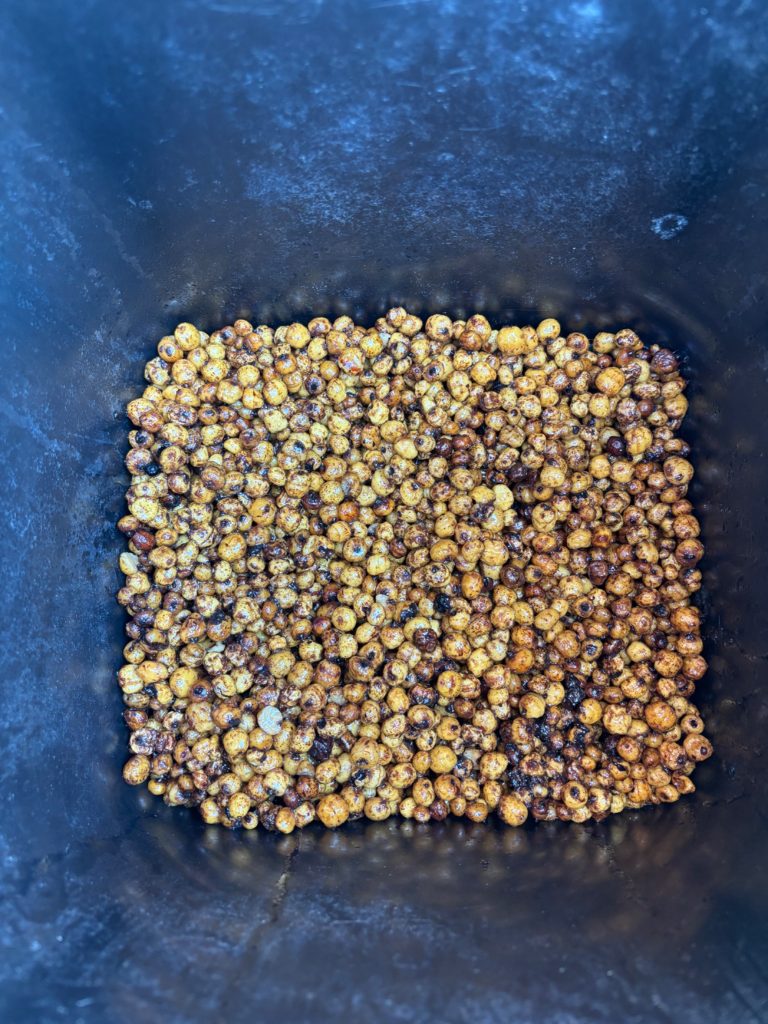
Dry tiger nuts need to be properly hydrated and cooked before they are used as loose feed.
A normal preparation process involves:
- Inspecting and rinsing the dry tiger nuts.
- Soaking them in plenty of water.
- Cooking them after soaking.
- Allowing them to cool and remain hydrated.
- Storing the finished bait correctly until it is used.
Exact soaking and cooking times vary with the size, age, dryness and supplier of the tiger nuts, so blindly following one number is less useful than following the supplier’s preparation instructions and making sure the finished bait is thoroughly hydrated.
If you buy commercially prepared, ready-to-use tiger nuts, the preparation step has already been completed by the manufacturer.
That still does not automatically make them legal at the lake.
A fishery can ban a perfectly prepared bait simply because its rules say so.
Prepared Does Not Mean Permitted
This distinction catches anglers out.
Imagine three products:
| Tiger nut bait | Prepared? | Automatically allowed? |
|---|---|---|
| Dry tiger nuts from a bag | No | No |
| Home-soaked and cooked tiger nuts | Yes | No |
| Sealed commercially prepared tiger nuts | Yes | No |
The third option gives a fishery more confidence about the origin and preparation of the bait, but venue rules still take priority.
Some venues use exactly this compromise.
Serenity Coarse Fishery, for example, currently allows tiger nuts but requires them to come from a reputable source and remain in their original sealed containers.
That is useful evidence that tiger-nut rules are not simply divided into “safe” and “dangerous.” Different fisheries manage the same concern differently.
Can You Use a Tiger Nut Only as a Hookbait?
Do not assume that using one tiger nut on the hair avoids a bait ban.
It depends entirely on how the rule is written.
A rule saying “no loose feeding of nuts” might leave room for a tiger-nut hookbait.
A rule saying “no tiger nuts” normally does not.
And some clubs go even further by prohibiting both the possession and use of nuts on their waters. Kelvedon District Angling Association, for example, places its all-nut prohibition under its fish-welfare rules.
If the wording is unclear, ask the fishery before the session rather than arriving with them and hoping a technical interpretation works.
How to Read Tiger Nut Rules Before You Fish
Fishery wording varies, but these are the most common versions.
| Fishery rule | Practical meaning |
|---|---|
| No nuts / no tiger nuts | Do not bring or use them unless the venue explicitly says otherwise |
| No particles | Tiger nuts will normally be included; confirm with the fishery |
| Prepared particles only | Preparation is mandatory, but confirm tiger nuts are included |
| Shop-bought / sealed bait only | Home-prepared tiger nuts may be prohibited |
| Tiger nuts as hookbait only | Loose feed is banned but the hookbait is permitted |
| Maximum bait quantity | Tiger nuts may be legal but subject to the stated feeding limit |
The safest habit is to read the bait section of the rules every time you visit an unfamiliar water.
Do not rely on what was permitted several years earlier either. Fisheries change rules when stock, ownership, fish health or management practices change.
How to Use Tiger Nuts Responsibly Where They Are Allowed
Where tiger nuts are permitted, there is rarely a need to treat them as bulk feed.
Their biggest practical advantage is that they are durable. A prepared tiger nut can remain intact as a hookbait when softer particles are being damaged or removed by nuisance fish.
A single tiger nut, two smaller nuts or a balanced tiger-nut presentation can therefore be used over a relatively modest amount of loose feed.
If you’re deciding between tiger nuts, boilies, maize, and corn, this guide to the best common carp bait explains when each option makes sense.

That fits particularly well with a controlled carp approach rather than simply filling the swim with particles.
If you are fishing a longer session, the same principle that applies to other carp baits still matters: start with a sensible amount, watch the fish’s response and add more because the situation justifies it — not merely because there is bait left in the bucket.
Prepared particles can also be part of a night carp fishing approach, but accurate feeding becomes even more important once darkness makes it harder to see exactly where repeated baiting is landing.
Never dump unused tiger nuts into the lake at the end of the session.
If the venue permits the bait, take whatever remains home.
Frequently Asked Questions
Are tiger nuts banned in the UK?
No. There is not a blanket UK-wide ban on tiger nuts as carp bait.
National and regional fishing regulations still apply, but individual fisheries and angling clubs can impose stricter bait rules. In practice, this is why one lake may allow tiger nuts and another nearby lake may prohibit them completely.
Are raw tiger nuts safe for carp?
Dry tiger nuts should not be treated as ready-to-use loose feed.
They are extremely hard and normally need soaking and cooking before use. What should be avoided is turning the precaution into an unsupported claim that every dry tiger nut eaten by a carp will inevitably kill it.
Prepare them properly and follow the fishery’s rules.
Are commercially prepared tiger nuts allowed?
Sometimes.
Commercial preparation solves the question of whether you have soaked and cooked the bait yourself, but it does not override fishery rules. Some fisheries accept only sealed commercially prepared products, while others ban tiger nuts regardless of how they were prepared.
Why do fisheries ban tiger nuts but allow boilies?
Because fishery rules are management decisions rather than a universal scientific classification of bait.
A venue may want predictable manufactured bait while limiting whole particles, nuts or large quantities of loose feed. Highbridge Fisheries, for example, currently prohibits tiger nuts and peanuts while allowing boilies containing them.
Are tiger nuts really nuts?
No.
Tiger nuts are small underground tubers produced by Cyperus esculentus. The word “nut” describes their appearance and common name rather than their botanical classification.
Can I use one tiger nut on the hair if loose tiger nuts are banned?
Only when the venue explicitly allows tiger nuts as hookbaits.
If the rule simply says “no tiger nuts”, assume that includes the hookbait unless the fishery tells you otherwise.
Final Takeaway
So, why are tiger nuts banned at some fisheries?
Usually because the fishery wants tighter control over particle preparation, bait quality and the quantity of food entering the lake — not because tiger nuts are universally illegal or inherently poisonous.
Properly prepared tiger nuts remain a widely used carp bait on waters where they are permitted.
The rule that matters most is therefore the simplest one: check the fishery before using them, even when the tiger nuts are commercially prepared and you only intend to use one as a hookbait.