
Choosing between a flat bottom vs V hull boat is really a choice between two different sets of strengths. A flat-bottom boat is normally at its best where the water is shallow and relatively calm, while a V-hull becomes increasingly valuable as waves, wind and boat wakes become part of the equation.
For anglers, that difference affects much more than ride comfort. Hull shape influences how shallow a boat can operate, how steady it feels while you are standing and casting, how much usable fishing space it has, how well it tracks and how hard it hits when running through chop.
There is no universally better hull.
The right choice depends on the water you fish most often — and on whether that means sheltered backwaters, shallow rivers and small lakes or long runs across exposed water where conditions can deteriorate quickly.
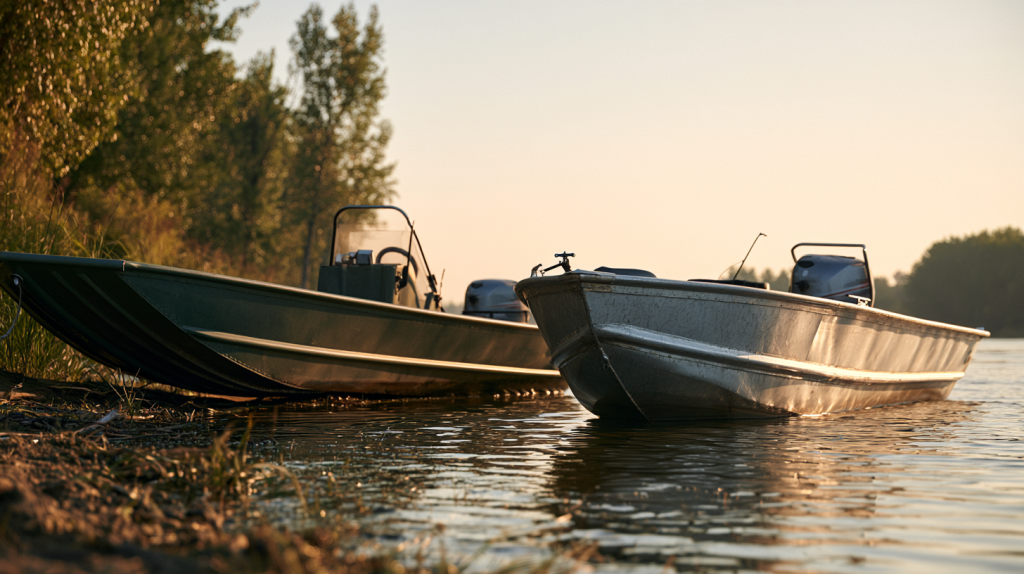
Flat Bottom vs V Hull: Quick Comparison
The simplest way to understand the difference is to look at what happens when the bottom of the boat meets the water.
A flat-bottom hull spreads much of the boat across a broad, relatively flat surface. A V-hull concentrates more of the hull downward into a V shape, with the angle becoming progressively greater as the design moves toward a deep-V.
That basic difference creates most of the trade-offs anglers notice.
| Factor | Flat Bottom | V Hull |
|---|---|---|
| Shallow-water access | Excellent | Usually requires more depth |
| Stability at rest | Usually very good, especially with a wide beam | Usually less initially stable at comparable size |
| Ride in chop | Can slap or pound | Cuts through waves more smoothly |
| Tracking | Can slide or wander more | Usually tracks more positively |
| Fishing/deck space | Excellent for the boat’s overall size | Hull shape can reduce interior volume |
| Power required | Often relatively efficient | More V generally requires more power |
| Standing and casting | Very good in calm conditions | Depends heavily on width and hull design |
| Wind and boat wakes | Less comfortable as conditions build | Generally better suited |
| Protected shallow rivers | Excellent | Good, but may draw more water |
| Large exposed water | Limited by conditions and boat design | Usually the stronger choice |
The important word in several of those rows is usually. Beam, length, weight distribution, freeboard, deadrise, engine weight and overall hull design can make two boats in the same broad category behave very differently.
What a Flat-Bottom Boat Does Well
The biggest advantage of a flat bottom is access.
Because relatively little hull extends deeply below the waterline, a lightly loaded flat-bottom boat can float and operate in water that would become problematic for many deeper-hulled boats.
That is useful around shallow lakes, ponds, marshes, backwaters, creek mouths, flooded areas and rivers with sandbars or shallow edges.
It also explains why jon boats and similar utility boats are so common among anglers. Getting onto the water does not always require a large, complex fishing boat.
Another major advantage is initial stability.
When a wide flat-bottom boat is sitting in calm water, shifting your weight a little to one side normally produces relatively little movement. For anglers who stand to cast, move tackle around the boat or land fish, that can make the platform feel very reassuring.
Width matters, however.
A narrow flat-bottom boat should not automatically be considered more stable than a wide V-hull simply because the bottom is flat. Hull shape is only part of the equation.
Flat Bottoms Give You Useful Fishing Space
The shape also makes efficient use of a small boat.
Straightforward bench seats, open floors, tackle boxes, batteries, rod storage and other equipment can often be arranged without the sides of a pronounced V taking away as much interior volume.
For an angler who mostly needs a simple fishing platform rather than a sophisticated console boat, that matters.
There is less value in having an excellent rough-water hull if half of your fishing consists of slowly moving around sheltered water and you constantly wish you had another square metre of usable deck.
Where a V-Hull Has the Advantage
A V-hull earns its advantage once the surface stops being flat.
Instead of meeting each wave with a broad section of relatively flat hull, the V enters the water progressively and parts it to either side.
The practical result is normally a softer ride through chop.
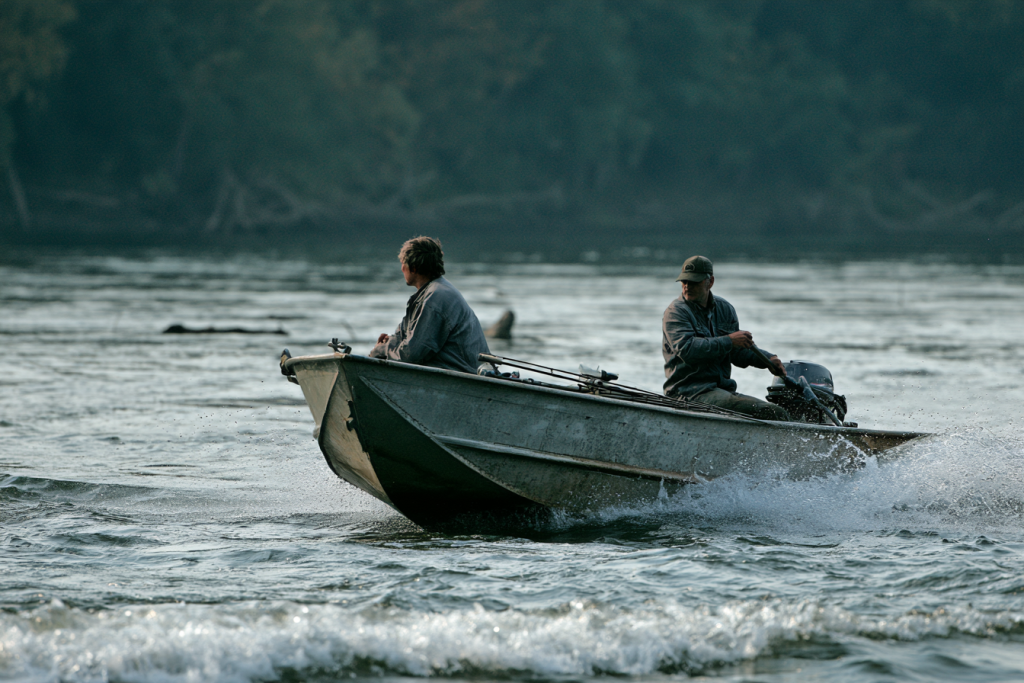
That can make a very noticeable difference during repeated impacts. A flat-bottom boat that feels excellent while you are fishing can become uncomfortable when you have several kilometres to travel against short wind-driven waves.
Boat wakes create the same problem.
One wake is not necessarily important. Repeated wakes from larger boats on a busy river can turn what appeared to be calm water into conditions where the ability to cut through waves matters considerably more.
A V-hull also generally tracks more positively because more hull is engaged beneath the surface. That can help when holding a line under power and when wind is pushing the boat sideways.
The trade-off is that you give something back.
More V generally means more draft, more wetted hull to move and less of the box-like interior space associated with a traditional flat-bottom utility boat.
Flat Bottom vs V Hull for River Fishing
The question of a flat bottom or V hull for river fishing cannot be answered simply by saying that flat bottoms are “river boats.”
Some rivers are almost completely protected.
Others are huge.
Even the same river can contain narrow sheltered channels, shallow backwaters, deep main channels, exposed sections where wind has room to build waves and busy areas receiving regular wake from larger vessels.
That distinction matters.
A flat-bottom boat can be extremely effective when the priority is reaching shallow areas, moving over sand or mud flats, working protected side channels and fishing at relatively low speeds.
Move onto a larger open section of river, however, and different priorities appear.
Wind, boat wakes and longer distances can make a smoother-running hull much more desirable. A V-hull may give up several centimetres of shallow-water capability that rarely matter while providing better behavior during the conditions you experience every trip.
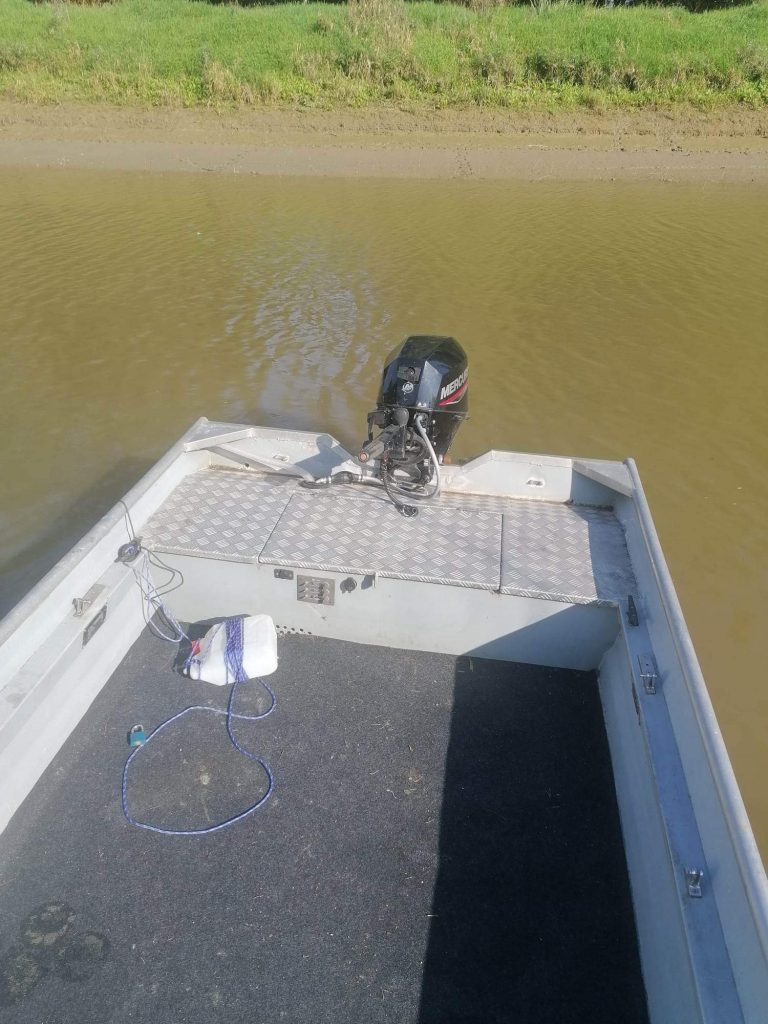
This is something I see directly when fishing from a friend’s small aluminum boat on the Drava and Danube.
In calm water or protected areas, a simple open fishing boat gives us exactly what we need: usable space, straightforward access and very little unnecessary complexity. But the main river is different from a quiet side channel. Once wind or wake begins moving the surface, ride quality becomes much more noticeable.
That is why I would never choose a river boat from the word river alone.
Choose it for the part of the river you actually fish.
Flat Bottom vs V Hull Stability Is More Complicated Than It Sounds
One of the biggest sources of confusion in the flat bottom vs V hull comparison is the word stability.
People often ask which boat is more stable as though there must be one answer.
There is not.
A broad flat-bottom hull normally has very good initial stability. Step slightly toward one side while the boat is sitting on calm water and it tends to resist that movement well.
That is the kind of stability anglers notice while casting.
A V-hull may lean more easily when weight is moved from one side to the other, particularly in smaller boats. That can make it feel less stable while stationary even though the boat may be considerably more comfortable once waves begin arriving.
So saying that a flat bottom is “more stable” without explaining the conditions can be misleading.
Likewise, saying a V-hull is “safer in rough water” should not be treated as permission to ignore boat size, freeboard, loading, weather or the manufacturer’s limitations. Hull shape cannot make a small craft appropriate for conditions it was never designed to handle.
Shallow Draft Does Not Mean the Whole Boat Can Run That Shallow
Draft is one of the strongest arguments for a flat bottom, but anglers should distinguish the hull from everything hanging beneath it.
The boat may float in remarkably shallow water while the outboard’s lower unit and propeller still extend much deeper.
That difference becomes important around rocks, timber, sandbars and rapidly changing river depths.
Loading also changes draft.
Add another angler, fuel, batteries, tackle, an anchor and a large outboard and the boat will sit lower than the same hull when almost empty.
This is why a manufacturer’s actual draft specification is more useful than claims that a particular style of boat will run in a certain number of inches of water.
The hull gets you part of the way.
The motor, total weight and how that weight is distributed determine the rest.
Fishing Space and Gear Layout Matter Too
Anglers sometimes spend so much time comparing hull performance that they forget they will eventually have to fish from the thing.
Look at where rods will go.
Check whether two anglers can cast without constantly crossing each other.
Think about battery placement, fuel, landing nets, anchors and tackle. Open every hatch. Sit where you would operate the boat. Imagine where the rod will be while fighting a fish.
A wide flat-bottom boat can be excellent here because it provides a simple working platform.
A well-designed V-hull can also have excellent deck space, especially as boat size increases, but do not compare overall length alone. Compare the actual usable fishing area.
Electronics deserve the same planning. Our fish finder mounting ideas cover removable, clamp-on and permanent mounting options that are particularly relevant to jon boats and other small craft.
The best hull is not very useful if the finished layout leaves you stepping over cables, rods and equipment all day.
What About a Modified-V Hull?
For many anglers, the real choice is not between two extremes.
A modified-V uses more V toward the bow to help the boat enter chop, while retaining a flatter running surface farther aft.
The idea is compromise.
You normally sacrifice some of the absolute shallow-water simplicity of a completely flat hull, but gain better tracking and a less punishing ride when the water becomes unsettled.
That makes modified-V aluminum boats particularly interesting for anglers who fish mixed water.
If your normal trip includes shallow protected areas but also requires travelling along a larger river or crossing an exposed lake, a compromise may make more sense than maximizing one characteristic.
A modified-V does not magically provide every advantage of both designs.
It simply moves the boat toward the middle of the spectrum.
Which Hull Should You Choose for Fishing?
Start with where the boat will spend most of its time, not with the fish species written on your tackle boxes.
Choose a flat bottom when your normal fishing involves shallow and protected water, standing and casting are important, deck space is valuable and rough-water travel is unusual.
Choose a V-hull when you regularly encounter wind chop, larger boat wakes, longer runs or more exposed water and are prepared to accept somewhat more draft in exchange for a smoother ride.
Consider a modified-V when your fishing genuinely falls between those two situations.
Then look beyond hull shape.
Compare beam, overall length, freeboard, capacity, engine rating, total boat weight, trailer requirements and the weight of everything you plan to carry.
Two boats both advertised as V-hulls can behave very differently.
So can two flat-bottom boats.
A Simple Decision Test
Ask yourself what would ruin more fishing trips:
Getting stopped by shallow water?
Or getting beaten up by waves on the way home?
That answer is often more useful than arguing about which hull design is theoretically better.
Common Mistakes When Comparing Flat Bottom and V-Hull Boats
Choosing from hull shape alone: Beam, length, freeboard and overall design can change stability and handling dramatically.
Treating every river as shallow, calm water: Large rivers can produce substantial wind waves and boat wakes.
Assuming a flat floor means a flat hull: Many V-hull boats have level interior floors. Look at the actual hull rather than the deck you stand on.
Judging stability only at the dock: A boat can feel exceptionally steady while stationary and still provide a harsh ride once the surface becomes rough.
Ignoring the normal load: Fuel, passengers, batteries, engines and fishing tackle affect draft and handling.
Buying for the rarest situation: Do not sacrifice the characteristics you use on 95 percent of your trips just to optimize for one unusual day each year.
Ignoring freeboard: Hull shape is not the only factor that matters when waves build. The height and design of the sides and bow also influence how suitable a boat is for exposed water.
Frequently Asked Questions
Is a Flat Bottom or V Hull Better for a River?
It depends on the river. Flat-bottom boats are excellent for shallow, protected rivers, backwaters and areas where low draft is important. A V-hull can be the better choice on large rivers with wind, heavy boat traffic, substantial wakes or long exposed runs. Modified-V boats are often useful where both conditions occur.
Is a V Hull More Stable Than a Flat Bottom?
Not necessarily. A wide flat-bottom boat normally has excellent initial stability in calm water and can feel steadier while standing or moving around. A V-hull generally handles chop more comfortably. The answer therefore depends on whether you mean stability while fishing at rest or behavior when travelling through rougher water.
Can a Flat-Bottom Boat Handle Waves?
Yes, within the limitations of the boat and conditions, but flat bottoms normally hit short waves more directly and can produce a harder, wetter ride than a comparable V-hull. As waves increase, speed often has to be reduced significantly.
Does a V-Hull Need More Water?
Usually. The V extends farther below the waterline than a comparable flat-bottom design, which generally increases draft. Exact figures depend on the individual boat, load and engine installation.
Are Flat-Bottom Boats Better for Fishing?
They can be excellent fishing platforms because they combine shallow draft, good stability at rest and efficient use of interior space. They are not automatically better when getting to the fishing area requires long runs across choppy or exposed water.
What Is the Best Hull for the Danube or Another Large River?
There is no single best hull for an entire large river. An angler concentrating on shallow backwaters may value a flat bottom, while somebody running considerable distances on the main channel may prefer a modified-V or V-hull for better ride quality in wind and wake. Choose around the sections and conditions you actually use.
Final Takeaway
The flat bottom vs V hull decision is not really about finding the superior boat.
It is about deciding which compromise suits your water.
Flat bottoms give anglers outstanding shallow-water access, good stability at rest and plenty of practical fishing space. V-hulls trade some of that shallow-water efficiency for better tracking and a smoother ride when waves and wakes become important.
For mixed conditions, a modified-V can sit between them.
Most importantly, do not choose from the hull label alone. Look at beam, freeboard, load, engine, draft and the actual conditions where the boat will spend its time.
A boat that perfectly matches your normal fishing water will be far more useful than one that wins a comparison table.
