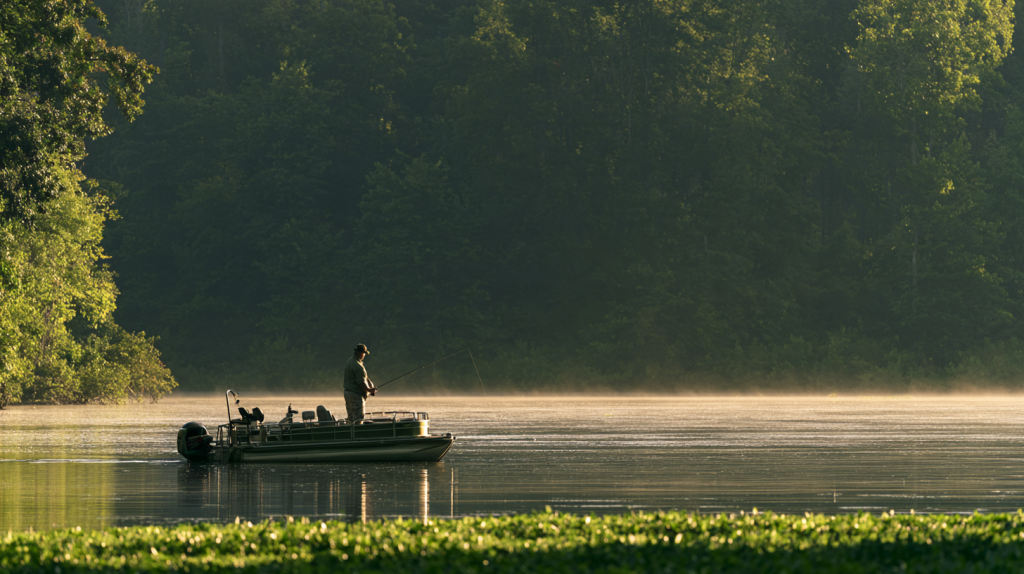
Bass fishing from pontoon boat platforms is more practical than many anglers assume. A pontoon may not turn, accelerate or hold a tight shoreline as easily as a dedicated bass boat, but it gives you a stable platform, plenty of casting space and access to water that shore anglers cannot reach.
The biggest challenge is not catching bass from one. It is controlling a relatively large boat well enough to make good casts repeatedly.
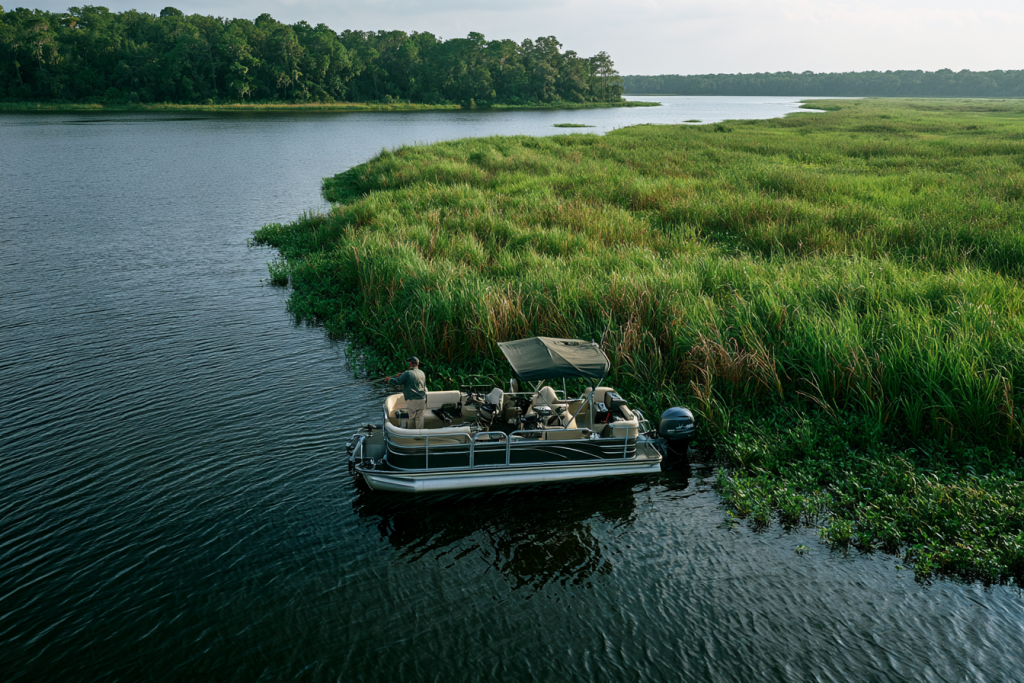
Instead of trying to fish a pontoon exactly like a smaller bass boat, use its strengths. Approach productive water slowly, keep the boat outside the cover, control your angle with wind and a trolling motor where available, and make deliberate passes along weed edges, docks, points and other likely bass habitat.
This guide refers to a conventional full-size recreational pontoon boat rather than a one-person inflatable fishing pontoon.
Can You Catch Bass From a Pontoon Boat?
Absolutely.
Bass fishing does not require a dedicated bass boat. Bass respond to habitat, food, seasonal conditions and lure presentation—not the style of boat floating above them.
A pontoon gives you access to a much larger part of a lake than shore fishing and allows you to change casting angles around cover without walking to another access point.
The main trade-off is precision.
A large pontoon has more surface area for wind to push, needs more room to turn and can be awkward when trying to squeeze into narrow pockets of vegetation or timber. The solution is normally to stay farther away and cast toward the cover rather than trying to drive directly into it.
If you need a broader refresher on location, depth and presentation, the general bass fishing tips guide covers that foundation. This article is specifically about making those decisions from a pontoon.
Bass Fishing From Pontoon Boat: Boat Control Comes First
The most important pontoon skill is learning to position the boat before worrying about which lure to throw.
A dedicated bass boat can change direction quickly and move down a shoreline with small adjustments. A pontoon usually requires more planning.
Decide what you want to fish before reaching it.
If the target is a weed edge, approach from far enough away that the boat can travel roughly parallel to the vegetation. If it is a dock, position yourself where several useful casting angles are available without drifting directly onto the dock.
When wind is present, think about where the boat will be after several casts rather than only where it is now.
A slow controlled pass is usually better than constantly correcting the boat after it has already drifted across the productive water. That keeps the lure in productive water longer and stops the boat from constantly crossing the same target line.
Pontoon Bass Fishing Quick Reference
| Pontoon challenge | What it changes | Practical adjustment |
|---|---|---|
| Wind pushes the boat | Casting angle changes quickly | Fish sheltered water or make controlled passes with the wind |
| Large turning radius | Tight cover becomes awkward | Stay outside the cover and cast toward it |
| High rails or furniture | Some casting angles are restricted | Establish one clear casting position |
| Large deck | Gear can spread everywhere | Keep rods, net and tackle out of walking areas |
| Main outboard | Too much power for fine positioning | Make the final approach slowly and use a trolling motor where available |
Position the Pontoon Before You Choose a Lure
Good bass fishing usually begins by finding something different from the surrounding water.
That might be the outside edge of vegetation, a dock creating shade, a submerged tree, a point extending into deeper water, an isolated clump of grass or a sudden depth change.
Weed Edges
Vegetation is particularly suited to pontoon fishing because you do not need to enter it.
Keep the boat in open water and follow the outside edge.
Cast parallel to the grass when possible. A parallel presentation keeps the lure near the vegetation considerably longer than repeatedly casting straight through the edge.
Also look for irregularities.
A point extending out from the weeds, a small opening, an isolated patch or a sudden change from thick to sparse vegetation can provide a more specific target than a perfectly uniform weed line.
Docks and Shaded Cover
Docks are another obvious target because a pontoon allows you to approach them from angles that may be unavailable from shore.
Do not motor directly beside every dock before making a cast.
Stay outside it and work the accessible corners, posts, shade lines and nearby depth changes first. If the layout allows safe and legal casting beneath part of the structure, a compact lure can reach water that receives less pressure.
Respect private property, other boats and people using the dock.
Submerged Wood
Fallen trees and submerged branches deserve attention, but a pontoon is rarely the boat to force deep into them.
Position outside the wood.
Start with the outer branches and gradually work closer. This gives you several presentations without putting the boat directly above the most useful part of the cover.
Points and Drop-Offs
One of the pontoon’s biggest advantages appears when bass are not tight to shoreline cover.
You can move offshore and fish points, deeper weed edges, humps and other depth changes that may be impossible to reach from the bank.
Electronics can make these areas easier to understand, but they are not mandatory. Visible shoreline shape, vegetation edges and changes in water depth can still give you starting points.
Use the Pontoon’s Strengths
The biggest difference from bass fishing from shore is that a pontoon lets you change casting angles without leaving productive water.
If one approach to a dock or weed edge does not work, move outside it and attack the same structure from another direction.
You can also carry several presentations without sacrificing mobility.
That does not mean turning the deck into a tackle store.
Two or three rods rigged for different jobs are usually more useful than ten rods lying across seats and walkways. Keep the active fishing area clear enough that somebody can move to the landing net without stepping over hooks, rods or loose tackle.
The stability of the platform also makes a pontoon comfortable for slower presentations.
When fish are concentrated around one productive area, there is nothing wrong with holding the boat nearby and thoroughly fishing it instead of constantly looking for somewhere new.
Best Lures for Pontoon Bass Fishing
Pontoon fishing does not require special pontoon lures.
Choose the presentation according to the habitat.
Weedless Soft Plastics
A Texas-rigged worm, creature bait or other weedless soft plastic is extremely useful around vegetation, docks and submerged wood.
It allows cover to be fished slowly while reducing the number of exposed hooks moving through branches and grass.
A weightless stick-style bait can also be useful when bass are holding around shallow shade or relatively calm cover.
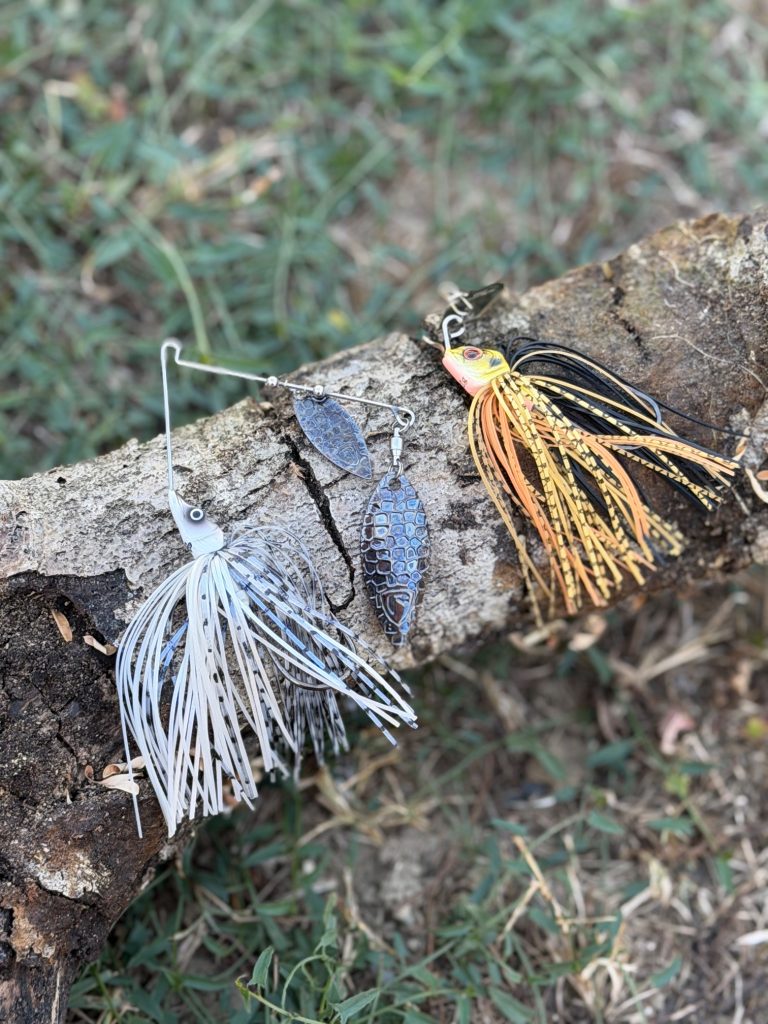
Spinnerbaits and Chatterbaits
Moving lures make sense when using a pontoon to cover longer stretches of shoreline or vegetation.
A spinnerbait can be worked around mixed cover and wood, while a chatterbait or bladed jig is particularly useful around grass and along weed edges.
If you are deciding between them, the chatterbait vs spinnerbait comparison explains where each design has the practical advantage.
Topwater Lures
Topwater presentations can be excellent around shallow vegetation, calm pockets and low-light periods.
A pontoon makes it easy to stay outside shallow cover and cast back toward it instead of moving directly over the area.
Crankbaits
Crankbaits become useful around rocky points, harder bottoms and open edges where treble hooks can be retrieved without constantly collecting vegetation.
The boat also lets you change casting direction until the lure contacts the useful part of a point or break at the right angle.
Finesse Presentations
When bass are concentrated around a smaller area, slow presentations can be extremely effective from a stable pontoon.
Instead of letting the boat drift rapidly through the spot, control its position and give the lure time to work.
Fishing From a Pontoon in Wind
Wind exposes the biggest weakness of bass fishing from pontoon boat setups.
A broad boat can begin moving while you are concentrating on a retrieve, and after several casts you may suddenly be much closer to the cover—or much farther away—than intended.
Try to use that movement rather than fight it continuously.
Position the boat so a light wind carries you along a productive edge instead of directly across it. Cast ahead and toward the cover while the boat travels slowly down the line.
If the wind becomes too strong for precise positioning, move into a protected cove, behind an island, onto the sheltered side of the lake or into another area where control improves.
Anchoring can be useful when you want to thoroughly fish one location, provided the water, traffic, weather and local rules make anchoring safe.
Do not become so focused on holding one fishing position that you ignore changing conditions or the trip back to the launch.
Keep the Pontoon Fishing Setup Simple
Large boats encourage anglers to bring too much equipment because space appears unlimited.
That can quickly work against you.
A practical pontoon bass setup might include a few versatile rods, a compact selection of lures for the available cover, pliers, cutters, a landing net, polarized sunglasses and the normal safety equipment required for the boat and location.
Keep one area dedicated to casting.
Rod tips should not extend through walkways. Open tackle boxes should not sit where somebody has to step over them. Loose lures should never be left where passengers can sit or walk.
If several people are fishing, agree on casting zones.
Two anglers can comfortably fish from many pontoons, but crossed casts become much more likely when everybody changes sides without warning.
The extra deck space is an advantage only when it remains organized.
Common Pontoon Bass Fishing Mistakes
Trying to Fish It Like a Bass Boat
A pontoon is not designed for constant tight turns and aggressive shoreline positioning.
Stay farther from cover and let casting distance do more of the work.
Driving Directly Over the Target
Seeing a promising patch of grass does not mean the boat needs to sit on top of it.
Stop outside the area and fish toward it first.
Making Every Correction With the Main Motor
Large corrections may require the outboard, but constantly starting and repositioning the boat is unnecessary when smaller adjustments would work.
Plan the approach earlier.
Letting Wind Decide Where You Fish
Drifting is useful when it follows productive water.
Randomly blowing across a flat is not a strategy.
Choose an angle that allows the wind to help rather than destroy the presentation.
Covering Water Without Fishing It Properly
Having a boat makes it tempting to keep searching for somewhere better.
When you find healthy vegetation, bait activity, useful shade or another combination of productive features, slow down and give the area a proper chance.
Ignoring Deck Organization
Hooks, rods, tackle and landing nets scattered across a large deck create problems when a fish is finally hooked.
Set up the working area before fishing begins.
Bass Fishing From a Pontoon Boat FAQ
Do you need a trolling motor for pontoon bass fishing?
No, but it can make precise positioning considerably easier. Without one, use the main motor for larger moves and then rely more heavily on controlled drifting or anchoring where safe and appropriate.
Can you fish docks effectively from a pontoon?
Yes. Stay outside the dock and use the pontoon’s position to create several casting angles. Avoid getting so close that the size of the boat limits your cast or disturbs other people using the area.
What is the best lure for bass fishing from a pontoon?
There is no pontoon-specific best lure. Match the lure to the cover: weedless plastics for heavy cover, moving baits for searching, topwaters around suitable shallow water and crankbaits around cleaner rock or harder structure.
Is a pontoon too big for bass fishing?
Not for most general lake fishing. Its size becomes a disadvantage mainly in extremely tight cover or when precise boat control is difficult. Keeping the pontoon outside the cover solves much of that problem.
Can several people bass fish from the same pontoon?
Yes, and the deck space is one of the platform’s advantages. Keep rods and tackle organized and establish casting areas so anglers are not constantly crossing lines.
Final Takeaway
Bass fishing from pontoon boat platforms works best when you stop trying to make the pontoon behave like a smaller fishing boat.
Use the space and stability. Stay outside the cover. Control the boat before making the cast, and use wind, casting angle and deliberate positioning to keep your lure in productive water.
The variable that matters most is boat position.
Put the pontoon in the right place and ordinary bass-fishing tactics still work perfectly well.