Choosing between a chatterbait vs spinnerbait can be confusing because the two lures occupy much of the same territory. Both are moving reaction baits, both use metal blades to create attraction, both can cover water quickly, and both can catch predatory fish in surprisingly similar conditions.
But they do not behave the same underwater.
A chatterbait — more generically called a bladed or vibrating jig — uses a blade directly in front of the jig head to create a strong side-to-side vibration. A spinnerbait suspends one or more rotating blades above and behind the hook on a wire frame, producing a different combination of flash, vibration and movement.
Neither is automatically better. The useful question is where are you fishing, what cover is present, how deep do you need the lure to run, and what type of presentation do you want?
Chatterbait vs Spinnerbait: What Is the Main Difference?
The biggest difference is the blade system.
A chatterbait has a flat metal blade immediately in front of its head. Water pressure makes that blade oscillate rapidly as the lure moves forward. Because the blade is directly connected to the lure, that movement transfers into the entire jig and skirt.
A spinnerbait uses an angled wire frame. The weighted head, skirt, and hook sit on the lower arm while one or more spinning blades are positioned on the upper arm.
Those rotating blades create flash and water displacement without making the entire lure shake in the same way.
That structural difference affects almost everything else: how the lure feels through the rod, how it comes through vegetation, how it handles wood, how easily it can be slow-rolled and the type of visual profile it presents.
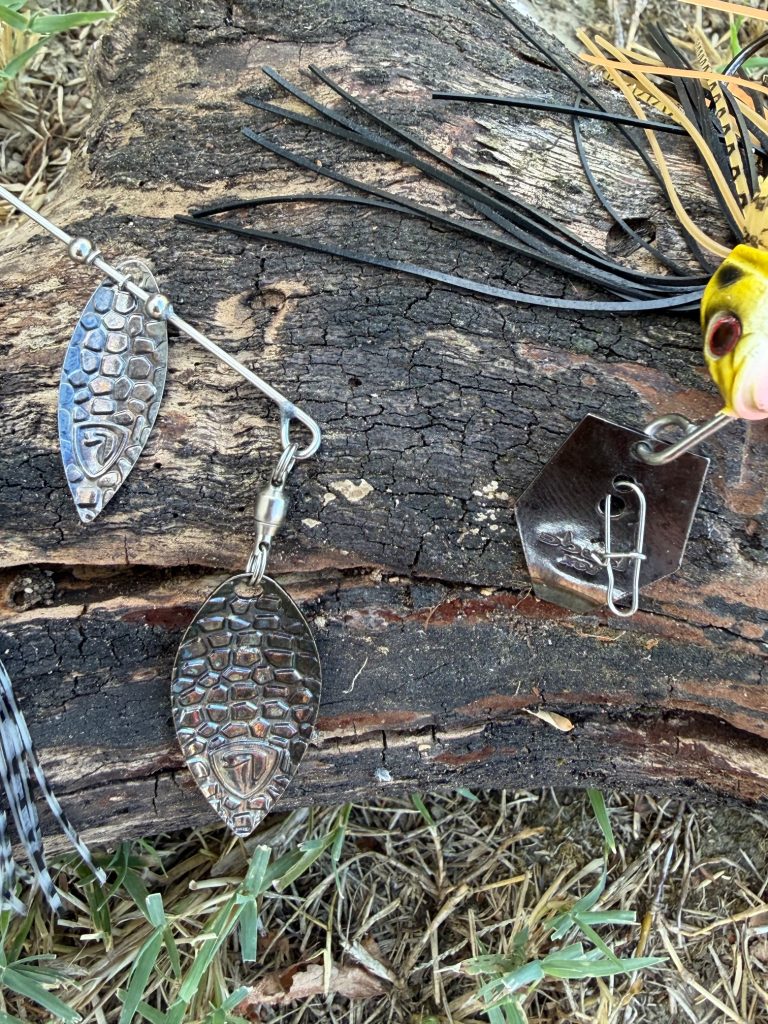
Strictly speaking, ChatterBait® is a Z-Man brand name. “Bladed jig” or “vibrating jig” is the generic term, although chatterbait has become the common search term anglers use for this style of lure. Z-Man describes its Original ChatterBait as using a direct head-to-blade connection that produces vibration, flash and action through the whole bait.
How a Chatterbait Works
A chatterbait is essentially a jig with a blade attached in front.
Once the retrieve begins, water pressure catches the blade and forces it to oscillate. The vibration is usually very obvious through the rod.
That feedback is useful.
If a properly working chatterbait suddenly stops vibrating, it may have collected weed, contacted something underwater or been struck by a fish.
The lure normally consists of:
- a metal front blade,
- a weighted jig head,
- a single hook,
- a silicone or rubber skirt,
- and often a soft-plastic trailer.
The whole package moves as one unit.
That makes chatterbaits particularly effective when you want a strong moving presentation without the wider wire frame of a spinnerbait.
They can be retrieved steadily, ripped out of vegetation, paused briefly, allowed to fall or worked with changes in speed.
How a Spinnerbait Works
A spinnerbait separates the blade from the hook and body.
The bent wire frame holds the blade above the weighted head and hook. Depending on the design, there may be one blade, two blades or occasionally more.
As the lure moves, the blades rotate around swivels or clevises rather than oscillating directly against the head.
Different blade shapes also change the lure considerably.
A broad blade generally produces more noticeable resistance and pulse, while a narrower blade can usually be retrieved faster with less lift and often creates stronger flashes as it rotates.
The wire frame has another major advantage: it helps deflect the hook away from many branches, reeds and other obstacles.
That is one reason spinnerbaits have remained such effective cover-fishing lures.
Chatterbait vs Spinnerbait Comparison
| Feature | Chatterbait / Bladed Jig | Spinnerbait |
|---|---|---|
| Main blade action | Front blade oscillates | One or more blades rotate |
| Feel through rod | Strong, direct vibration | Steadier pulsing resistance |
| Flash | Moderate to strong depending on blade | Usually stronger and more continuous |
| Grass | Excellent around sparse vegetation and edges | Good, but blades can collect vegetation |
| Wood | Usable but exposed hook can snag | Usually better due to wire frame |
| Open water | Excellent | Excellent |
| Slow rolling | Good with correct weight | Excellent |
| Skipping | Generally easier | Awkward because of wire frame |
| Stop-and-go retrieve | Very effective | Possible, but less natural |
| Trailer | Commonly used | Optional depending on presentation |
| Best use | Grass, flats, reaction fishing | Wood, wind, depth control, mixed cover |
The table is a starting point rather than a set of rules.
You can catch fish on either lure in almost every condition listed above.
The point is to choose the lure that makes the job easier.
When to Use a Chatterbait
Around submerged grass
Grass is probably the strongest argument for choosing a chatterbait.
A bladed jig can be retrieved above vegetation, along weed edges or through relatively sparse stems. This also makes it a strong option for bass fishing from shore, where weed edges and shallow cover are often within easy casting range.
When the lure begins to catch vegetation, a sharp acceleration or rod movement can often free it. That sudden release can also produce an erratic change of direction.
You should still expect some weed to reach the exposed hook. A chatterbait is not magically weedless.
But compared with a spinnerbait carrying multiple rotating blades and swivels above the lure, the compact design can be much easier to work around certain types of vegetation.
Professional bass-fishing sources make the same practical distinction: chatterbaits are commonly favored around grass, while spinnerbaits often gain the advantage around harder cover such as wood.
When you want a compact vibrating target
The blade makes the entire chatterbait pulse.
That gives you a relatively compact lure with a lot happening around it.
This can be useful when fish appear willing to chase but you want more vibration than a standard swim jig or soft plastic provides.
When skipping under cover
The compact body also makes a chatterbait much easier to skip than most spinnerbaits.
Docks, overhanging branches and similar targets can therefore favor the bladed jig even when both lures would otherwise work.
When a straight retrieve is not producing
A chatterbait responds well to changes in speed.
Try accelerating it, briefly killing the retrieve, ticking vegetation and ripping it free, or occasionally letting it fall before restarting.
You do not need to constantly jerk the lure.
Small disruptions to an otherwise steady retrieve are often enough.
When to Use a Spinnerbait
Around wood and branches
This is where the spinnerbait’s unusual shape becomes an advantage.
The upper wire arm often contacts an obstacle before the hook does. With a controlled retrieve, the lure can roll or deflect around branches that would catch a more exposed jig.
That does not make it snag-proof.
But if I had to choose between the two around submerged branches, laydowns or similar hard cover, I would normally start with the spinnerbait.
In wind and surface chop
Spinnerbait blades can create conspicuous flashes as they rotate.
A little chop also breaks up the surface and reduces the unnaturally clear view fish may otherwise have of a large wire lure.
This is one reason windy banks are classic spinnerbait water.
When you need to slow down
A spinnerbait can be very effective when retrieved slowly enough to keep the blades turning while maintaining the desired depth.
This technique is usually called slow rolling.
Heavier spinnerbaits can be worked deeper along drop-offs, points, weed edges and near the bottom while still producing blade movement.
A chatterbait can also be fished deep, but the spinnerbait often gives the angler a particularly wide range of retrieve speeds.
When you want more blade options
Spinnerbait blade configuration is extremely adjustable.
Changing blade size, shape, number and finish changes lift, flash, resistance and vibration.
A chatterbait offers variations too, but a conventional spinnerbait gives you more obvious ways of changing the blade package itself.
Does Water Clarity Change the Choice?
Yes, but not in the simple way lure packaging sometimes suggests.
Predatory fish still have to detect and locate prey before they can attack it.
Research on largemouth bass has shown that increasing turbidity changes feeding behavior and reduces the distance and efficiency with which bass can locate some prey.
That is where vibration, profile, contrast and flash become worth thinking about.
In stained water, I would normally lean toward a lure the fish can locate easily rather than obsessing over an exact color formula.
Both chatterbaits and spinnerbaits can provide that.
The chatterbait offers strong direct vibration. The spinnerbait can combine pulse with repeated flashes from rotating blades.
So instead of assuming “dirty water equals chatterbait” or “dirty water equals spinnerbait,” look at the other conditions too.
If that dirty water is full of submerged grass, the chatterbait may make more sense.
If it contains laydowns, branches and hard cover, the spinnerbait may be easier to fish effectively.
The research supports the importance of visibility and turbidity to bass feeding, but it does not prove that either lure type is universally superior in murky water.
Grass vs Wood: The Simplest Way to Choose
If you only remember one practical rule from this comparison, make it this:
Grass pushes me toward a chatterbait. Wood pushes me toward a spinnerbait.
It is not absolute, but it is a very useful starting point.
With submerged grass, retrieve a chatterbait just above the tops or alongside the edge.
If you feel it beginning to load with vegetation, accelerate it or snap it free.
Around branches, slow the spinnerbait slightly before impact and let the wire frame contact the obstacle rather than trying to blast through it at maximum speed.
Rocks are less clear-cut.
Either lure can work over stone, riprap and harder bottoms.
The spinnerbait usually wins if snag avoidance matters more, while the chatterbait is useful when you deliberately want the head to contact or deflect from isolated hard objects.
Which One Is Better for Fishing Deeper?
Weight matters more than lure category.
A light chatterbait retrieved quickly will naturally ride higher than a substantially heavier version fished slowly.
The same is true of spinnerbaits.
Your 10 g and 22 g lures, for example, are not interchangeable simply because the skirt and blade style are similar. The heavier lure gives you much more control when you want to reach deeper water, hold the lure down in current or retrieve faster without immediately pulling it toward the surface.
For shallow water, lighter versions can be easier to keep above weed and structure.
For deeper edges, channels or stronger current, heavier versions become much more useful.
With spinnerbaits, blade size can also affect how much the lure wants to rise. A large blade generates more resistance and lift than a smaller, narrower blade.
That means lure weight and blade configuration need to be considered together.
What Colors Should You Use?
Color should match the job rather than follow a rigid chart.
If you are deciding whether a luminous finish is worth using in low light, see our guide to whether glow in the dark lures work.
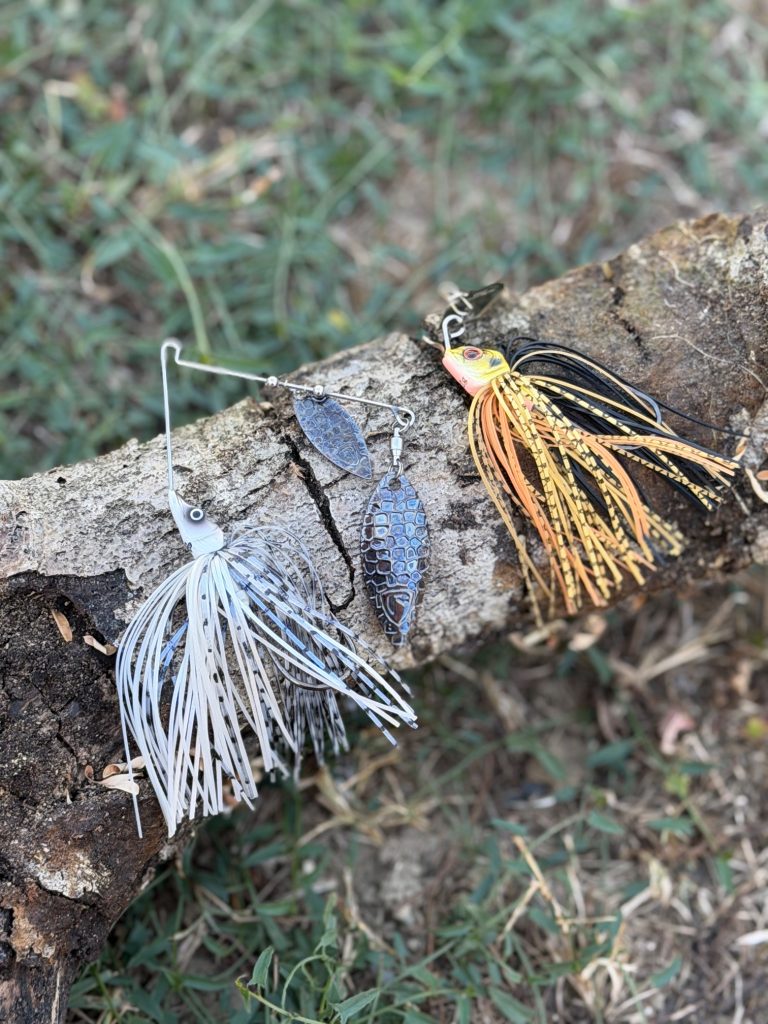
You already have three useful extremes in your own tackle box.
Black creates a strong silhouette and is a logical option in low light or when you want a very obvious profile.
Black and silver gives you more of a conventional baitfish appearance, particularly when the blade or body can catch available light.
Firetiger provides very high visual contrast and is worth trying in stained water or anywhere a natural baitfish pattern is disappearing into the background.
But fish behavior should override theory.
If you are getting follows, bumps or obvious interest without committed takes, changing from a highly visible pattern to something subtler — or doing the reverse — can be more useful than immediately changing lure type.
Do You Need a Trailer?
A soft-plastic trailer is extremely common on chatterbaits.
It adds body, changes the overall profile and can influence how the lure moves.
Paddle tails, minnow shapes and other streamlined plastics are all used.
The important thing is making sure the trailer does not fight against the blade action.
Check the lure beside the bank before making a full cast.
If the trailer causes the entire bait to roll unnaturally, rig it straighter or try a different shape.
Spinnerbaits can be used with or without a trailer.
Sometimes the skirt and blade package already provides enough bulk. A trailer can add size, movement and a different profile when required.
Again, there is no need to add one merely because somebody else does.
Chatterbaits and Spinnerbaits Are Not Just Bass Lures
Most chatterbait vs spinnerbait discussions are centered on bass fishing, but the underlying lure mechanics are useful for other predatory fish too.
Pike in particular readily attack skirted moving lures.
When pike are present, however, the lure choice is only part of the setup. Their teeth can damage ordinary fishing line, so use leader material appropriate for toothy predators. FishingChief’s guide on pike teeth and leader considerations explains why.
The same general approach applies regardless of species:
- use the lure that fishes the available cover cleanly,
- choose enough weight for the depth,
- make sure the lure is working properly,
- and adjust based on actual fish response rather than lure reputation.
What If Fish Hit the Lure but Do Not Get Hooked?
First determine whether it is really a missed strike.
With a chatterbait, the blade can temporarily stop when it touches weed, rock or other structure. That can feel surprisingly similar to contact from a fish.
When the rod actually loads, keep pressure and sweep into the fish rather than making an enormous overhead hook set.
With spinnerbaits, fish sometimes strike the blades or skirt without properly taking the hook.
If you repeatedly feel obvious bumps but never connect, experiment with retrieve speed and lure profile before changing everything.
A slightly slower retrieve may give the fish more time to take the lure.
A smaller overall bait can also help when fish are clearly attacking but not committing.
For a broader troubleshooting process, see fish biting but not getting hooked.
Common Chatterbait vs Spinnerbait Mistakes
Assuming chatterbaits are weedless: They are excellent around many types of vegetation, but the single exposed hook can still collect weed and snag hard cover.
Fishing a spinnerbait too fast through branches: Let the wire frame do its job. A controlled retrieve gives the lure time to deflect.
Choosing entirely by water clarity: Visibility matters, but cover, depth and retrieve speed often make the decision easier.
Ignoring lure weight: A 10 g lure and a 22 g lure can behave very differently even when their overall design looks almost identical.
Using one retrieve all day: Both lure types can be sped up, slowed down and worked at different depths.
Changing lure type when the current lure is fouled: Check the blade and hook before deciding the fish have stopped responding.
Assuming one lure permanently replaces the other: There is too much overlap. Carrying both makes far more sense.
Chatterbait vs Spinnerbait FAQ
Is a chatterbait better than a spinnerbait?
Not overall. A chatterbait often has an advantage around submerged grass and when you want aggressive direct vibration. A spinnerbait is usually easier to fish around wood, gives you extensive blade options and can be particularly effective when slow-rolled.
When should I use a chatterbait instead of a spinnerbait?
Start with a chatterbait around grass, shallow flats, weed edges and situations where a compact vibrating lure makes sense. It is also easier to skip beneath docks and overhanging cover.
When should I use a spinnerbait instead of a chatterbait?
Choose the spinnerbait when fishing branches, timber and mixed hard cover, or when you want to manipulate blade size and retrieve speed extensively. Windy banks are another classic spinnerbait situation.
Is a chatterbait good in muddy water?
It can be. The lure creates strong vibration, which makes it an obvious moving target. But spinnerbaits can also work extremely well in poor visibility. Cover, depth and retrieve style should help make the final choice.
Which lure is better around weeds?
A chatterbait is usually my first choice around submerged grass and weed edges. It can be retrieved above the vegetation and ripped free when it begins to catch strands. Neither lure is completely immune to fouling.
Which is better around wood?
Usually the spinnerbait. Its wire frame helps keep the hook away from branches and allows the lure to deflect around many obstacles more cleanly.
Can you fish a chatterbait slowly?
Yes, especially with enough weight to keep it down. However, a spinnerbait often gives you more freedom when extremely slow presentations and deeper slow rolling are required.
Can pike be caught on chatterbaits and spinnerbaits?
Absolutely. Both create the flash, vibration and moving profile that predatory pike will attack. Use suitable leader material where pike are present.
Final Takeaway
The chatterbait vs spinnerbait decision becomes much easier once you stop asking which lure is universally better.
Use the cover to make the first decision.
If you are fishing submerged grass, weed edges or need a compact vibrating bait that can be skipped, start with the chatterbait.
If you are working through branches, fishing windy banks, slow rolling deeper water or want more control through blade configuration, start with the spinnerbait.
Then adjust for depth, water clarity, weight, color and fish response.
And if conditions fall somewhere in the middle, there is no reason to overthink it.
Tie one of each on.
Let the fish decide.