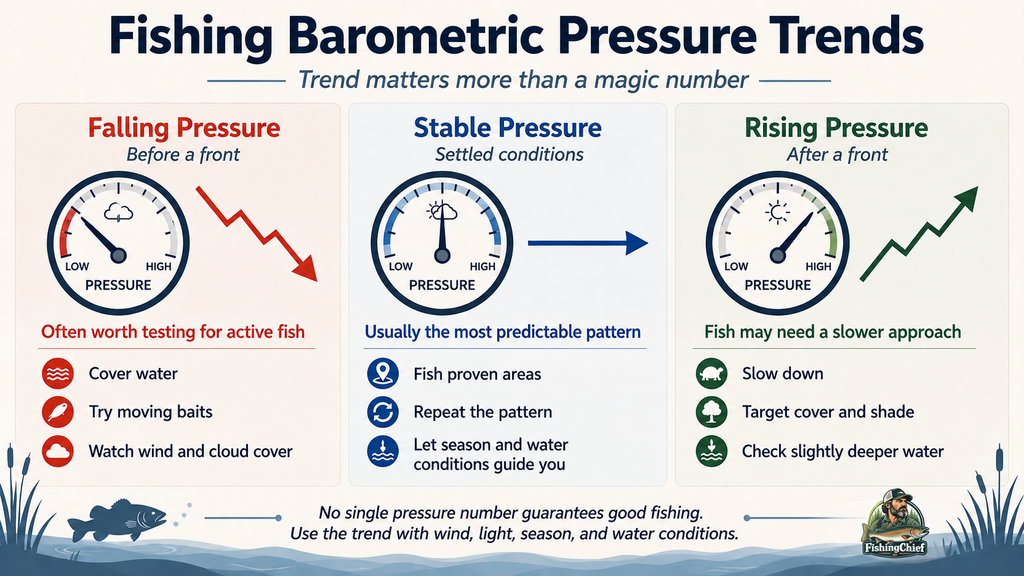
The best barometric pressure for fishing is not one magic number. A pressure trend that accompanies favorable weather changes is usually more useful than whether the barometer happens to read 29.8, 30.0, or 30.2 inches of mercury.
Anglers often pay closest attention to falling pressure ahead of an approaching front, because the changing cloud cover, wind, light, and other conditions can create a productive feeding window. Stable weather can also produce consistent fishing, while the clear, rapidly changing conditions immediately after a front can sometimes make fish harder to catch.
Is There Really a Best Barometric Pressure for Fishing?
A common fishing chart might tell you that 29.70 to 30.20 inHg is good, anything above that is poor, and low pressure is either excellent or terrible depending on which chart you read.
That should tell you something.
There is no well-supported universal pressure range at which fish suddenly become more willing to bite.
Standard sea-level atmospheric pressure is about 29.92 inHg, or 1013.25 hPa, according to the National Weather Service. That number is a meteorological reference point, not an optimum fishing pressure.
A reading around 29.92 inHg can occur while pressure is:
- falling quickly ahead of a front;
- sitting almost unchanged during settled weather;
- rising after a storm has passed.
Those are three very different fishing situations despite showing the same number at some point.
Fishing Pressure Quick-Reference Table
| Pressure Situation | Situation What It Often Means | Fishing Approach |
|---|---|---|
| Falling steadily | Weather system or front approaching | Cover water and test more active presentations |
| Stable for many hours | Settled conditions | Fish established patterns and productive structure |
| Rising quickly after a front | Weather clearing and conditions changing | Slow down, tighten target areas and fish cover carefully |
| Stable high pressure | Often clear, bright, settled weather | Focus on shade, depth, cover and low-light periods |
| Stable low pressure | Often cloudy or unsettled weather | Let actual wind, light, temperature and fish activity guide tactics |
The table is a starting point, not a bite forecast. Water temperature, season, species, light, wind, dissolved oxygen, forage availability, and fishing pressure can all matter as much as—or more than—the barometer.
Why Falling Barometric Pressure Gets So Much Attention
Falling pressure is closely associated with approaching weather systems. That can mean increasing clouds, changing wind, reduced light penetration, rain, and a general shift from settled conditions.
Those changes can affect the entire food chain.
Wind can move plankton and small prey. Baitfish may reposition. Reduced light can give predators an advantage. Waves may break up an otherwise bright, calm surface. A fish that was reluctant to move far under clear skies may suddenly have better conditions for feeding.
That is why “fish the falling barometer” can be useful advice even if atmospheric pressure itself is not the sole reason the bite improves.
Research also shows why it is risky to isolate pressure from the rest of the weather. A telemetry study of gray triggerfish during hurricanes found large changes in fish movement, but wave-generated water movement explained their behavior better than barometric pressure did.
The practical lesson is simple: use the barometer as an indicator that conditions are changing, not as a remote control for fish.
Does Barometric Pressure Really Affect Fish?
Fish can respond to changes in environmental pressure, and many bony fish use a gas-filled swim bladder to regulate buoyancy.
That has led to a popular explanation: atmospheric pressure falls, the swim bladder expands, the fish becomes uncomfortable and changes depth or feeding behavior.
The physics behind pressure and gas volume is real. The leap from that physics to predictable feeding behavior is much less certain.
Fish routinely experience substantial pressure changes simply by moving vertically through the water. Atmospheric weather changes are relatively small compared with the hydrostatic pressure differences fish encounter as depth changes.
More importantly, studies examining actual fish behavior and angling success do not produce a simple universal rule.
A long-term study of targeted walleye and muskellunge fishing on Wisconsin’s Escanaba Lake included barometric-pressure trends among numerous environmental and angler variables. Pressure changes were not among the strongest predictors of fishing success, while factors connected with anglers, bait, timing and other conditions often mattered more.
That does not mean barometric pressure is useless. It means an angler should avoid treating a particular reading as biological certainty.
How to Fish a Falling Barometer
A falling barometer ahead of an approaching front is one of the situations worth watching closely.
If the water has been relatively stable and fish begin feeding more actively, take advantage of it rather than automatically fishing cautiously.
Cover Water First
Start with presentations that let you contact active fish efficiently.
Depending on the species, that might mean moving baits, faster retrieves, searching different depths or working several pieces of productive structure before slowing down.
Do not interpret “falling pressure” as an instruction to fish fast regardless of what the fish show you. It simply gives you a reason to test for increased activity.
Watch Wind and Light
The accompanying weather can matter more than the pressure reading.
A strengthening wind may create a productive windward bank or concentrate forage. Increasing cloud cover can reduce harsh light. Slightly stained water may let predators roam farther from cover.
If the pressure is dropping but none of the other conditions are favorable, there is no reason to assume the bite must suddenly become excellent.
Keep an Eye on Safety
A productive pre-front bite is never a reason to remain exposed to dangerous weather.
Thunderstorms, lightning, high winds and rapidly deteriorating water conditions override any fishing advantage a falling barometer might provide.
How to Fish After the Pressure Starts Rising
The period immediately after a front is where anglers often blame “high pressure” for difficult fishing.
The barometer may be rising, but several other things may have changed at the same time: cloud cover disappears, sunlight becomes stronger, wind changes direction, temperature drops and shallow water may become noticeably clearer or calmer.
Fish do not have to stop feeding completely. Their position and willingness to chase may simply change.
Slow the Presentation
If reaction presentations stop producing, reduce speed before abandoning an otherwise productive area.
Give fish longer to inspect the bait and avoid making unnecessary lure changes every few casts.
Fish Tighter to Cover
Bright post-front conditions can make shade, vegetation, docks, timber, rocks, depth changes and other forms of cover more important.
Instead of covering hundreds of yards quickly, concentrate casts around the highest-quality targets.
Check Deeper Water
Some fish may shift vertically or move toward more secure structure as conditions change.
That does not mean every species automatically “goes deep when pressure rises.” Treat depth as something to test rather than a rule.
Stable Pressure Can Be Excellent for Fishing
Pressure does not need to be falling for fishing to be worthwhile.
Several days of relatively stable weather allow fish and forage to establish consistent patterns. Once you locate that pattern, the fishing can be easier to repeat than during a rapidly changing weather system.
Stable conditions are especially useful when trying to determine whether fish are responding to:
water temperature, depth, cover, current, forage, time of day or another variable.
When the weather is changing every few hours, it becomes harder to separate one influence from another.
For many anglers, a predictable bite under stable pressure is more useful than chasing a theoretical “perfect” number.
Don’t Compare Pressure Numbers Without Considering Altitude
There is another reason fixed barometric-pressure charts can be misleading: not every pressure display represents exactly the same thing.
Atmospheric pressure decreases as elevation increases. Weather services therefore commonly convert observations to equivalent sea-level pressure so readings from different locations can be compared. The National Weather Service identifies 29.92 inHg, or 1013.25 mb, as standard sea-level pressure.
A phone weather app may therefore show sea-level-adjusted pressure, while a local instrument may show actual station pressure.
For fishing, the easiest solution is not to obsess over the absolute number.
Use the same weather source consistently and watch how the reading changes over several hours.
Pressure Is Only One Part of the Fishing Equation
Barometric pressure becomes most useful when combined with other observations.
If the barometer is falling, ask what else is happening.
Is cloud cover increasing? Has the wind changed? Is a cold front approaching? Is water temperature stable? Are baitfish moving? Has rain increased current or changed water clarity?
Likewise, do not automatically blame poor fishing on high pressure.
A difficult day may have more to do with cold water, excessive sunlight, fishing pressure, poor lure placement, inactive forage or simply fishing an unproductive location.
Scientific results reflect that complexity. Studies have documented relationships between storms, pressure and fish movement, but they also show that associated environmental factors can explain more of the response than atmospheric pressure by itself.
Frequently Asked Questions
What barometric pressure is good for fishing?
There is no proven universal number. Around 29.92 inHg is standard sea-level atmospheric pressure, but that is not a biological optimum. Watch whether pressure is falling, stable or rising and combine that with the rest of the weather.
Is fishing better when barometric pressure is rising or falling?
Falling pressure ahead of a front can coincide with very good fishing, but it is not guaranteed. The associated changes in cloud cover, wind and light may be as important as the pressure change itself.
Is high barometric pressure bad for fishing?
Not necessarily. Stable high pressure can still produce good fishing. Bright, calm post-front conditions may make some fish harder to locate or less willing to chase, so targeting cover, shade, depth and low-light periods can help.
How fast should barometric pressure change before it matters?
There is no scientifically established fishing threshold that applies across species and waters. Instead of chasing a specific rate, look for a clear multi-hour trend and the weather changes accompanying it.
Should I cancel a fishing trip because the pressure is wrong?
No. Pressure is only one variable. If conditions are safe, use the barometer to help choose tactics rather than allowing one reading to decide whether you fish.
Final Takeaway
The best barometric pressure for fishing is not a specific number on a chart. The most useful information is whether pressure is changing and what weather is arriving with that change.
Watch the trend, then watch the water.
A falling barometer can be a signal to test for active fish before a front. Stable pressure can produce reliable patterns. If a front passes and conditions become bright and difficult, slow down and fish high-quality cover or structure more carefully.
Use barometric pressure as one clue—not as the answer.