
The pickerel vs pike question sounds simple until a long, toothy green fish comes over the side of the boat. Chain pickerel and northern pike have the same general body shape, belong to the same fish family and can look surprisingly similar at a glance.
Fortunately, several features separate them reliably — and you do not have to judge the fish by color alone.
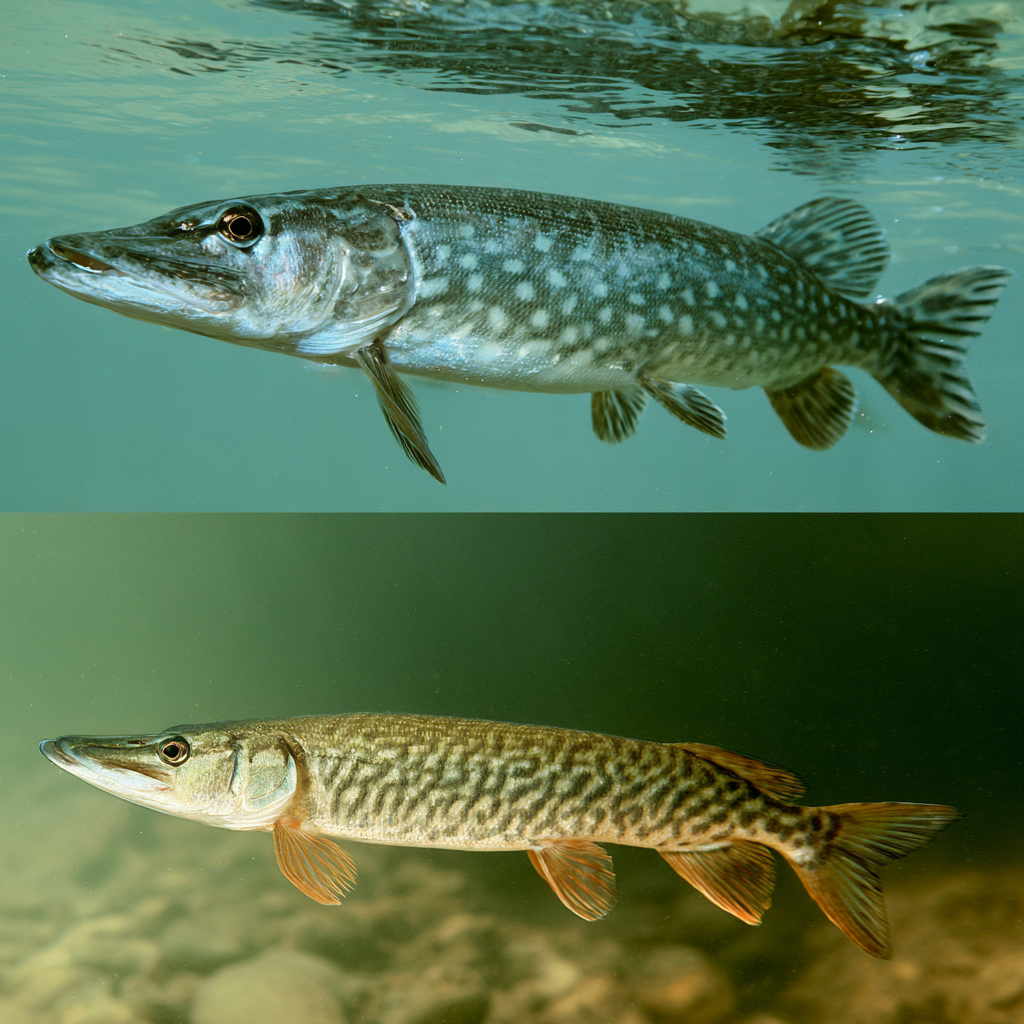
Pickerel vs Pike: Quick Comparison
| Feature | Chain Pickerel | Northern Pike |
|---|---|---|
| Scientific name | Esox niger | Esox lucius |
| Body pattern | Dark chain-like network on lighter sides | Light spots or short markings on darker sides |
| Dark bar below eye | Usually obvious | Usually absent |
| Cheek scales | Fully scaled | Fully scaled |
| Gill-cover scales | Fully scaled | Mainly upper portion scaled |
| Lower-jaw sensory pores | Usually 4 pairs | Usually 5 pairs |
| Overall size | Smaller species | Considerably larger potential size |
| General distribution | Primarily eastern North America | Much broader northern distribution |
The fastest visual clues are usually the body markings and the bar beneath the eye. If the fish is unusually colored, small, damaged or otherwise difficult to identify, gill-cover scaling and jaw pores give you better confirmation. Fisheries agencies use these structural characteristics to separate the species.
What Is the Difference Between a Pickerel and a Pike?
In this comparison, “pickerel” means the chain pickerel (Esox niger), while “pike” means the northern pike (Esox lucius).
They are different species, but they are close relatives. Both belong to the genus Esox and the pike family, Esocidae. That explains the similar long bodies, flattened duckbill-like snouts, rear-positioned dorsal fins and mouths full of sharp teeth.
There are other pickerels as well, including redfin and grass pickerel. The word therefore describes more than one fish rather than simply being another official name for northern pike.
There is one extra source of confusion for Canadian anglers: “pickerel” is also commonly used as a regional name for walleye. Walleye belong to the perch family and are not pickerel in the biological sense. Ontario government fishing information specifically acknowledges this use of the name.
So if someone says they caught a pickerel, geography matters.
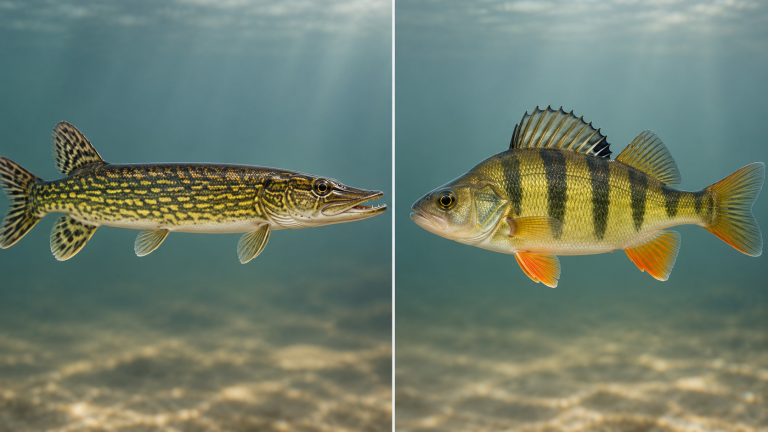
If the comparison is with a deeper-bodied perch instead, our pickerel vs perch guide explains the differences in body shape, markings, fins, teeth and fishing behavior.
How to Identify Pickerel vs Pike
Look at the Pattern on the Sides
Body markings provide the easiest starting point.
Adult chain pickerel are named for the dark, interlocking pattern running along their greenish sides. It can look like a chain-link fence or a network of irregular lines.
A northern pike reverses the general visual effect. The body is usually darker olive or green, with lighter oval spots or short pale markings.
A useful memory aid is:
Pickerel: dark markings on light.
Pike: light markings on dark.
Color itself can vary with water clarity, habitat, age and the individual fish, so pattern is more useful than deciding whether a fish looks “green enough” to be one species or the other. Maryland fisheries guidance specifically highlights the chain-like pattern as a distinguishing feature of chain pickerel.
Check for the Dark Bar Below the Eye
One of the best quick clues on a chain pickerel is the dark vertical mark directly below the eye.
It is often strong enough to be visible immediately in a clear photograph.
Northern pike do not normally have this conspicuous sub-eye bar. If the fish has a textbook chain pattern plus a strong dark stripe beneath the eye, chain pickerel becomes the much more likely identification. West Virginia and Maryland fisheries agencies both list the eye bar as a useful chain-pickerel characteristic.
Do not rely on one marking alone, however. Muddy water, poor photographs, juvenile coloration and unusual individuals can make visual identification less obvious.
Examine the Cheek and Gill Cover
When the pattern leaves doubt, scale coverage around the head is considerably more useful.
A chain pickerel has scales covering both the cheek and essentially the entire gill cover.
A northern pike also has a fully scaled cheek, but the lower part of its gill cover is largely unscaled. Maine fisheries guidance specifically uses this feature when distinguishing the two species.
This may require looking at the fish closely, but it is especially valuable when identifying smaller fish whose body markings are less obvious.
Count the Pores Under the Lower Jaw
For an even stronger identification, look beneath the lower jaw.
Northern pike generally have five pairs of sensory pores, while chain pickerel normally have four pairs.
This is not usually the first thing an angler will check while holding a fish, but it is a useful tie-breaker when a positive species identification matters.
Use several characteristics together rather than treating any single visual feature as infallible.
Pickerel vs Pike Size: Which Gets Bigger?
Northern pike win this comparison easily.
Chain pickerel can become impressive fish, but northern pike have a much higher growth ceiling. The U.S. Fish & Wildlife Service notes that northern pike can reach lengths around 4.5 feet and weights exceeding 60 pounds at the extreme upper end of the species. USGS lists chain pickerel to approximately 99 centimeters, or about 39 inches, in its species profile.

That difference becomes even clearer when looking at record fish.
The long-standing IGFA All-Tackle northern pike record is 55 pounds, 1 ounce, caught in Germany in 1986. The recognized 9-pound, 6-ounce chain pickerel caught in Georgia in 1961 remains dramatically smaller by comparison.
Records represent exceptional fish rather than normal catches, but they demonstrate just how much larger northern pike are capable of becoming.
Do Pike and Pickerel Live in the Same Places?
There is overlap, but their overall ranges differ.
Chain pickerel are primarily an eastern North American species. USGS describes their native range as extending along Atlantic and Gulf Coast drainages, with additional populations elsewhere through natural distribution and introductions. They commonly use vegetated lakes, swamps, backwaters and quiet sections of rivers and streams.
Northern pike have a much broader northern distribution across North America as well as Europe and Asia. They use lakes, reservoirs, rivers, backwaters and other freshwater habitats, often associating with vegetation and structure from which they can ambush prey.
Both species can therefore turn up around weed beds and shallow cover, so habitat alone is not a reliable identification method.
Are Pickerel and Pike Similar to Catch?
Very much so.
Both are ambush predators built to accelerate quickly after prey. They feed heavily on other fish and regularly strike moving lures.
That means many of the same lure categories can catch both species: spoons, spinnerbaits, jerkbaits, swimbaits and other presentations that imitate vulnerable forage can all produce fish under the right conditions.
Their mouths also contain sharp teeth. Identification should be done without placing fingers inside the mouth; suitable long-nose pliers make hook removal considerably easier.
That is as far as the teeth discussion needs to go here — the detailed structure, replacement and handling implications deserve their own article.
Can Northern Pike and Chain Pickerel Hybridize?
Yes, although it is not something most anglers will encounter regularly.
Natural hybrids between northern pike and chain pickerel have been documented, and USGS maintains records for the hybrid Esox lucius × niger. Maine fisheries information also notes that hybrids can display characteristics associated with either parent species.
That is another reason not to depend entirely on body color.
If a fish shows an unusual mixture of characteristics and correct identification matters for harvest regulations, photograph it clearly and consult the appropriate local fisheries agency rather than guessing.
Why Correct Identification Matters
Knowing the difference is more than fish trivia.
Fishing regulations can differ by species, location and waterbody. Size limits, possession limits, protected status and invasive-species rules are all jurisdiction-specific.
A fish that merely “looks like a pike” should therefore not automatically be treated as one when regulations differ.
Always check the current rules for the water you are fishing. A quick photograph of the full side of the fish, head and lower jaw can also make later identification much easier.
Frequently Asked Questions
Are pickerel and pike the same fish?
No. Chain pickerel and northern pike are separate species, although both belong to the genus Esox and the pike family.
What is the easiest way to tell a pickerel from a pike?
Start with the markings. Chain pickerel usually have dark chain-like markings and a dark bar below the eye. Northern pike generally have light spots on a darker body. Gill-cover scales provide a more reliable confirmation.
Does a pickerel have the same teeth as a pike?
Both have numerous sharp teeth suited to catching fish, but they are different species. Handle either one with appropriate tools rather than placing fingers into the mouth.
Which is bigger, a pickerel or a northern pike?
Northern pike grow substantially larger. Exceptional northern pike can exceed 50 pounds, while even record-class chain pickerel are below 10 pounds.
Why do Canadians sometimes call walleye pickerel?
“Pickerel” is a traditional regional name for walleye in parts of Canada. Biologically, however, walleye belong to the perch family rather than the pike family.
Final Takeaway
For pickerel vs pike, start with the obvious clues: chain pickerel have dark chain-like markings and usually a black bar beneath the eye, while northern pike usually carry pale spots over a darker body.
When you need a confident identification, the gill-cover scales are the better test: chain pickerel have a fully scaled gill cover; northern pike do not. Add the lower-jaw pore count if necessary, and use several features together rather than trusting color alone.

One Comment